

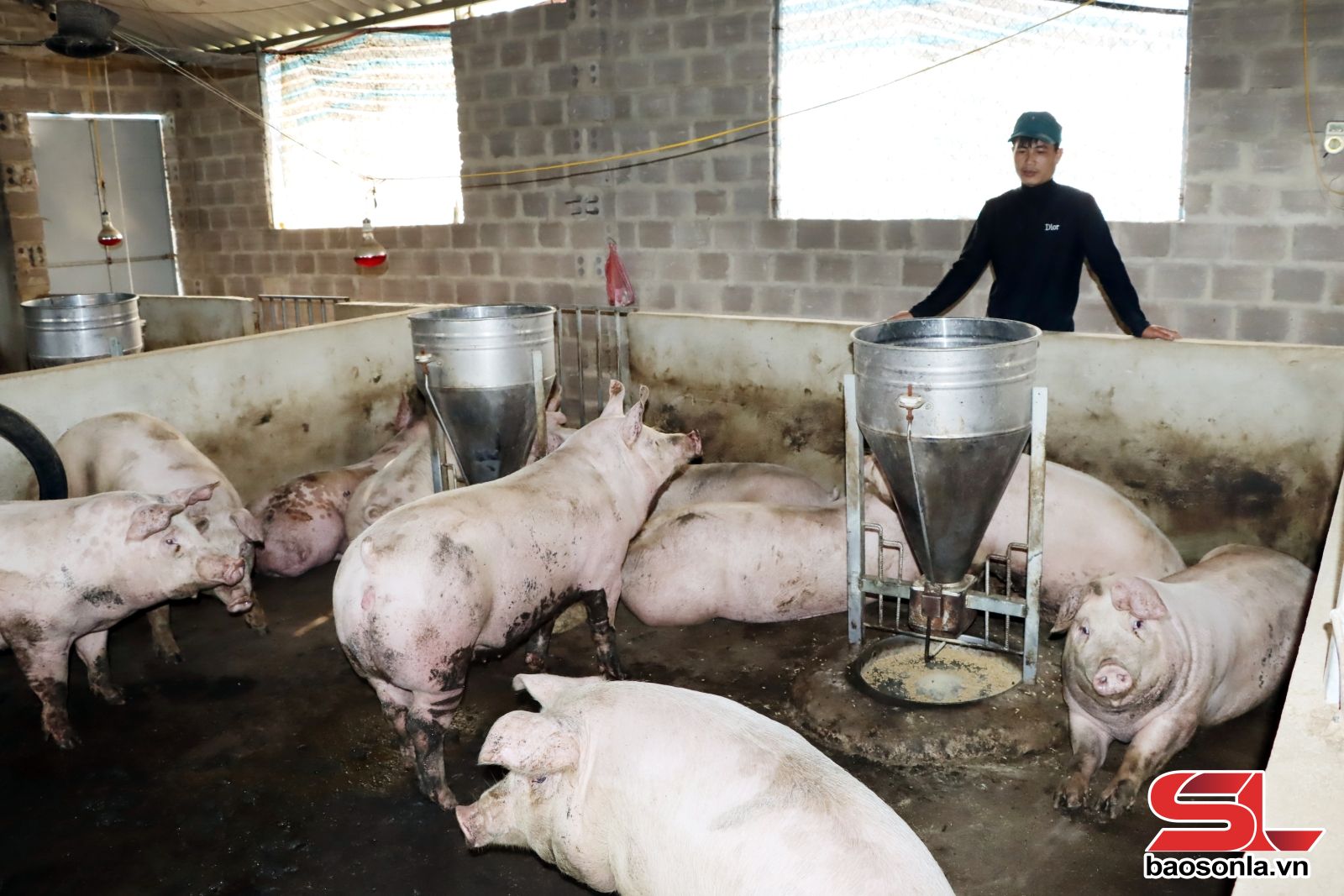
During the 2026 Lunar New Year, livestock farmers in Chieng Mung commune sold a large quantity of livestock and poultry. Currently, many farms and households are actively restocking their herds in a controlled manner, paying attention to disease prevention and control, ensuring supply meets market demand. At the family of Mr. Ca Van Huong in Bo village, Chieng Mung commune, 70 pigs were sold during the 2026 Lunar New Year. Immediately after selling the pigs, his family cleaned the barns, sprayed disinfectant, and sprinkled lime powder to sterilize them. At the end of February, Mr. Huong bought 50 piglets to restock his herd, and the pigs are currently thriving. He showed us around his barn system, which is a closed system with an automatic feeding and watering system.
Mr. Huong said: "My family divides the farm into two areas: one for raising adult pigs and one for raising breeding pigs. For the newly purchased breeding pigs, I keep them separate and monitor them for three weeks to ensure they are healthy before introducing them to the main herd. Currently, it's the transitional season, so we disinfect the pens once a week to prevent disease outbreaks. We source our breeding pigs from reputable companies and farms, and they are fully vaccinated. During the rearing process, it's necessary to regularly monitor and supervise the health of the livestock to proactively implement disease prevention and treatment measures."
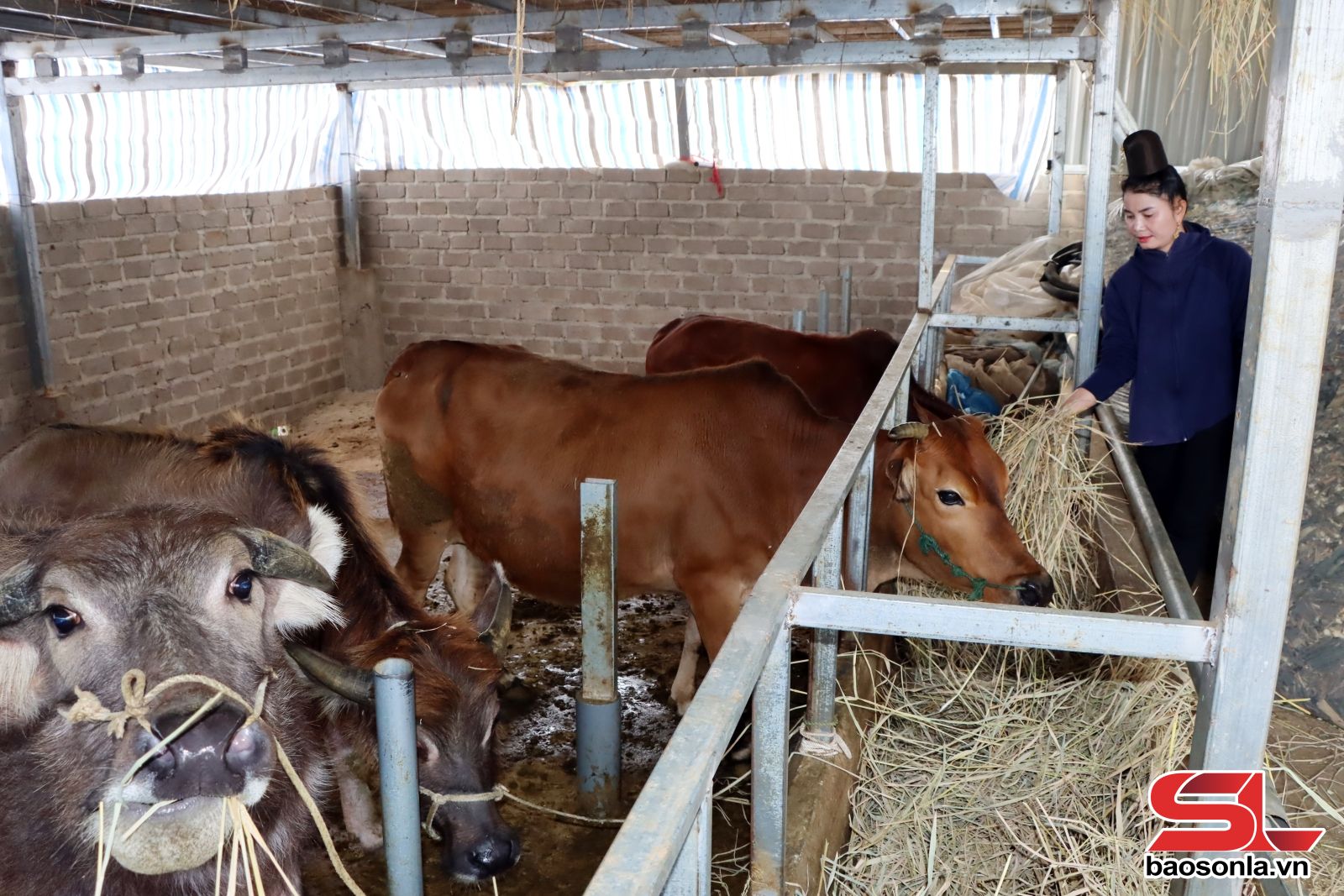
Meanwhile, the family of Ms. Tong Thi Phuong, from Cap village, Chieng Mung commune, has arranged their buffalo and cattle breeding area far from residential areas. The barns are solidly built, cool in the summer and warm in the winter; they also have a room for fermenting feed for the livestock. Each year, Ms. Phuong's family sells 20 buffalo and cattle; the calves are purchased for 10-12 million VND/each, and after 5-6 months of raising, they are sold for 25-30 million VND/each. After deducting feed costs, they earn a profit of 10-12 million VND/each. In early February, her family bought 6 more buffalo and cattle to replenish their herd.
Ms. Phuong said: "Restocking livestock is divided into two stages, at the beginning and middle of the year. My family regularly cleans the barns and disinfects them; we utilize fermented sweet corn as feed for the livestock. In addition, we regularly vaccinate the animals against diseases... If we follow the correct care procedures, the buffaloes and cows will thrive and fetch the best prices, especially during the period leading up to Tet (Lunar New Year)."
In 2026, the commune set a target of increasing livestock and poultry herds by over 6%. The entire commune has 53 households raising pigs in family farms and large-scale farms, with a size of 50-200 pigs, mainly concentrated in the villages of Cap, Bo, Bon, Mai Tien, Hamlet 6, Hamlet 7, and Hoang Van Thu Hamlet... The people have planted 267 hectares of elephant grass and over 45 hectares of bananas; in addition, they utilize corn and straw to ensure a food source for their livestock. Most of the family farms and large-scale farms are planned far from residential areas, have fully invested in infrastructure, have waste treatment systems using biogas digesters to minimize disease risks; and apply biosecurity practices to produce safe products.
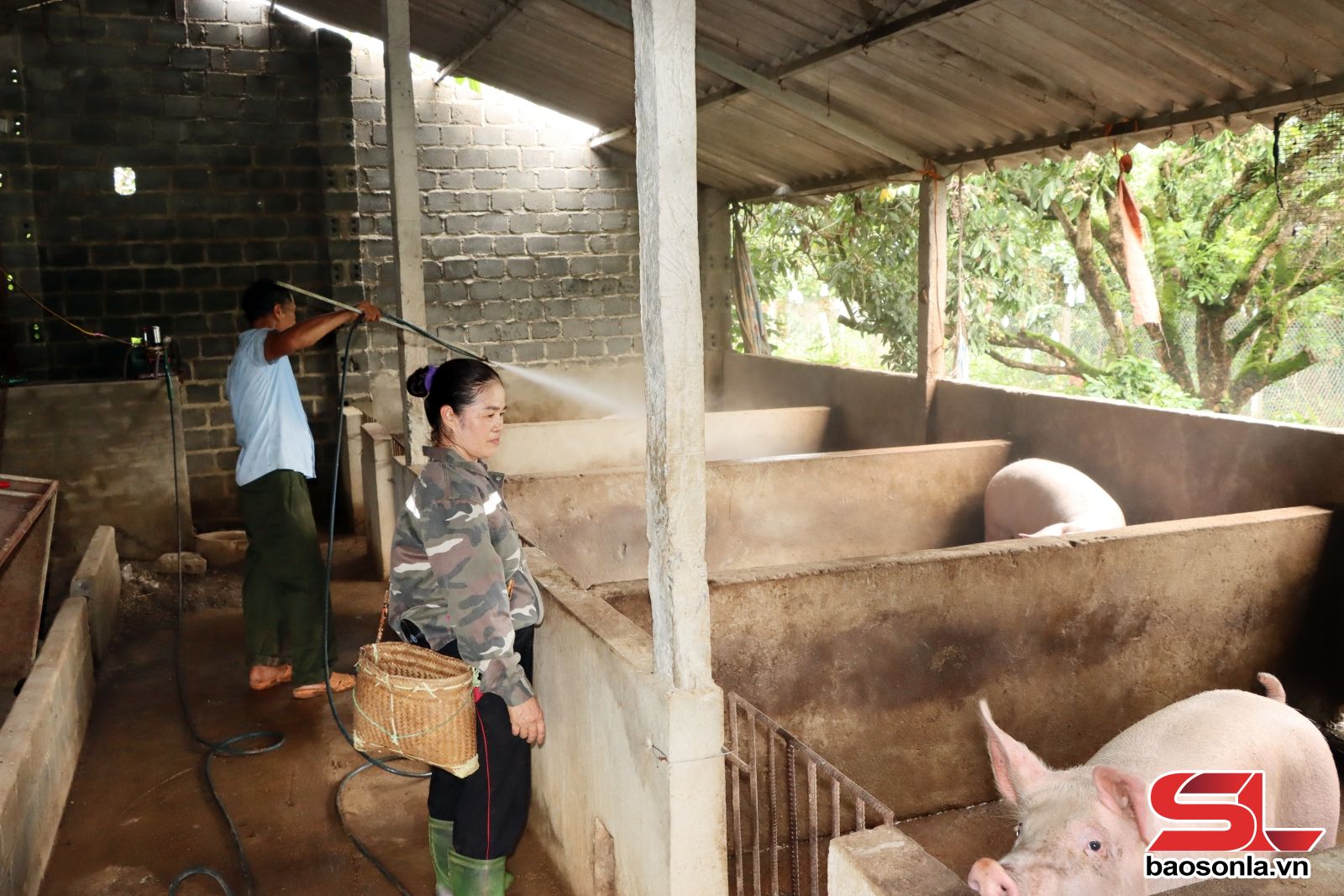
Currently, farms, smallholdings, and livestock breeders in Chiềng Mung commune are focusing on restocking their herds. However, this is a transitional period between seasons, with unpredictable weather patterns that can easily lead to disease outbreaks. Therefore, it is necessary to strengthen disease prevention and control measures, keep barn floors dry and free of standing water, and use lime powder or other disinfectants to spray and sanitize barns. In addition, it is essential to provide adequate feed, water, and nutrition to boost the animals' immunity. For those importing breeding stock from outside, it is crucial to research and choose to purchase breeding stock from reputable establishments with quarantine certificates.
Chiềng Mung commune directed the General Services Center to guide villagers on disease prevention and control, and to encourage households to purchase medicine and ensure full vaccination; striving for a vaccination rate of 96% or higher for livestock and poultry. During the breeding process, people regularly monitor and observe their livestock and poultry. When they notice any unusual symptoms, they quickly isolate them in a separate area for examination and monitoring; at the same time, they report to the commune's veterinary officers for guidance on timely disease prevention and treatment measures.
Mr. Nguyen Thanh Long, Vice Chairman of the People's Committee of Chieng Mung commune, said: The commune promotes and encourages households to build sturdy livestock pens, ensuring environmental hygiene. The commune's General Service Center is directed to coordinate with specialized agencies to organize training courses on transferring scientific and technical knowledge in livestock farming, raising awareness, and helping people gradually change their production methods from traditional small-scale farming to concentrated, bio-secure farming, reducing costs, and improving productivity and product quality...
With proactive measures and comprehensive solutions ranging from zoning planning to the application of biosafety techniques, the livestock industry in Chiềng Mung commune continues to expand and develop in the right direction, contributing to high incomes for farmers and creating an important driving force for sustainable economic development.
Source: https://baosonla.vn/kinh-te/chieng-mung-mo-rong-quy-mo-chan-nuoi-iHDBzN5vg.html




![[Photo] National Assembly Chairman Tran Thanh Man attends the policy seminar to promote Vietnam-Türkiye cooperation.](https://vphoto.vietnam.vn/thumb/1200x675/vietnam/resource/IMAGE/2026/04/16/1776351415367_vna-potal-chu-tich-quoc-hoi-tran-thanh-man-du-toa-dam-chinh-sach-thuc-day-hop-tac-viet-nam-tho-nhi-ky-8705791-jpg.webp)






































































Comment (0)