

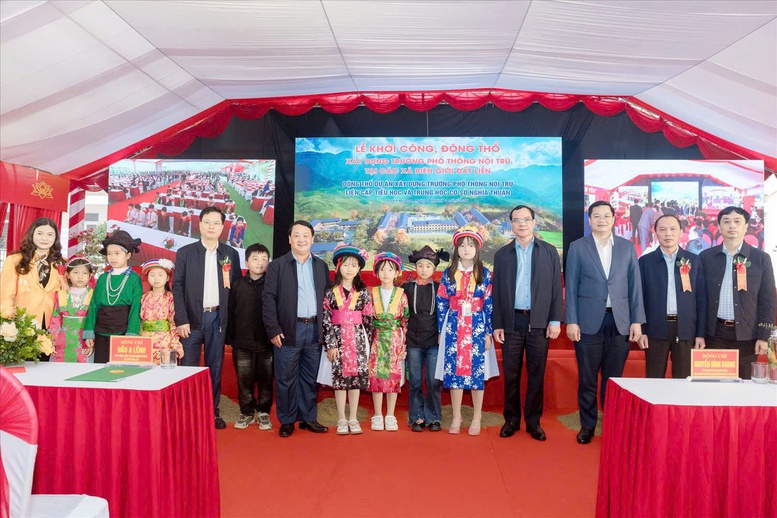
Minister of Ethnic Minorities and Religion Nguyen Dinh Khang, along with delegates and students, attended the groundbreaking ceremony for the construction project of Nghia Thuan Inter-level Boarding School ( Tuyen Quang ), on March 19, 2026.
Minister of Ethnic Minorities and Religion Nguyen Dinh Khang's comments after his recent trip back to Tuyen Quang (formerly Ha Giang) are not only a factual observation but also raise a major question about the ultimate effectiveness of policies for ethnic minority and mountainous regions.
The minister recounted that at one boarding school, the students' drinking water still had to be piped from a source 10km away. A small detail, but one that clearly reflects a persistent "gap" in essential infrastructure in the highlands.
"The ultimate goal of the National Target Program for socio -economic development in ethnic minority and mountainous areas must be to address the most essential needs of the people… The issue of clean water for ethnic minorities in mountainous areas needs to be fundamentally resolved," the Minister emphasized.
From the issue of clean water, an urgent need arises: future ethnic policies cannot stop at numbers or percentages, but must "touch" real life.
According to Report No. 812/BC-BDTTG of the Ministry of Ethnic Minorities and Religions summarizing the implementation of ethnic policies in the period 2021–2025 and proposing orientations for ethnic policies in the period 2026–2030, many positive changes have been recorded.
Economic growth in ethnic minority and mountainous regions remains at a relatively high level: Northwest over 8%/year, Central Highlands around 7.5%, Southwest over 7%, exceeding the national GDP growth rate in 2024 (7.09%).
Significant results have been achieved in poverty reduction: the multidimensional poverty rate decreased by an average of 1.03% per year, and by as much as 3.4% per year in ethnic minority areas. By 2024, the poverty and near-poverty rate will be 22.36%; average income will reach 43.4 million VND/person/year, a 3.1-fold increase compared to 2020.
Essential infrastructure has improved significantly: 99.3% of communes have roads leading to their centers; 91.6% of villages have roads; nearly 99% of households have electricity; and 94.9% of people use clean water.
In education and healthcare, the enrollment rate for primary school students is nearly 99%, and for secondary school students over 96%; the health insurance participation rate reaches 93.8%; and more than 95% of women give birth at healthcare facilities.
Regarding governance, administrative procedure reforms have been accelerated recently. Deputy Minister of Ethnic Minorities and Religions Y Vinh Tơr stated: "The Ministry has simplified 100% of administrative procedures in the field of ethnic affairs according to the decentralization plan, and has also decentralized three levels of authority to provincial People's Committees in the field of belief and religion."
Regarding the simplification of administrative procedures in the implementation of decentralization according to the two-tiered local government system, 78 out of 108 administrative procedures in the field of ethnicity, belief, and religion have been reduced and simplified (reaching 72.2%); at the same time, internal administrative procedures have been simplified by publicly disclosing and entering data on 118 internal administrative procedures into the National Database.
Identify some obstacles
Nevertheless, stories like the one in Tuyen Quang (formerly Ha Giang) show that the gap between policy and reality still exists.
One of the reasons cited is the lack of synchronization in the policy system, especially in national target programs. Disbursement progress is slow, coordination mechanisms are not smooth, and implementation capacity in some areas remains limited.

Deputy Minister of Ethnic Minorities and Religion Y Vinh Tơr
Deputy Minister Y Vinh Tơr shared: "In the National Target Program for socio-economic development of ethnic minority and mountainous areas for the period 2021-2030 (Phase I: from 2021 to 2025), the system of documents was only basically completed around 2023, coinciding with the COVID-19 pandemic. This is an objective factor that significantly affected the implementation progress."
However, the problem is not just procedural. Fundamental bottlenecks such as lack of housing land, agricultural land, clean water, or sustainable livelihoods have yet to be resolved, especially in particularly disadvantaged areas.
Another noteworthy point raised by the Minister of Ethnic Minorities and Religions, Nguyen Dinh Khang, concerns the matching fund mechanism. Accordingly, although not immediately necessary, the matching fund allocation for the National Target Program on New Rural Development, Sustainable Poverty Reduction, and Socio-Economic Development in Ethnic Minority and Mountainous Regions for the period 2026-2035 must be considered soon.
According to him, poor communes and provinces, where ethnic minority policies are directed, are precisely the places with the lowest capacity to mobilize resources. Without a flexible mechanism, the policy could easily fall into the situation of "having money but not being able to spend it," or not reaching the places that need it most.

The ethnic policy for the period 2026–2030 is oriented towards shifting from a "multi-program, multi-objective" approach to a "few focal points, clear results" approach.
A new phase: Measured by quality of life.
The new context demands a change in approach. Ethnic policy for the period 2026–2030 is oriented towards a strong shift from "measuring inputs" to "measuring final results." The Ministry of Ethnic Minorities and Religions has proposed several tasks and solutions, including:
Improving institutions and policies; enhancing management effectiveness: Reviewing and streamlining policies to avoid overlaps; shifting from "multi-program, multi-objective" to "fewer agencies, clear results." Promoting decentralization and accountability. Building a unified data system for ethnic minority and mountainous regions as a foundation for resource allocation and monitoring. Improving the management mechanism of national target programs, assigning results-based targets, and increasing autonomy for localities.
Sustainable economic and livelihood development: Shifting from "support" to "developing the stakeholders." Focusing on improving production capacity, community governance, and market access. Exploiting the advantages of each region; developing forest economy, medicinal plants, specialty agricultural products, OCOP (One Commune One Product) programs, community tourism; preferential credit linked to the market.
Developing essential infrastructure and digital connectivity: Prioritize addressing fundamental needs such as transportation, electricity, clean water, schools, healthcare, telecommunications, internet, and disaster warning systems. Avoid spreading resources too thinly and focus on particularly disadvantaged areas.
Addressing specific "bottlenecks": Resolving land shortages for housing and production; implementing flexible land use mechanisms in mountainous areas; allocating land and forests linked to livelihoods. Completing a sustainable water supply system. Linking development with forest protection, water security, population stability, green economy, and climate change adaptation.
Human resource development and social services: Improve nutrition and basic healthcare; invest in boarding and semi-boarding schools; prioritize preschool education in disadvantaged areas; strengthen Vietnamese language skills while preserving mother tongues. Vocational training linked to employment, development of ethnic minority cadres. Innovate training according to market needs, pilot specific policies for very small ethnic groups.
Cultural preservation involves the role of the community: Promoting the "living preservation" model, linking heritage with tourism and livelihoods; the community is the main manager and beneficiary.
And policy, ultimately, doesn't just exist on paper. It's present in every drop of water flowing to the villages, every road to school, every nutritious meal for children in the highlands… The next phase will be a test, to see if the identified concerns can truly be addressed at their root.
Son Hao
Source: https://baochinhphu.vn/chinh-sach-dan-toc-do-hieu-qua-bang-muc-do-cham-doi-song-102260421091455305.htm































































































Comment (0)