

The latest government directive, aimed at resolving difficulties in the production and consumption of construction materials by accelerating public investment, social housing, and real estate projects, is expected by the cement industry to create momentum for consumption and improve revenue in the remaining months of the year.
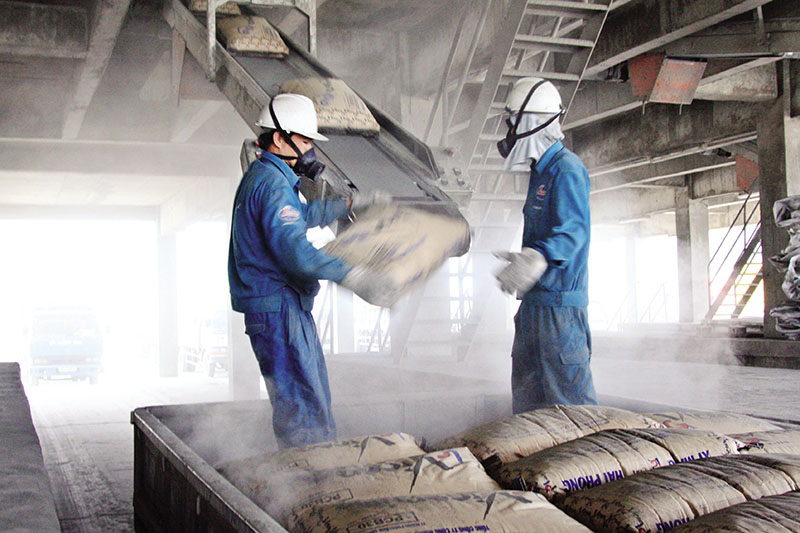 |
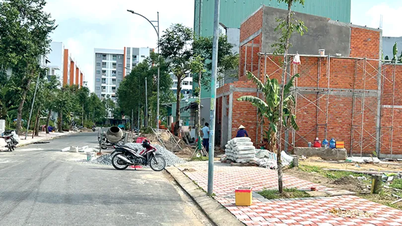
| The cement industry is hoping that government measures to alleviate difficulties will help boost consumption. Photo: Duc Thanh |
Low business efficiency
Market signals in Q2/2024 were better than in Q1, helping domestic cement companies improve their sales performance. Combined with cost reductions in finance, this resulted in some companies reducing losses, and some even reporting profits. However, overall business performance remained low.
Bim Son Cement Joint Stock Company (Vicem Bim) has just announced its 2024 semi-annual financial report, with net sales revenue reaching VND 1,710 billion, a decrease of 1.7% compared to the same period last year. After deducting expenses, Vicem Bim returned to profitability in the second quarter with a profit of VND 27 billion after several months of losses. For the first six months of 2024, the company still incurred a loss of VND 22.6 billion; however, compared to the loss of VND 55.3 billion in the same period last year, this cumulative loss has decreased by more than VND 32 billion.
According to Vicem Bim Son's leadership, cement supply still far exceeds demand, leading to pressure from product inventory and excess capacity, resulting in fierce competition among businesses, price reductions, and the development of new products to increase sales volume and expand market share.
Furthermore, cement prices tend to decrease, while raw material and fuel prices remain high, reducing business efficiency. The shift from bagged cement to bulk cement also reduces business efficiency due to the brand value associated with bagged cement.
The most significant improvement in business performance in the second quarter was by Vicem Ha Tien Cement Joint Stock Company (HT1). This company recorded net revenue of nearly VND 1,909 billion in the second quarter, with a net profit of nearly VND 46 billion. For the first six months of 2024, Vicem Ha Tien's revenue reached over VND 3,400 billion, a decrease of 8%, and its net profit reached over VND 21 billion.
Looking at the Q1/2024 business results, with revenue reaching just over 1,585 billion VND and a net loss of over 24 billion VND, Vicem Ha Tien has made a spectacular turnaround from loss to profit. However, the reason for Vicem Ha Tien's profit is not due to a recovery in revenue, but rather to a significant reduction in interest expenses. The company managed to cut interest expenses from 70 billion VND in the same period last year to only 30 billion VND.
These are just a few businesses that have seen improved business results, while the majority of businesses in the industry are still struggling. For example, Vicem But Son (HNX: BTS) lost over 36 billion VND in the second quarter of 2024. With no profit in both quarters, the cumulative net loss for the first six months of the year is 92 billion VND.
Meanwhile, Vicem Hai Van (HOSE: HVX) recorded revenue of over 97 billion VND in the second quarter of 2024, a decrease of 43% compared to the same period last year, marking the company's fifth consecutive quarter of losses. According to the company's leadership, the main reason for the decline in profit was the decrease in cement sales volume in the second quarter by nearly 48,000 tons, including a decrease of 27,800 tons of clinker, equivalent to a 31% decrease compared to the same period last year.
For the first six months of 2024, Vicem Hai Van's revenue decreased by 49% compared to the same period last year, reaching 152 billion VND. The company incurred a net loss of nearly 30 billion VND.
Weak demand, coupled with domestic and international competition, has left the financial outlook for cement companies bleak. According to statistics from 18 listed cement companies, these businesses incurred pre-tax losses of nearly 110 billion VND in the first half of the year, 3.4 times higher than the same period last year.
Expectations for government measures to resolve difficulties.
Cement businesses are expecting a surge in production and business activity in the remaining months of the year, thanks to increased public investment and a recovery in the civil construction sector.
 Statistics for the first half of 2024 show that total clinker and cement consumption reached approximately 44 million tons, equivalent to the same period last year. With the government's directive to remove obstacles for construction materials, it is expected that cement consumption will see a new surge from now until the end of the year, helping manufacturers overcome difficulties.
Recently, Deputy Prime Minister Tran Hong Ha signed Directive 28/CT-TTg on a number of solutions to overcome difficulties and obstacles and promote the production and consumption of cement, iron and steel, and construction materials.
Accordingly, the Directive requires all levels and sectors to closely follow practical realities and improve institutions and policies to support businesses producing and trading in this field.
Promote public investment, build transportation and irrigation infrastructure, invest in urban and rural infrastructure development, national defense and security projects, and projects in the sea and islands; implement the plan to invest in the construction of at least 1 million social housing units; research increasing the proportion of using reinforced concrete viaducts for expressway projects; prioritize investment in cement concrete roads in the development of rural and mountainous areas, and areas with difficult terrain…
Associate Professor Dr. Luong Duc Long, Vice President and General Secretary of the Vietnam Cement Association (VNCA), stated: "The key is to strengthen infrastructure development and basic construction to boost cement consumption, so that manufacturing businesses have a market outlet."
One of the government directives that cement industry businesses are waiting for is for the Ministry of Finance to study and adjust tax policies on the export of clinker and cement products to ensure competitiveness with other countries exporting these products and to remove obstacles to exports.
"If the export tax on clinker is reduced to 0% instead of the current 10%, it will help businesses increase their competitiveness in exports," a representative from VNCA stated.
In fact, since the beginning of 2023, when the export tax on clinker increased to 10% and the 10% value-added tax was no longer deductible, Vietnamese clinker prices lost up to 20% of their competitive edge in the market, resulting in businesses being unable to export.
Source: https://baodautu.vn/cho-doi-tieu-thu-xi-mang-khoi-sac-d223893.html


![[Photo] General Secretary and President To Lam meets with National Assembly delegates from ethnic minorities.](https://vphoto.vietnam.vn/thumb/1200x675/vietnam/resource/IMAGE/2026/04/20/1776696701056_a1-bnd-8331-3342-jpg.webp)


![[Image] National Assembly discusses the implementation of the socio-economic development plan.](https://vphoto.vietnam.vn/thumb/1200x675/vietnam/resource/IMAGE/2026/04/20/1776696707422_ndo_br_img-20260420-185419-jpg.webp)





















































































Comment (0)