

Immediately after a successful durian harvest, Mr. and Mrs. Han began pruning, weeding, and using MANCOZEB to clean the orchard and sanitize the trees. “Doing a little each day keeps the orchard clean and beautiful. Then we spray pesticides to control pests and diseases, kill green aphids and red mites; next, we apply organic fertilizer to improve the soil, and NPK fertilizer, prioritizing nitrogen. This stage is very important; we must help the trees recover their health and produce two new shoots, meaning two new leaf cycles. After that, we restrict watering to create drought conditions. The trees then transition from growth to reproduction and flowering,” Mr. Han recounted, describing how he cares for his durian trees as if they were “fussy princesses.”
Durian flowers grow in clusters and develop in several stages. Starting from a "crab eye" shape, they evolve into a "pencil" shape, then to the final stage of flowering, lasting approximately 50 days. During this time, Mr. Han and his wife are busy watering the trees and fertilizing them to encourage the growth of new leaves, as durian trees don't obtain nutrients from their roots but rather from their leaves to nourish the fruit. Each stage of fertilizing, from leaf growth to flowering and fruiting, is meticulously documented in his "plant diary," which he considers an indispensable guide to caring for his durian trees.
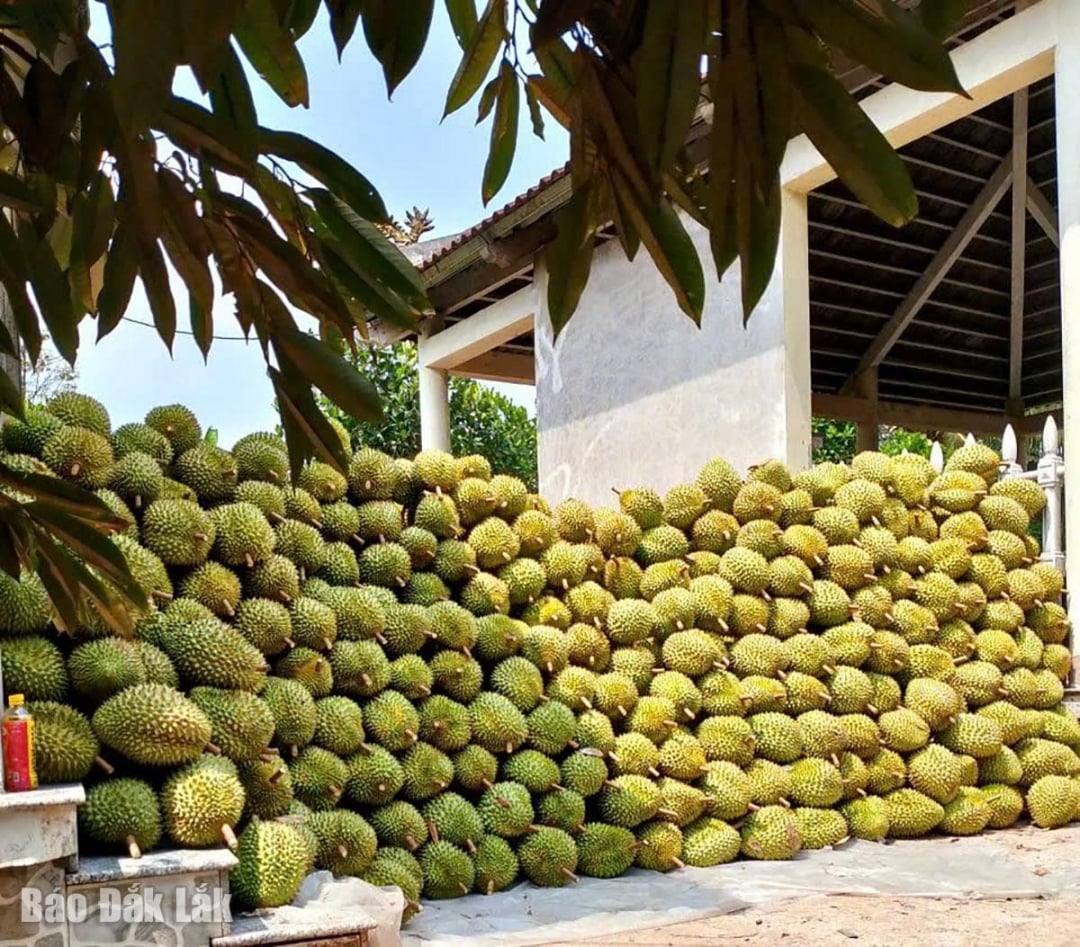 |
| Durian is in its harvest season. |
According to Mr. Han, two factors determine productivity and quality: "Stimulating shoot growth and suppressing shoot growth. Stimulating shoot growth encourages the plant to produce young leaves, creating a source of nutrients; suppressing shoot growth allows the plant to concentrate its energy on nourishing flowers and fruits. If the plant is allowed to produce both leaves and fruits simultaneously, it's a losing proposition. Young leaves will compete for nutrients, resulting in small fruits or fruit drop. Many people think that fruits weighing 1 to 1.5 kg are a sure thing, but they realize that they can all fall off within a few days if shoot growth isn't suppressed in time."
Durian flowers are pollinated at night, and relying solely on bees and butterflies results in a very low fruit set rate. Therefore, when the flowers bloom, Mr. and Mrs. Han stay up all night, using flashlights and soft brushes to artificially pollinate the flowers. Each gentle brushstroke on the flower's stigma is crucial; if done incorrectly or unskillfully, the flower will not bear fruit.
A regular task for Mr. and Mrs. Han is listening to the weather forecast. Many days, when they hear that a storm is brewing, the couple becomes anxious and can't sleep. "The scariest thing is storms and strong winds! Just one strong gust of wind can break branches, cause flowers and fruit to fall, and all our hard work goes down the drain…," said Mrs. Lai, Mr. Han's wife.
Each durian flower cluster can have thousands of blossoms; if all of them were allowed to bear fruit, which branch could possibly support it? Therefore, from the pencil-shaped stage until the fruit is the size of a finger, Mr. Han divides the process of pruning flowers and removing fruit at least three times: Flowers growing horizontally, pencil-shaped fruits pointing upwards, and fruits at the top of the branch must be cut off, keeping only the beautiful clusters and fruits in favorable positions. Each branch, left to grow naturally, can bear 20-30 fruits, but he only keeps 10-15.
| In the sun-drenched and windy Central Highlands, the sweat of farmers like Mr. and Mrs. Han has transformed into the rich, sweet, and fragrant flavor of each durian segment, creating a brand for the entire region. |
For durian varieties like DONA from Thailand, Ri6 from Vietnam, or new durian varieties, when the fruit begins to form, within 60 days, the shoots must be pruned using a high-potassium fertilizer. If necessary, spray with a fungicide to burn off the young leaves, allowing the tree to focus on nourishing the fruit and minimizing fruit drop. Between 60 and 110 days, one shoot should be pruned to encourage the growth of new leaves, providing nutrients for the fruit to enter the "fleshing" stage. After that, prune the shoots again to allow the tree to concentrate its energy on fruit development. The following 60-90 days are crucial for fruit quality and appearance, so a balanced nutrient regime is essential. Many people don't realize that over-fertilizing with nitrogen to make the fruit grow faster can cause the thorns to break, ruining the fruit. Therefore, a balanced amount of NPK and micronutrients is necessary.
Growing durian is not just about technique; it's also a psychological battle. "Sometimes I jokingly tell my wife: Taking care of a durian tree is like taking care of a spoiled princess," Mr. Han confided.
“When watering durian trees, don’t overwater them like you would coffee trees. The water only needs to be moist enough that chickens leave footprints when they walk by. Water them early in the morning; if you water them in the afternoon, the durian trees will get angry…,” Mr. Han said with a laugh.
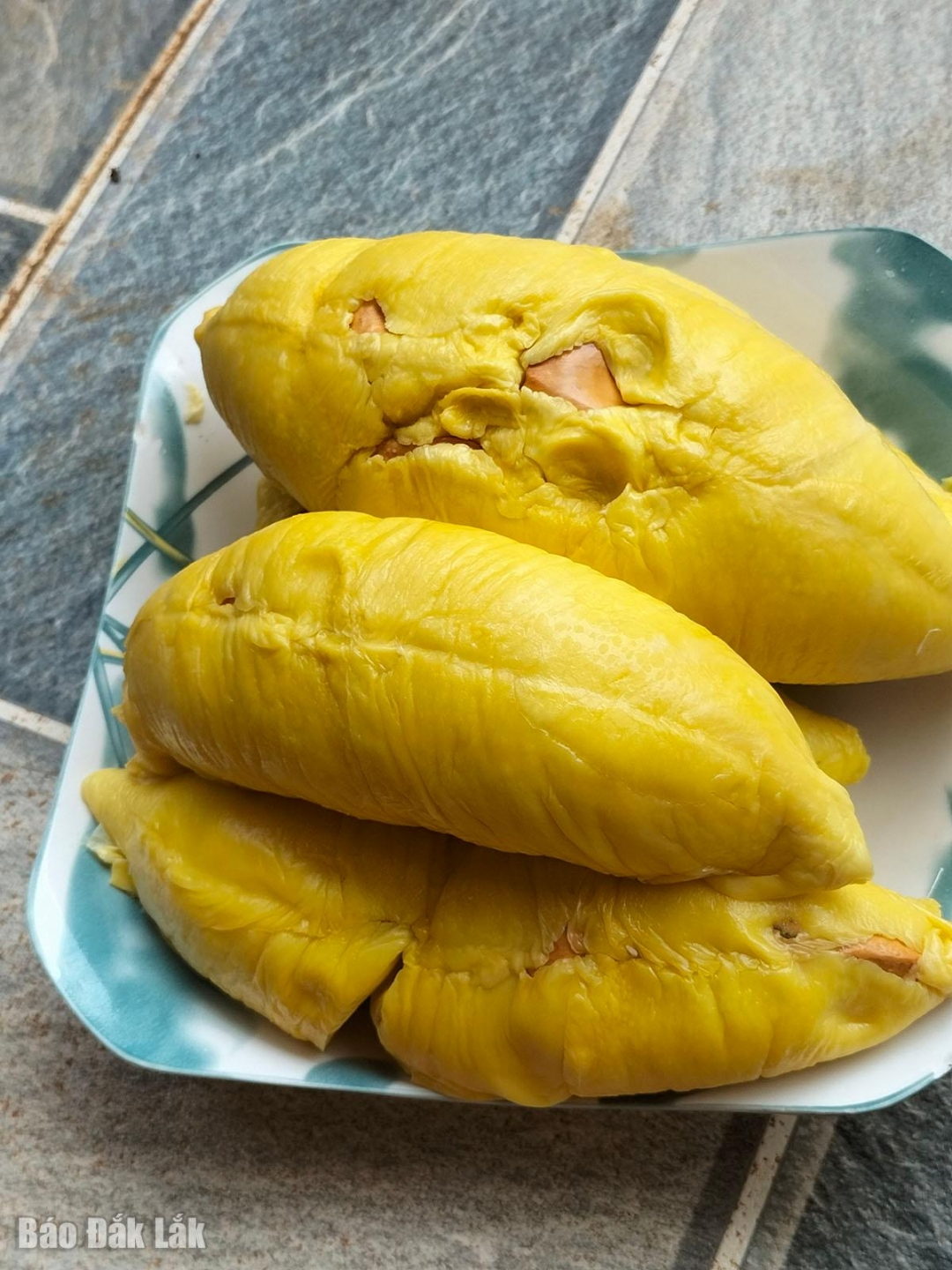 |
| To have a successful durian harvest, farmers put in countless hours of hard work. |
During the rainy season, durian trees are often affected by fungal diseases, aphids, flies, and mosquitoes. Whenever he sees fungal spots at the bottom of the fruit, Mr. Han immediately sprays pesticides and spreads lime to disinfect. He meticulously records the spraying and fertilization of each tree, including the date, type of pesticide, and dosage; this is a quantitative approach to farming, not a matter of intuition!
When the durians were over 100 days old, Mrs. Lai would climb ladders from tree to tree every day, pulling branches and hanging baskets for the fruit. Thousands of durians had to be individually hung in baskets. At night, she and her husband would stay up late trapping birds, using alcohol-powered guns, and setting traps for squirrels to scare them away from biting and damaging the fruit. Who can count how much sweat they poured into this? And so, when the fruit was round, with sharp edges and a sweet, golden flesh, traders would come to inspect the goods. “The whole village is excited during harvest season; only when I hear the phone ringing to announce that the money has been transferred do I forget all the fatigue,” Mrs. Lai said with a cheerful smile.
For the past two seasons, Mr. Han's orchard has yielded 7 tons of durian each, with all the fruits meeting export standards: large, round, with 5 ridges, hedgehog-like spines, and yellow flesh, weighing between 3 and 5 kg. Traders only need three cuts, completing the harvest in just one week, while many other households have to harvest in small batches over a month, resulting in uneven fruit and lower prices.
It's good news when money flows into the account. Mr. Han shared: "I'm happy, but durian farmers in general are suffering a lot. Some households were deducted hundreds of millions of dong just because they sprayed pesticides too close to the fruit, causing the thorns to burn (darken the thorns). Another household, with a 15-ton orchard of beautiful fruit, had nearly 150 million dong deducted just because a few tons of fruit had 'burned thorn tips'... Not only that, the erratic market prices also make farmers 'unable to eat or sleep peacefully.' Some choose to sell in bulk to secure a good price, while others want to sell according to regulations to get a higher price, leading to arguments and even fights."
Looking at the lush green durian orchard on 5 acres of land and Mr. Han's plan to achieve 10 tons of fruit in the upcoming harvest season, one is truly impressed! Every year, in addition to durian, his family also earns hundreds of millions of dong from betel nuts, coffee, pepper, and Thai jackfruit.
In the sun-drenched and windy Central Highlands, the sweat of farmers like Mr. and Mrs. Han has transformed into the rich, sweet, and fragrant flavor of each durian segment, creating a brand for the entire region.
Source: https://baodaklak.vn/kinh-te/202512/cho-mua-sau-rieng-qua-ngot-2521673/

























































































Comment (0)