

Vietnamese people are very familiar with the image of markets. In the past, before supermarkets, rural markets were the only trading points for people in the countryside. Today, modern cities have added supermarket systems and chain stores, which are essentially also markets. Therefore, when I visited the United States, I went to many places and states to understand the similarities and differences between the market system there and Vietnamese markets.
American markets are still markets...
The rate of urbanization in the US is quite high, so it's difficult to find traditional rural markets with vendors selling their wares like in Vietnam. The most common form of commerce in the US is supermarkets. Of course, in supermarkets, there's no bargaining like in rural markets; everything is pre-packaged and labeled, so customers choose what they like. At the exit, someone checks the items and processes the payment, or in many places, there are self-checkout machines where customers scan the product codes and pay with their cards. In large cities, supermarkets have multiple floors and incredibly spacious areas.
Goods are displayed similarly to Vietnam, meaning they are organized into functional zones. For example, the first floor might sell fruits and fresh food, the second floor clothing and shoes, and the third floor jewelry and cosmetics. In smaller cities, supermarkets are also smaller due to the smaller population, but even though they are small, they still stock a full range of essential goods needed for daily life.

Markets in the US often have food courts - Photo: XH
Besides general supermarkets selling all kinds of goods, similar to Vietnam, the US also has specialized supermarkets such as fruit and vegetable supermarkets, meat and seafood supermarkets, bakery supermarkets, and children's toy supermarkets. There are even supermarkets that cater to the needs of Asian people for religious offerings. I saw one such supermarket, which had all kinds of incense, candles, votive paper, and fake money – meaning nothing was missing for religious needs.
Or consider another unique type of "market," the "graveyard" market for discarded old cars. On a vast open plot of land, there are thousands of old cars of all kinds. Visitors have to buy a ticket, which is cheap, around 5-10 US dollars. Inside, customers can freely browse and choose suitable and usable parts such as tires, rims, rearview mirrors, and everything else. After dismantling and taking them out, someone will appraise them and collect the money. Of course, the prices are low because if no one needs them, the old cars will only end up in a recycling plant.
... but more diverse and with giant supermarket chains.
Unlike Vietnam, the United States is a melting pot, formed from many immigrant groups from all over the world , so American markets are also diverse in form. Besides the general supermarket system for mixed-population areas, supermarkets are designed according to the population size of each ethnic group. Areas with a large Asian population have Asian supermarkets, while areas with a large Indian or Mexican population have Indian or Mexican supermarkets. The same applies to areas with a large European, Korean, or Russian population.
Due to the early and rapid development of industrial life, the United States has many "giant" supermarket chains. For example, one of them is Walmart, a supermarket chain present in all states across the US. Founded in 1969 and listed on the New York Stock Exchange in 1972, Walmart currently has approximately 50,000 locations nationwide in various formats: hypermarkets, supermarkets, discount stores, warehouse centers, etc.
To be precise, Walmart is not only a giant in the US but also extends its reach across continents and worldwide. It is estimated that in 2021, Walmart employed over 2.3 million people, generated approximately $560 billion in revenue, with operating profits of around $23 billion, and total assets exceeding $250 billion.
Currently, due to its strategy of selling cheap, ultra-cheap goods, Walmart doesn't choose locations in the city center but instead moves to the suburbs with very large store layouts, sometimes thousands of square meters. If you get lost inside Walmart, your only chance of finding it is to use your phone's GPS.

The stalls on the second floor of Phuoc Loc Tho Shopping Mall - Photo: XH
Besides Walmart, the US has many other "giants" in the market, selling goods wholesale and retail, both in-store and online, such as supermarket chains like Kroger, Albertsons, Publix, Amazon, Meijer, Whole Foods Market, etc. Each of these corporations has a chain of supermarkets selling goods across the US, numbering in the thousands or more.
To add to the diversity, in the US there are also "special" markets like the "1 USD market." These are incredibly cheap markets selling everything from cultural items, stationery, children's toys, fashion eyewear, household goods like cups, bowls, chopsticks, knives, cutting boards, cosmetics, and cleaning cloths... Everything is priced at just one US dollar.
Vietnamese markets in America
I've come to realize that Vietnamese people have a rich cultural identity... especially in markets. In places with large Vietnamese communities, like Little Saigon in California, the Phuoc Loc Tho Shopping Center is considered a very famous Vietnamese market. This spacious shopping center has two floors with over 400 stalls, almost entirely run by Vietnamese people. The main items sold here are high-end goods such as traditional ao dai (Vietnamese dress), gold, silver, and gemstones. The lower floor of the shopping center also has a food court catering to Vietnamese people, offering a full range of dishes from all three regions of Vietnam: pho, banh uot (steamed rice rolls), bun bo Hue (Hue-style beef noodle soup), chao long (pork offal porridge), mi Quang (Quang-style noodles), hu tieu (rice noodle soup), and even ram cuon (spring rolls), banh trang tron (mixed rice paper salad), fertilized duck eggs, pork sausage, and beef sausage...
Even in areas with smaller Vietnamese populations, such as the vicinity of Boston in Massachusetts, there are still markets catering to the Vietnamese community. For example, in Wocester, a city just over an hour's drive from Boston, there's a Vietnamese market called Ha Tien Market. I visited this market and was surprised by the variety of goods on display. There were dried goods like dried squid, dried fish, instant noodles, dried vermicelli, dried pho noodles, and instant coffee packets. Vegetables included water spinach, onions, cilantro, winter squash, bitter melon, gourds, and loofahs...
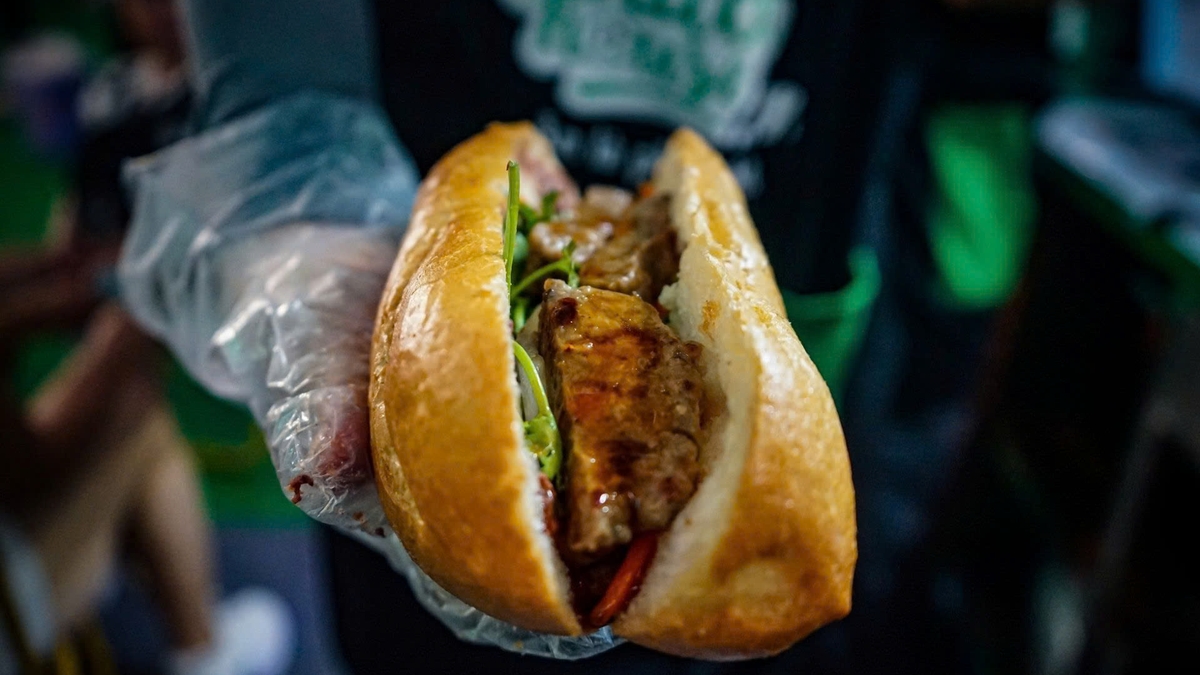
Especially noteworthy are the dishes that can be eaten right at the market or bought to take away. There are Vietnamese-style sandwiches, with the inside of the sandwich split open and topped with soy sauce, along with sausage and vegetables. I even saw a stall selling sticky rice cakes wrapped in thorny leaves with a small sign advertising: Sticky rice cakes wrapped in thorny leaves - A specialty of Binh Dinh.
In one place, also in Southern California, I passed through a Vietnamese neighborhood and saw a makeshift market, meaning there were only about fifteen or twenty people buying and selling. The goods on display were simply bunches of vegetables and chili peppers. I asked my traveling companion, who had settled in America, and learned that every Vietnamese family tried to set aside a small plot of land to grow vegetables, chili peppers, and lemons. If they couldn't eat it all, they would sell it – not really selling, but rather sharing with their relatives, with money not being the main concern.
So, that's what I call identity... the Vietnamese market that's carried all the way to the other side of the globe. It sounds simple, but only when you travel far do you realize that for Vietnamese people, the spirit of the countryside is intertwined with the spirit of the market. No matter how civilized we become, no matter how large and convenient the supermarkets are, the image of the market, even the humble "street market," remains etched in our memories with a simple yet poignant feeling.
Pham Xuan Hung
Source





































![[Infographic] Vietnam's Economic Situation Report, Q1 2026: Strong Growth Momentum](https://vphoto.vietnam.vn/thumb/402x226/vietnam/resource/IMAGE/2026/04/04/1775298512042_tang-truong-kinh-te-viet-nam.jpeg)
![[Image] Close-up view of the 10-lane road connecting to Long Thanh Airport](https://vphoto.vietnam.vn/thumb/402x226/vietnam/resource/IMAGE/2026/04/04/1775291871988_ndo_br_1-resize-5690-jpg.webp)












Comment (0)