


AI content "matrix"
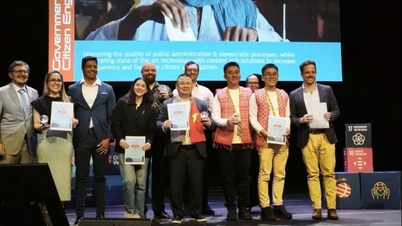
In early May, the Consensus Miami 2026 conference took place in Florida, attracting over 20,000 participants from approximately 100 countries to discuss future technologies. One of the most discussed topics was the question: "How can you prove your identity online without revealing all your personal information?"
This question is based on the fact that AI is deeply infiltrating every aspect of life. In just minutes, AI can create videos , images, voices, or articles that "look very real." On social media, much of the AI-generated content even trends without any annotations or warnings, making it difficult for users to distinguish between real and fake.
Mr. Luu Hoang Tuan Tu (32 years old, graphic designer, residing in Xuan Hoa ward) said that he frequently uses AI in his work, but sometimes he can't tell the difference between real content and AI-generated content. "If young people like me are confused, then older people are even more likely to make mistakes. Recently, my parents ordered dietary supplements costing over 3 million VND based on advice from an 'online doctor.' When I found out and checked, there was no such doctor. The image of the doctor sitting in a hospital examining patients was entirely created by AI," Mr. Tuan Tu recounted.
In the fields of culture and education , the risk of misinformation is also becoming increasingly evident. Ms. Phan Thi Thu Hang (29 years old, a sales employee residing in Cau Kieu ward, Ho Chi Minh City) once immediately turned off a history video her daughter was watching because she discovered inaccurate content. The video used images from the "Nhat Tao Fire" event of hero Nguyen Trung Truc in 1861 to illustrate Ngo Quyen's victory at Bach Dang in 938. "Learning history with inaccuracies is very dangerous because it affects the perception of an entire generation, especially children," Ms. Hang shared.
True value remains at the core.
Faced with this situation, many young digital content creators have chosen traditional methods, prioritizing authenticity. Nguyen Truong Sang, a PhD student in Cultural Studies at the University of Social Sciences and Humanities, Vietnam National University Ho Chi Minh City, and founder of the "City's Codes" project, stated that his project team refused to use AI, remaining loyal to traditional research methods based on books, dissertations, scientific works, and other authoritative sources of information.
“Initially, we also tried AI, but quickly discovered that in many cases, AI obtained incorrect information, or even worse, created inaccurate data. As historians, data errors are the most frightening thing. That's why we stopped using AI. If we don't have enough data, we will seek advice from researchers and scientists. Every piece of content is cross-referenced from multiple sources before being published,” Nguyen Truong Sang revealed.
Beyond research, many schools and youth organizations are now strengthening digital skills training for students. Many universities in Ho Chi Minh City even organize workshops on identifying fake news, verifying sources, protecting personal data, and using AI safely and responsibly.
According to many experts, AI is a powerful tool; if used correctly, it can support learning, research, content creation, and improve work efficiency. Conversely, if users receive information indiscriminately or become overly dependent on technology, they can easily be misled by misleading content.
In the context of rapid digital transformation, information recognition skills, critical thinking, and digital citizenship are becoming essential requirements for young people. Amidst the dizzying pace of technological development, many young people are choosing a more cautious approach: ready to embrace new things but without losing their ability to think independently and the value of genuine knowledge.
According to many technology experts, the worrying thing is that AI has now learned how to create content that is "3 parts fact, 7 parts fiction," mixing fake information with real information, making it increasingly difficult for users to identify if they lack verification skills.
Source: https://www.sggp.org.vn/chon-loc-thong-tin-truc-lan-song-ai-post854007.html
































































































Comment (0)