

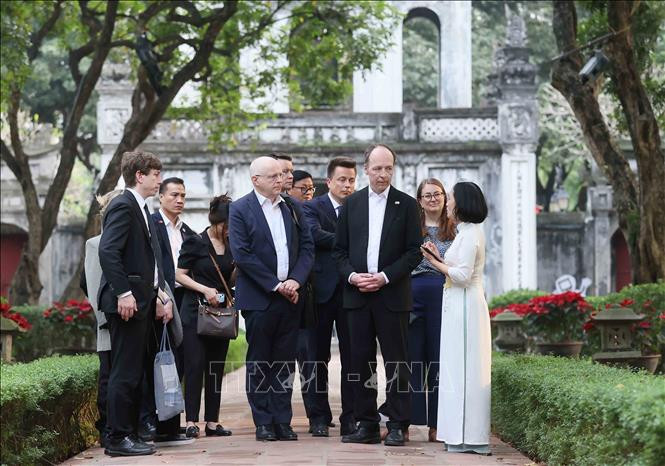
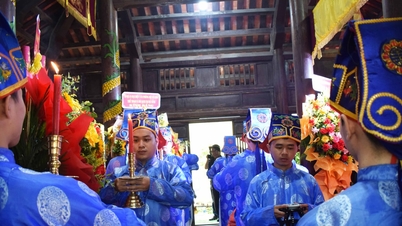
During a visit to the Van Mieu - Quoc Tu Giam National Special Monument, National Assembly Chairman Jussi Halla-aho and his delegation were given a presentation on the history and development of Vietnam's first university, a place closely associated with the nation's tradition of valuing education and a gathering place of the intellectual elite of ancient Dai Viet and present-day Vietnam.
The Speaker of the Finnish Parliament and his delegation visited ancient architectural sites such as the Dai Trung Gate, Khue Van Cac Pavilion, Dai Thanh Palace, the garden of doctoral steles, and the memorial to the revered teacher Chu Van An; learning about places that preserve and honor scholarship, and which best showcase the outstanding values of Vietnamese culture.
Here, the Speaker of the Finnish Parliament signed the commemorative guest book. The leaders of the Van Mieu - Quoc Tu Giám Cultural and Scientific Activities Center presented the Speaker of the Finnish Parliament and the delegation with the book "Van Mieu - Quoc Tu Giám Thang Long".
The Temple of Literature - National University, built in 1070 (the second year of the Thần Vũ era of Emperor Lý Thánh Tông), is considered a symbol of knowledge and education in Vietnam. With its ancient architecture and unique humanistic values, the Temple of Literature - National University serves as a historical link between Hanoi's past and present, enriching the nation's cultural heritage. Over the years, the Temple of Literature - National University has become an attractive cultural destination, drawing visitors from both within and outside the country.
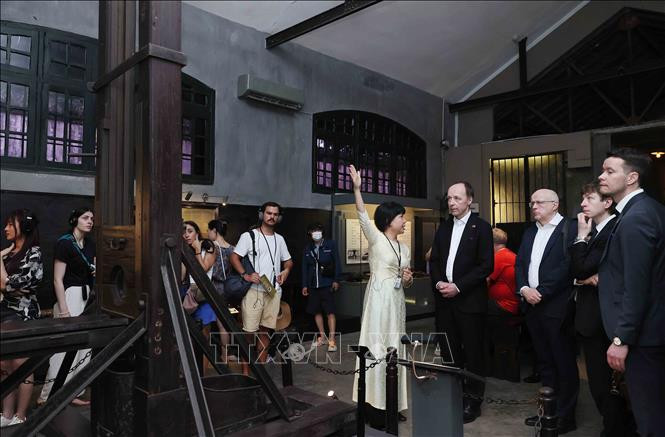
In Hanoi, on the same day, National Assembly Chairman Jussi Halla-aho and his delegation visited and learned about the Hoa Lo Prison historical site, which houses many valuable documents and artifacts, gaining a deeper understanding of the heroic and resilient activities of Vietnamese revolutionaries.
Hoa Lo Prison (now the Hoa Lo Prison Historical Site) was one of the largest prisons of the French colonialists in Indochina, built in 1896 in Phu Khanh village, Vinh Xuong commune, Tho Xuong district, Hanoi (now Hoa Lo Street, Hanoi). It was where thousands of patriotic Vietnamese were imprisoned. Despite enduring harsh living conditions and torture, the revolutionary fighters maintained their patriotism, unwavering resilience, and determination, overcoming hardships and transforming the prison into a revolutionary school.
Today, Hoa Lo Prison Relic has become a "red address," a place for educating all levels of the population, especially the younger generation of the capital, about patriotic and revolutionary traditions; a place that attracts many domestic and international visitors for sightseeing, research, and learning.
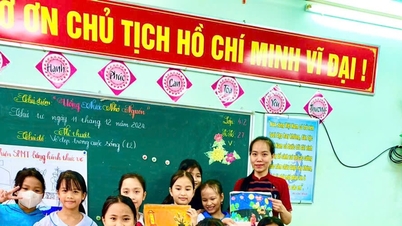
On the same day, the Speaker of the Finnish Parliament, Jussi Halla-aho, and his delegation visited and worked at Tan Thoi Dai School (Le Trong Tan Street, Ha Dong District, Hanoi). This is the first primary school in Hanoi to fully utilize Finnish educational methods, notably the "Fun Learning" approach. The school's curriculum, developed by leading Finnish and Vietnamese experts based on the new curriculum of the Ministry of Education and Training, is integrated into six areas.
On the afternoon of March 26th, the Speaker of the Finnish Parliament and his delegation visited and attended the opening ceremony of the new consular office of the Finnish Embassy in Hanoi.
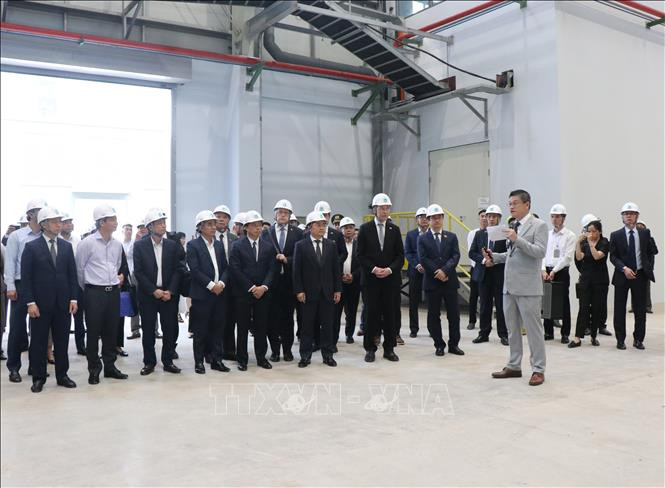
Earlier that morning, Finnish Parliament Speaker Jussi Halla-aho and his delegation attended the completion certification ceremony for the Thang Long - Bac Ninh Waste-to-Energy Plant Project in Dong Sai village, Phu Lang commune, Que Vo town, Bac Ninh province (supported, built, and operated using Finnish technology). Bac Ninh Provincial Party Secretary Nguyen Anh Tuan received the delegation.
Witnessing the completion ceremony of the project, the Speaker of the Finnish Parliament stated that, after more than 50 years of diplomatic relations, the two countries have shifted from development aid to development cooperation, promoting trade cooperation on a mutually beneficial basis. This project is one of the proofs of this cooperation, contributing to improving the environment, mitigating climate change, and moving towards the green and sustainable development goals that both countries are striving for.
Vice Chairman of the Bac Ninh Provincial People's Committee, Dao Quang Khai, expressed his honor that Mr. Jussi Halla-aho and the delegation had taken the time to attend the event, demonstrating the effective support and assistance of the Finnish Government to environmental protection efforts in Vietnam in general and Bac Ninh province in particular; further enhancing the good cooperative relationship between the two countries.
Bac Ninh currently has 16 industrial parks under development and 12 already in operation, with nearly 2,000 registered businesses and approximately 300,000 workers. The province generates about 1,100 tons of household waste daily (not including hundreds of tons of industrial waste). This amount is increasing by about 7-10% annually. Currently, the province has 4 waste-to-energy plants with a total capacity of approximately 1,500 tons/day. To date, one plant has officially commenced operation, and two are in trial operation.
The Thang Long - Bac Ninh Waste-to-Energy Plant project covers a total area of approximately 5 hectares, with a processing capacity of 500 tons/day, a power generation capacity of 11 MW, and a total investment of approximately VND 1,400 billion (equivalent to USD 58.3 million). The project utilizes advanced technologies and equipment directly imported from Finland, notably the first-ever use of a fully fluidized bed incinerator and waste pre-treatment line in Vietnam. This will be the "final piece" for Bac Ninh province in definitively addressing the daily generated household waste.
After the waste-to-energy plant becomes operational, Bac Ninh will be the first province in the country to process all of its daily generated household waste using advanced, world-class waste-to-energy incineration technology.
On this occasion, the Speaker of the Finnish Parliament and his delegation visited the plant and received a presentation on the plant's operation and waste treatment processes.
Source

![[Photo] Prime Minister Pham Minh Chinh receives the Chinese Ambassador to Vietnam](https://vphoto.vietnam.vn/thumb/1200x675/vietnam/resource/IMAGE/2026/04/05/1775397481797_ndo_br_dsc-5512-jpg.webp)





































![[INFOGRAPHICS] Exploiting children's personal images for profit can result in fines of up to 50 million VND.](https://vphoto.vietnam.vn/thumb/402x226/vietnam/resource/IMAGE/2026/04/06/1775442200854_1775442148.webp)













Comment (0)