

Positive effect
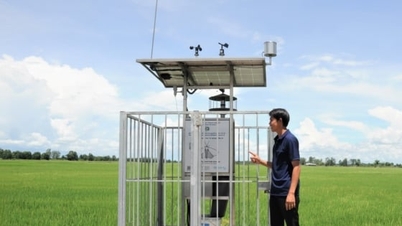
The "One Million Hectare Rice Project," initiated by the Ministry of Agriculture and Environment (MARD), includes the issuance of rice cultivation practices to reduce emissions and procedures for measuring, reporting, and assessing greenhouse gas emissions (MRV). It also involves the implementation of 11 pilot models covering over 543 hectares, with 355 participating households. These models help reduce production costs by 1.7-4.9 million VND/ha and reduce emissions by 3.7 tons of CO2e/ha/crop. In addition, localities have implemented numerous high-quality, low-emission rice cultivation models covering a total area of over 353,800 hectares.
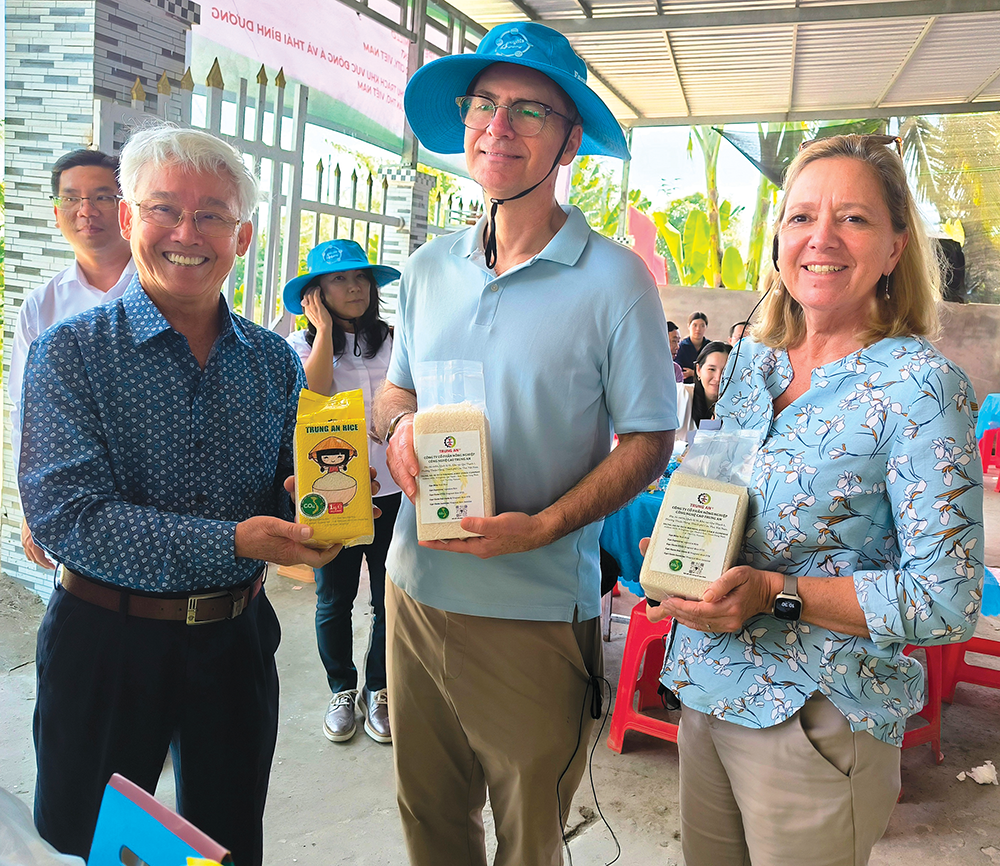
Trung An High-Tech Agriculture Joint Stock Company introduced its "green, low-emission rice" branded rice product to a World Bank delegation visiting Can Tho in November 2025.
According to the Department of Cooperative Economics and Rural Development under the Ministry of Agriculture and Environment, high-quality, low-emission rice production models have attracted the participation of hundreds of cooperatives, cooperative groups, and many businesses. Through this, businesses have formed a "green," low-emission rice chain, with rice products bearing the "green, low-emission rice" logo and label, meeting domestic consumption and export demands.
Can Tho is the first locality in the Mekong Delta region to coordinate with central ministries, agencies, and relevant units to implement a pilot model for producing high-quality, low-emission rice, covering an area of 50 hectares at Tien Thuan Cooperative starting from the 2024 summer-autumn crop. To date, Can Tho has implemented 12 models at cooperatives and cooperative groups in the city, with an average area of 50 hectares per model.
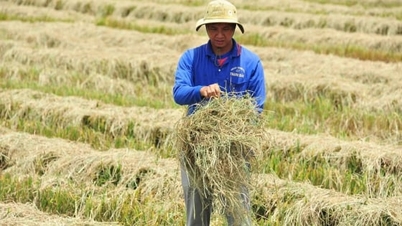
According to Ms. Nguyen Thi Giang, Deputy Director of the Department of Agriculture and Environment of Can Tho City, the cultivated areas within the model have helped increase profits by at least 20% compared to the same cultivated area outside the model. Farmers significantly reduced the amount of rice seeds sown, fertilizers, and pesticides, while yield, quality, and selling price of rice increased, resulting in higher profits ranging from 1.3 to 6.5 million VND/ha. Farmers also gained additional income from collecting straw from the fields for exploitation and use in a circular economy approach.
Focus on attracting investment into the Project.
Despite initial successes, scaling up and developing the model of high-quality, low-emission rice production remains challenging and limited, requiring support from relevant authorities and investment from numerous domestic and international organizations, businesses, and partners. Based on this need, specialized agencies under the Ministry of Agriculture and Environment, along with localities in the Mekong Delta region, have been strengthening public-private partnerships to attract investment from organizations and businesses, especially those from countries with advanced agriculture such as Japan, to participate in the One Million Hectare Rice Project.
According to Ms. Nguyen Thi Giang, Deputy Director of the Department of Agriculture and Environment of Can Tho City, the city is very interested in inviting Japanese businesses to invest in sustainable production, especially in the One Million Hectare Rice Project in the area. Cooperation will focus on production, technology, capital, and trade. Can Tho hopes that Japan will cooperate in supporting farmers, businesses, research institutes, and universities in applying mechanization and transferring solutions for emission-reducing field practices; researching climate change-resistant rice varieties; and building brands for emission-reducing rice...
Mr. Le Duc Thinh, Director of the Department of Cooperative Economics and Rural Development, stated: "The investment needs for the One Million Hectare Rice Project in the Mekong Delta are enormous, especially in investment and technology transfer in production, processing, digital transformation, green transformation, and traceability; cooperation in the consumption of low-emission rice, development of green finance and carbon markets; and cooperation in training and capacity building for farmers, cooperatives, managers, and extension officers. Therefore, attracting investment from Japan is essential."
According to Mr. Tran Chi Hung, Vice Chairman of the People's Committee of Can Tho City, with the decisive involvement of the Ministry of Agriculture and Environment, other ministries, sectors, localities, experts, scientists, and businesses, along with active support from the Japanese Government, JICA, and Japanese businesses, many opportunities for cooperation and development will be created. This is a solid foundation for expanding cooperation and building a sustainable rice value chain, aiming for green development in the agricultural sector.
Japan is Vietnam's largest ODA donor, third-largest investor, and most important trading partner. In the agricultural sector, the ministerial-level dialogue mechanism within the framework of the long-term Vietnam-Japan agricultural cooperation vision has become a crucial foundation for promoting bilateral cooperation. Many Vietnamese businesses have high expectations for opportunities to strengthen cooperation with Japanese investors to enhance the value chain of green, low-emission rice and expand the market for their products.
According to Mr. Pham Thai Binh, Chairman of the Board of Directors of Trung An High-Tech Agriculture Joint Stock Company, the company has successfully exported the first 500 tons of low-emission rice under the One Million Hectare Rice Project to the Japanese market at a high price. Therefore, the potential to boost exports of low-emission rice is enormous. Vietnam has a large rice supply, and Japan has a high demand; thus, Vietnamese businesses wish to strengthen cooperation in exporting rice to this potential market, as well as develop deep processing of rice products.
Text and photos: KHANH TRUNG
Source: https://baocantho.com.vn/chuyen-bien-tich-cuc-trong-thuc-hien-de-an-mot-trieu-hec-ta-lua-a195884.html














![[INFOGRAPHICS] Can Tho River Culture Festival 2025 “Can Tho - The Colors of the River”](https://vphoto.vietnam.vn/thumb/402x226/vietnam/resource/IMAGE/2025/12/23/1766473036074_1766472752.webp)



































Comment (0)