

An Giang's rice granary is undergoing a dramatic transformation with smart rice fields. High-quality rice paddies now feature small "monitoring stations," each only a few square meters in size. These are intelligent pest monitoring systems, connected to the Internet of Things (IoT), operating 24/7 to track pests in the fields.
The smart pest monitoring system consists of light traps placed on the field edges, specialized cameras, environmental sensors (temperature, humidity, rainfall), a processor, and solar panels. Insects are attracted by the multi-wavelength LED lights, fall into the trap chamber, and are periodically photographed by the camera.
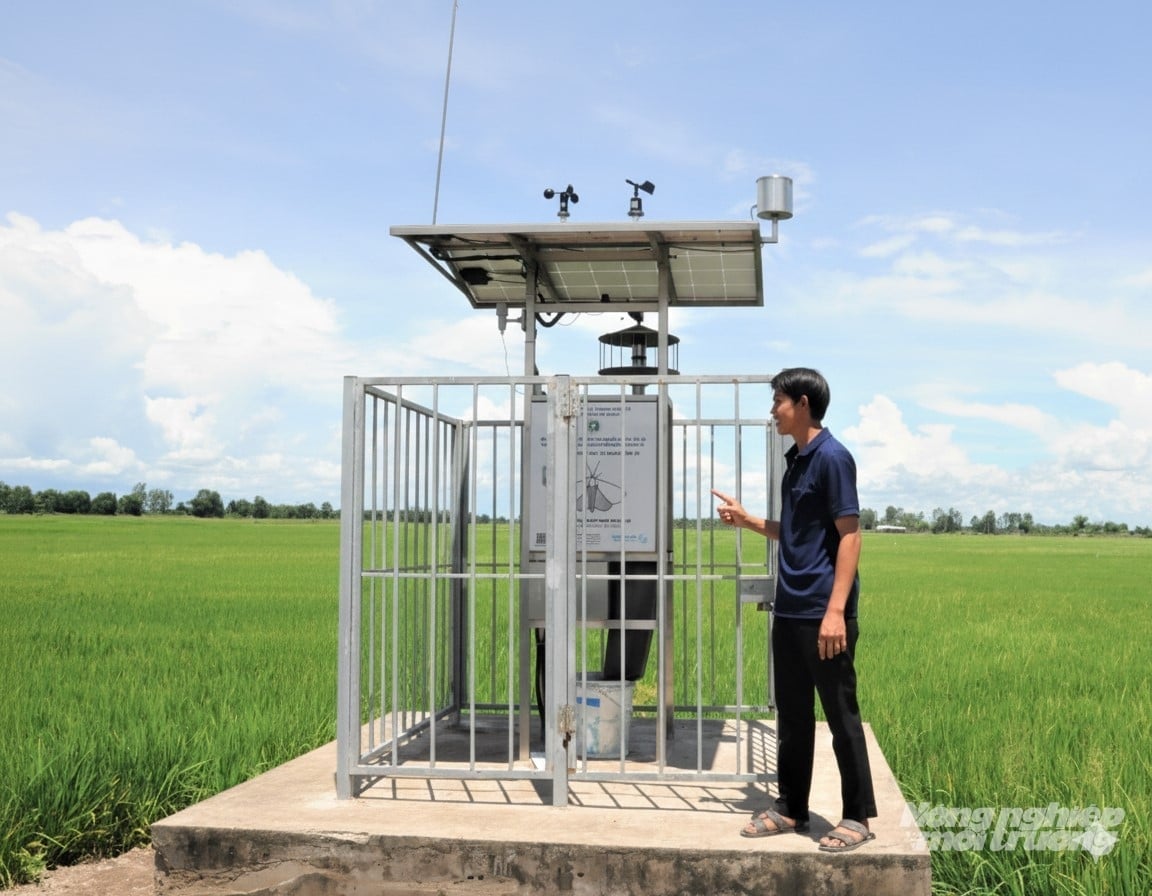
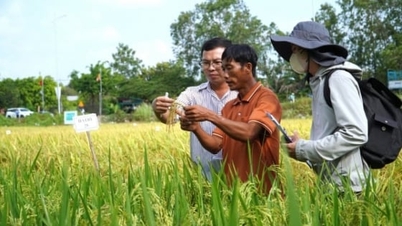
Intelligent pest monitoring systems are likened to "all-seeing eyes" that help farmers effectively track and control pests. Photo: Trung Chánh.
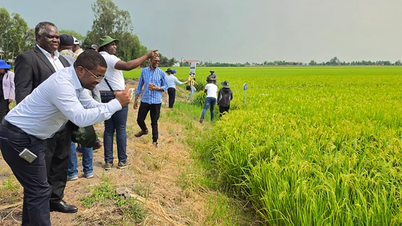
In the cooperatives participating in the 1 million-hectare project for high-quality, low-emission rice cultivation in Tan Hoi, Thanh Dong, and Giong Rieng communes, dozens of automated monitoring stations are placed in the middle of vast rice fields. Farmers can monitor pest and disease situations on their smartphones via applications running on iOS and Android.
Unlike traditional light traps that require manual counting and recording, the new system utilizes artificial intelligence, machine learning, and computing technology to automatically identify and statistically analyze pest density directly at the station. This system can identify over 100 different insect species, distinguishing between harmful and beneficial predators. Only when the density reaches a warning threshold is the processed data sent to the central hub and synchronized with the application for technical staff, cooperatives, and farmers.
The biggest benefit the system brings to high-quality rice farming in An Giang is the change in how farmers decide to spray pesticides. Mr. Nguyen Van Huynh, Director of the Phu Hoa Youth Agricultural Service Cooperative (Tan Hoi commune), said: “Instead of spraying whenever we see pests, thanks to technology, farmers only spray when the system and technical staff warn that the density has exceeded the economic threshold, and they are advised to prioritize biological control methods over chemicals. As a result, the amount of pesticides used has decreased significantly, production costs have decreased, and the health of workers and the field environment are better protected.”
Many rice fields in An Giang are also equipped with smart irrigation systems using the alternating wet-dry (AWD) technique, where water levels and moisture are monitored via sensors. When the field is dry enough according to a predetermined threshold, the pump is automatically activated, avoiding frequent flooding.
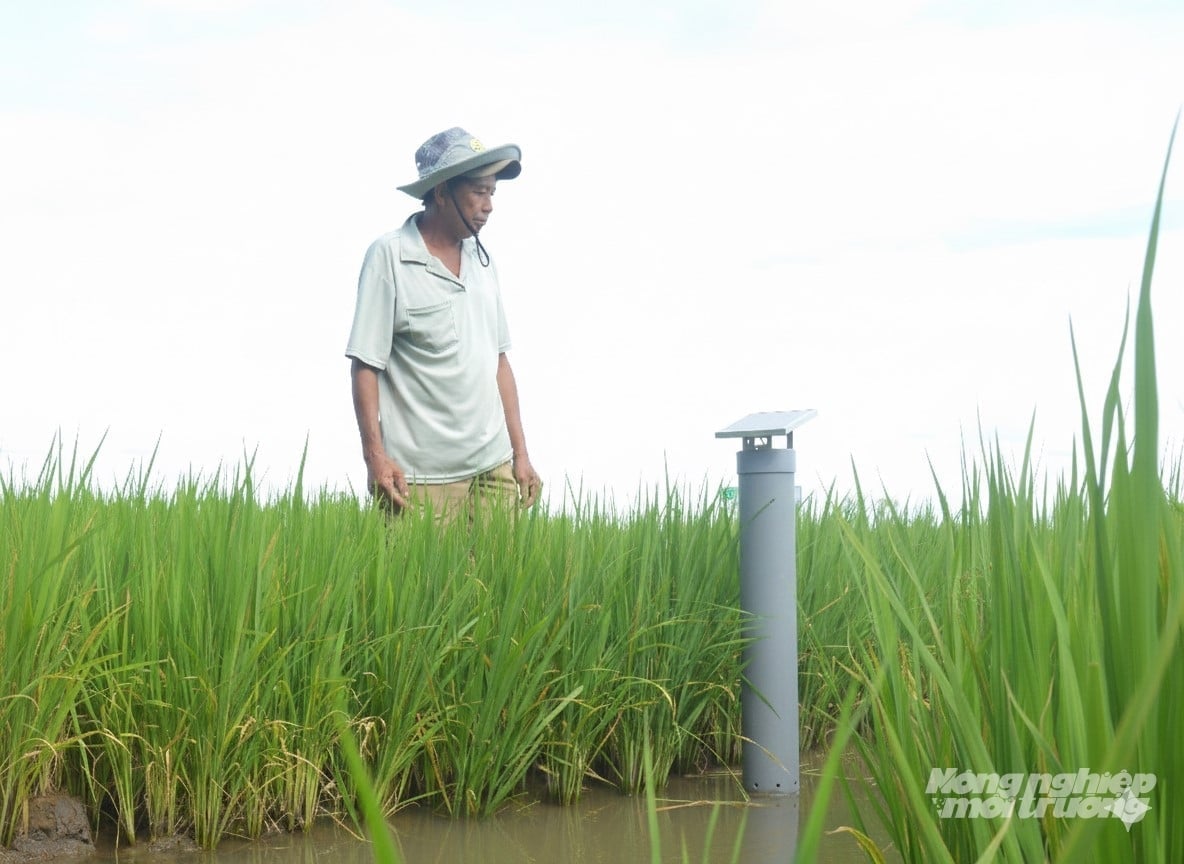
Smart technology that monitors water levels in rice fields helps the alternating wet-dry irrigation system operate effectively. Photo: Trung Chánh.
When integrated with other solutions such as alternating wetting and drying, smart nutrient management, drone spraying, and high-quality, low-emission rice cultivation, the economic benefits are clearly evident. Yields are stable, costs are reduced, and profits are significantly increased compared to traditional farming practices.
The application of smart sensor technology helps collect data, increasing economic efficiency for farmers while protecting the environment. By controlling the amount of irrigation water, rice plants grow optimally, water usage is significantly reduced, fields are not continuously flooded, and greenhouse gas emissions are reduced.
When the soil is alternately flooded and dried, an aerobic environment is maintained, limiting methane production. Furthermore, rice yield and quality increase because the soil is kept in better condition, has time to "breathe," the rice roots develop healthily, there are fewer pests and diseases, and the plants are stronger.
Applying technology and digitalizing farm management demonstrates a determination to transform traditional agriculture into large-scale, transparent, and environmentally friendly commodity production. Implementing the Project for 1 million hectares of high-quality, low-emission rice, rice production in An Giang is gradually moving away from manual, fragmented methods. This forms the foundation for building a green rice value chain, meeting traceability requirements, low-emission certification, and expanding export opportunities.
Source: https://nongnghiepmoitruong.vn/mat-than-canh-gac-ruong-lua-d787286.html













![OCOP during Tet season: [Article 4] Elevating local products](https://vphoto.vietnam.vn/thumb/402x226/vietnam/resource/IMAGE/2026/01/29/1769652810578_2935-z6982071462129_649e82db06fb2f2ea701388b1f5f5b0b-173322_176-185229-202804_457.jpeg)

![[Photo] New recruits happily exercise their right to vote at their unit.](https://vphoto.vietnam.vn/thumb/1200x675/vietnam/resource/IMAGE/2026/03/14/1773473286544_stug0337-6388-jpg.webp)









































Comment (0)