On the morning of June 5th, in Ninh Binh, the Ministry of Science and Technology, in coordination with the Ninh Binh Provincial People's Committee and the Vietnam Union of Science and Technology Associations, organized the Vietnam National Digital Forum 2026 (DigiFest 2026) with the theme " Developing digital platforms and services, shifting operations to the digital environment".
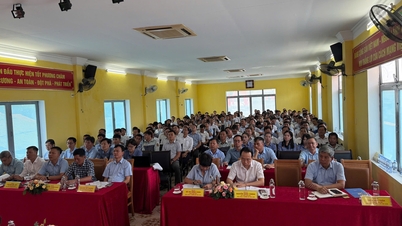
The forum brought together more than 1,000 delegates, including leaders from ministries, departments, localities, technology companies, and experts from both within and outside the country.

Deputy Minister of Science and Technology Bui Hoang Phuong. Photo: Organizing Committee.
In his opening remarks, Deputy Minister of Science and Technology Bui Hoang Phuong stated that Vietnam is entering a new phase of digital transformation, where science and technology, innovation, and digital transformation are for the first time placed in a unified whole in accordance with the spirit of Resolution 57 of the Politburo .
According to him, if science and technology create knowledge, and innovation transforms knowledge into solutions, then digital transformation is the path to bringing those solutions into practical management, production, and social life.
According to the Deputy Minister, digital transformation is no longer limited to the central or provincial levels, but has "reached down to the commune and ward levels." Evidence of this is the fact that Vietnam has established numerous national digital platforms, national databases, and a comprehensive national digital architecture framework.
Public services are increasingly being moved to the digital environment, while government administration, businesses, and social life are gradually shifting to the digital space.



This message reflects the new direction of transformation set forth by DigiFest 2026. While previously digital transformation mainly focused on digitizing processes, deploying software, or online public services, the current phase is being shaped towards restructuring the operating methods of the entire system in a digital environment.
The goal is not just to "move operations to the digital environment," but to move towards forming a national model that operates based on real-time data, interconnectedness, and intelligent decision-making.
In this new approach, digital data is identified as a strategic resource, digital platforms as core infrastructure, and AI as a new growth engine for the digital economy. This year's forum focuses heavily on topics related to national digital architecture, shared digital platforms, data ecosystems, AI in governance, and building a comprehensive digital space.
Deputy Minister Bui Hoang Phuong emphasized that digital transformation is no longer just about "putting paper documents on a screen," but a fundamental shift in the way the nation is governed, from traditional administrative management to development governance based on data and artificial intelligence.

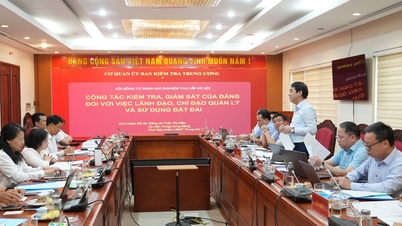
The panel discussion was held within the framework of DigiFest 2026. Photo: Organizing Committee.
Sharing more on this issue, Tran Duy Ninh, Director of the National Digital Transformation Agency, said that the criteria for evaluating digital transformation cannot stop at the number of systems deployed, the amount of data digitized, or the number of online services. More importantly, what value do those digital resources create for socio-economic development, for state management activities, and for the people?
The concept of "national digital capacity" has been introduced, signifying the ability to mobilize, organize, master, and effectively utilize digital resources to create value for socio-economic development. Accordingly, the focus of the next phase will be on effectively exploiting these digital resources to enhance national competitiveness.
The proposed model comprises five tiers of digital capabilities, ranging from citizens and businesses to the public sector and the national ecosystem, and includes mastery of strategic technologies such as AI, semiconductors, cloud computing, and big data. The first foundational tier is the ability of citizens to safely access, use, and participate in the digital environment.



The call to "bring digital transformation down to the commune level," raised at DigiFest 2026, has become even more urgent. Discussions at the forum clearly indicated that the grassroots level will be the deciding factor in the actual impact of digital transformation, as this is where citizens directly interact with public services, healthcare, education, population management, and daily administrative activities.
Nevertheless, Deputy Minister Bui Hoang Phuong frankly acknowledged that many bottlenecks still exist, from the gap between institutions and implementation, between infrastructure investment and value creation, to the digital trust of citizens and businesses. He argued that digital transformation needs to move to a more substantive action phase, in which policy dialogue, data interoperability, digital workforce development, and governance model innovation will be key issues.
Within the framework of DigiFest 2026, the high-level policy dialogue session "Touching and Removing Bottlenecks in Digital Transformation" was also held, focusing on issues such as institutional improvement, data security, public-private partnership mechanisms, and governance innovation in the AI era. This direction shows that Vietnam is shifting from a mindset of "applying information technology" to "building a digital nation".
Source: https://nongnghiepmoitruong.vn/chuyen-doi-so-phai-xuong-den-cap-xa-d815123.html














































![[Image] Ho Chi Minh City: Ma Lang area, Chicken-Rice Market about to change its appearance](https://vphoto.vietnam.vn/thumb/1200x675/vietnam/resource/IMAGE/2026/06/25/1782377698627_ndo_br_m1-jpg.webp)