

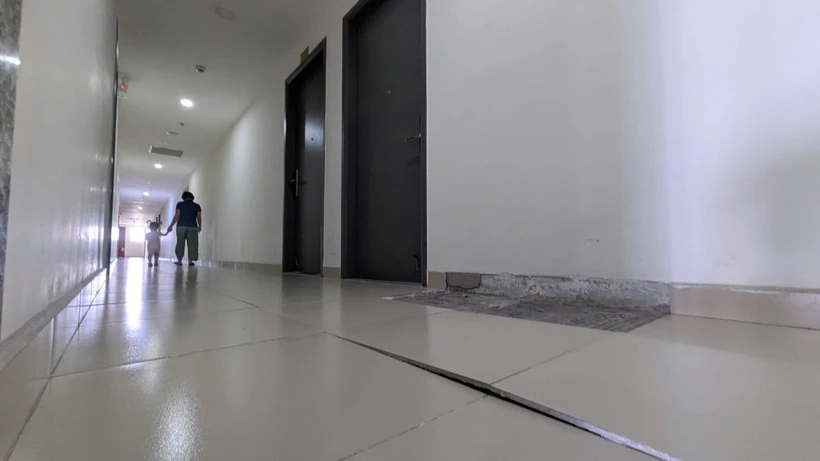
Many areas of the common corridors in the Diamond Riverside apartment complex (District 8) have peeling and bulging tiles following the earthquake aftershocks. (Source: Tin Tuc Newspaper)
However, high-rise buildings are increasing in both number and height nationwide. Therefore, the 7.7 magnitude earthquake in Myanmar, with its severe damage at the epicenter and widespread tremors, has raised public concern about the resilience of high-rise buildings in Vietnam. This is especially true in Ho Chi Minh City, where residents have reported cracks and peeling floor tiles following the earthquake on March 28th.
Sharing his concerns, expert QH stated that since 1990, construction projects have essentially been designed to withstand earthquakes. Prior to that, high-rise buildings were mostly old apartment complexes, typically 3-5 stories high, built during the "subsidy period" and not taking this factor into account. However, since Vietnam is not located within an "earthquake belt," this issue was not considered a major concern then, and prevention was the primary focus.
According to expert QH, since 2006, earthquake-resistant building design has become a mandatory requirement to ensure the safety of structures and users, especially in areas with unstable geological conditions. Specifically, in 2006, the Ministry of Construction issued the Vietnamese Construction Standard TCXDVN 375:2006 "Earthquake-Resistant Building Design," which was converted into the national standard TCVN 9386:2012 in 2012.
This provides a basis for investors to calculate the earthquake resistance of their buildings. Thus, the legal framework and the system of regulations and standards related to earthquake resistance for buildings are relatively complete and continuously updated. The next issue is the monitoring of implementation, this expert affirmed.
From the perspective of a professional agency, Dr. Le Minh Long, Deputy Director of the Department of Science , Technology, Environment and Building Materials under the Ministry of Construction, stated that the Ministry of Construction has issued and advised on the issuance of regulations and standards related to the design and construction of earthquake-resistant structures to ensure the safety, durability, and resilience of structures against earthquake impacts.
Article 91 of the 2014 Construction Law (amended and supplemented in 2020) stipulates the requirements for ensuring the safety of construction projects. Accordingly, construction projects must be designed and constructed to ensure load-bearing capacity, stability, and durability in earthquake conditions.
By 2022, the Ministry of Construction had issued QCVN 02:2022/BXD, the National Technical Standard on Natural Condition Data Used in Construction, based on a review of QCVN 02:2009/BXD. This technical standard specifies the natural condition data applicable in the preparation, appraisal, and approval of construction activities, including: construction planning; investment project preparation; design, construction, construction supervision; and investment project management in Vietnam.
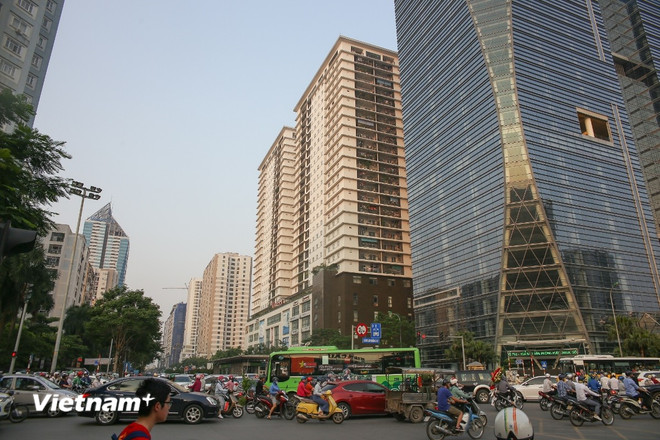
The impact on key infrastructure and construction projects needs to be assessed. (Photo: Hung Vo/Vietnam+)
When designing earthquake-resistant structures, the reference ground acceleration peak at the construction site is determined in one of two ways: either according to the reference ground acceleration peak zoning table based on administrative geographical locations; or, for greater accuracy, according to the Reference Ground Acceleration Peak Zoning Map of Vietnam at a scale of 1:1,000,000 (stored at the Institute of Geophysics, Vietnam Academy of Science and Technology).
Vietnam is located far from the geological fault zone of the earthquake belt, so major earthquakes do not occur frequently, especially in densely populated urban areas with high-rise buildings like Hanoi and Ho Chi Minh City. However, regulations and standards on this matter must still be strictly adhered to. When constructing buildings, surveys, designs, construction, and acceptance testing must comply with regulations and standards to ensure quality and durability; ensure safety for people, contribute to protecting property, and minimize damage in the event of an earthquake, Mr. Long said.
Many experts believe that the ability of buildings to withstand an earthquake depends on the geological conditions of the area and the quality of construction, such as whether the construction process ensured the correct quality and sufficient materials as designed. In addition, the height of the building must be considered, as taller buildings are more susceptible to earthquake tremors. Therefore, in large cities like Hanoi and Ho Chi Minh City – where many high-rise buildings are concentrated – the tremors from the recent earthquake were felt very clearly by residents.
Vietnam now has seismic design standards for buildings; these include the creation of a nationwide earthquake hazard map with ground acceleration values. Accordingly, all buildings must be designed to withstand earthquakes according to these standards.
According to Dr. Nguyen Xuan Anh, Deputy Director of the Institute of Earth Sciences under the Vietnam Academy of Science and Technology, ensuring the earthquake resistance of structures is crucial; earthquake risk assessment and adaptation are necessary from the foundation pouring and construction stages.
For example, in Hanoi, there are many dilapidated apartment buildings and housing complexes with weak structures that require earthquake risk assessments. Weak structures that don't withstand earthquakes pose a significant danger. Therefore, authorities need to conduct periodic assessments to develop plans for either reinforcement or demolition to ensure the safety of residents.
Without being complacent, conducting regular inspections, monitoring, and assessments of the earthquake resistance quality of structures is necessary according to the Government's earthquake prevention regulations; in which, the role of local authorities and relevant specialized agencies is very important, Mr. Xuan Anh analyzed.
For high-rise buildings, vibration measuring devices should be installed to assess the level and impact of vibrations. Currently, the assessment of the impact on buildings is mainly done by people observing the vibrations. Monitoring equipment will allow for the precise determination of the vibration level. Based on this data, appropriate warnings and recommendations can be issued to the public.
According to VNA
Source: https://baothanhhoa.vn/chuyen-gia-giai-dap-ve-kha-nang-chong-chiu-dong-dat-cua-cac-cong-trinh-cao-tang-244403.htm


![[Photo] Prime Minister Pham Minh Chinh presides over a meeting on private sector economic development.](/_next/image?url=https%3A%2F%2Fvphoto.vietnam.vn%2Fthumb%2F1200x675%2Fvietnam%2Fresource%2FIMAGE%2F2025%2F12%2F20%2F1766237501876_thiet-ke-chua-co-ten-40-png.webp&w=3840&q=75)




























































































Comment (0)