 |
Many students admit to having cheated at some point. Photo: Pexels . |
During a conversation with a group of freshmen about using AI in research, Professor Austin Sarat (Amherst College, USA) unexpectedly posed a question unrelated to technology: "How many of you cheated in high school?"
Most students raised their hands.
The professor said the students' reaction wasn't one of shame or avoidance. On the contrary, many were quite calm, realizing they weren't alone. This wasn't the first time he'd asked this question, and the results were almost always the same.
Based on his teaching experience, Professor Sarat believes that many students enter university thinking that cheating is acceptable in some circumstances, especially when under pressure for grades or admission to prestigious schools. This means that AI is not the root cause of academic dishonesty. The technology only emerges when the problem already exists.
Cheating before entering university
According to The Conversation , numerous studies show that cheating is quite common in American high schools. In 2018, educational psychology researcher Eric Anderman published the results of a nationwide survey in which 51% of high school students admitted to having cheated on tests.
 |
Common forms of cheating include copying, cheating, plagiarism, etc. Photo: Pexels . |
Another survey conducted in 2020 with 70,000 students also found that 64% had cheated on exams, 58% had plagiarized, while about 95% admitted to participating in at least one form of cheating such as copying, plagiarism, or cheating.
At a high school in Pennsylvania, 90 out of 100 students surveyed in 2018 admitted to having cheated at least once. One student even responded succinctly: "Everyone cheats."



According to experts, the reasons for this behavior are diverse. Some students feel they are not adequately prepared but still want to achieve high scores to compete for university admission.
Others believe cheating is wrong, but justify it by saying "everyone does it" or because the teacher isn't teaching effectively. More notably, many students don't see themselves as cheaters.
Discussing this phenomenon, sociologists Gresham Sykes and David Matza call it "neutralization technique," meaning people create plausible reasons to justify behavior they know is wrong.
The situation isn't much better at the secondary school level; the picture at universities is no more promising.
A 2020 study of 840 college students found that nearly one-third of participants had cheated on exams. Meanwhile, many instructors are choosing to change their testing methods instead of directly addressing the problem.
In 2025, the Wall Street Journal reported that many American universities were beginning to reduce written assignments and return to in-person testing.
However, Professor Austin Sarat argues that changing the assessment method cannot solve the root of the problem if students have already developed a habit of cheating.
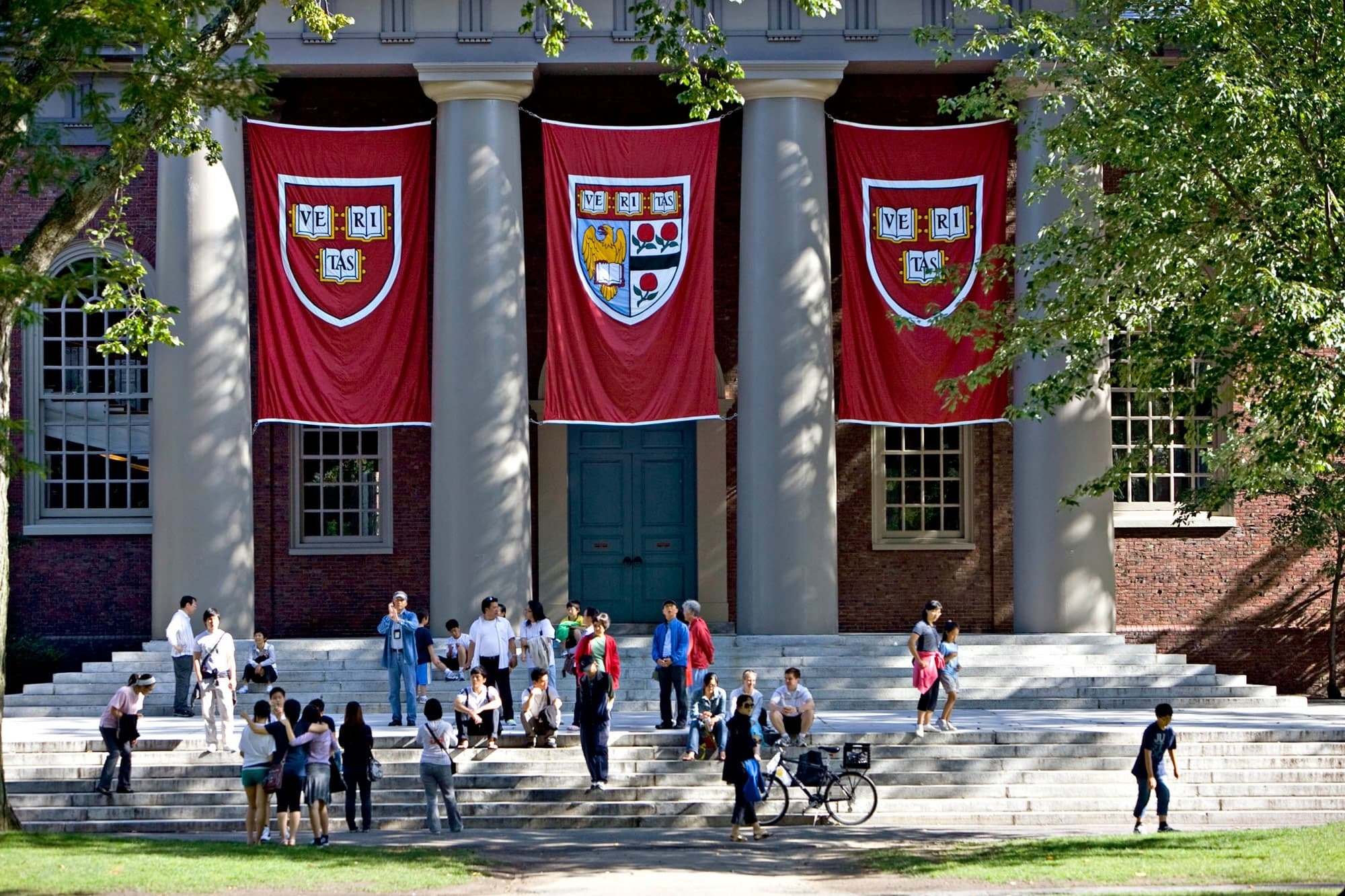 |
Many Harvard students admit to having plagiarized. Photo: Harvard . |
Blaming AI
Currently, most universities have strict regulations regarding academic integrity. For example, Harvard considers cheating on exams, plagiarism, data falsification, or using other people's ideas to be serious violations of academic standards. Students may fail the course or even be expelled.
But at Harvard, the rate of student cheating is alarming. In a Harvard Crimson article published in early 2026, author Matthew Tobin cited a 2024 survey showing that 47% of the 850 Harvard seniors surveyed admitted to having cheated.
Among them, many blame AI or the lack of interest in learning among modern students, but that's only part of the story.



"Plagiarism and other forms of academic dishonesty have been all too common at Harvard long before these problems emerged," the author emphasizes.
Not only Harvard, but many other universities in the US have also recorded similar trends. The number of reported academic misconduct cases at Ohio State University increased by 57% between 2014 and 2018. Meanwhile, Princeton University ended its 133-year rule of not holding invigilation exams in response to concerns about academic integrity violations, including the misuse of AI.
According to Professor Austin Sarat, instead of simply tightening supervision or changing examination methods, universities need to focus on building academic integrity. While not wanting to view students with suspicion or turn the classroom into a control center, he believes that schools must help students develop good study habits.
"Faculty members can begin by integrating discussions of academic integrity throughout their courses, while also encouraging students to reflect on what kind of person they want to become," he emphasized.
Source: https://znews.vn/chuyen-kho-tin-tai-harvard-post1663105.html

![[Image] Schools organize meetings and introduce teaching models to students admitted to grade 10.](https://vphoto.vietnam.vn/thumb/1200x675/vietnam/resource/IMAGE/2026/06/25/1782368077271_ndo_br_z7970052192242-1ec8daeb77a6eed1a4e9f58c564ddd3e-jpg.webp)
![[Photo] General Secretary and President To Lam receives Palestinian Ambassador Saadi Salama](https://vphoto.vietnam.vn/thumb/1200x675/vietnam/resource/IMAGE/2026/06/25/1782365384740_a1-bnd-9423-8322-jpg.webp)

![[Image] Ho Chi Minh City: Ma Lang area, Chicken-Rice Market about to change its appearance](https://vphoto.vietnam.vn/thumb/1200x675/vietnam/resource/IMAGE/2026/06/25/1782377698627_ndo_br_m1-jpg.webp)