

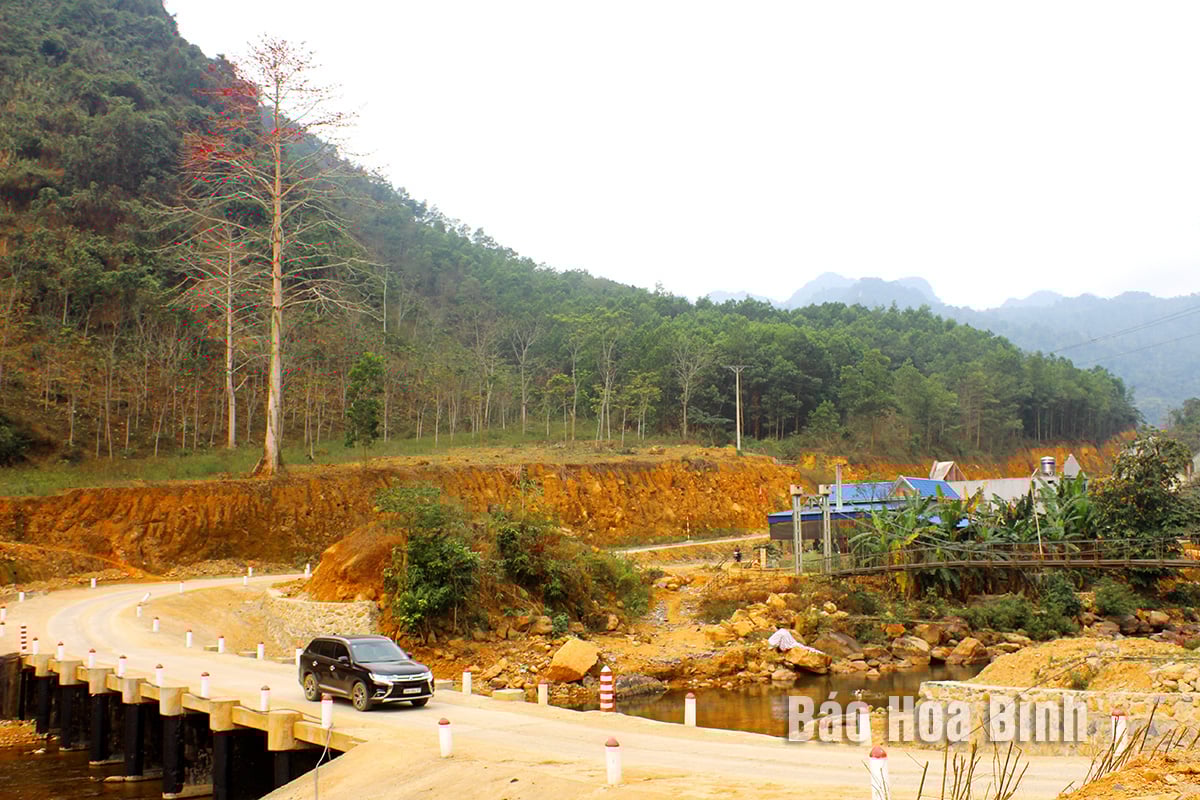
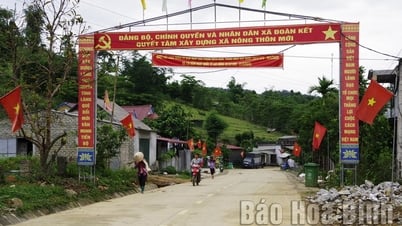
The opening of the Cao Son - Trung Thanh road has broken the isolation of the area, creating momentum for the development of Trung Thanh commune (Da Bac district).
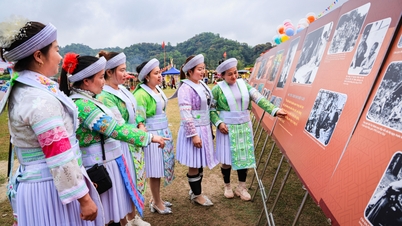
Trung Thanh - the place that commemorates the victory of shooting down an American plane.
Historical records show that, starting in 1964, due to successive and heavy defeats on the battlefields, the US imperialists frantically escalated their bombing campaign against North Vietnam. Enemy planes repeatedly flew over the Da Bac area, dropping leaflets. By 1965, 10 communes in the district had directly participated in 45 battles against US imperialist bombing raids. Each commune had a platoon using infantry rifles to shoot down low-flying aircraft and established watchtowers for observation. The militia of Da Bac achieved many resounding victories in combat, especially the victory of shooting down a US RF101 aircraft by the people and soldiers of Trung Thanh commune.
The victory of shooting down the American RF101 aircraft on April 29, 1966, was a remarkable triumph, demonstrating the courage and ingenuity of the local people in combat. At that time, American planes were constantly infiltrating and bombing areas in the North, including Da Bac district. In response, the military and people of Trung Thanh commune continuously strengthened their forces, increased their combat readiness, and were determined to defend their homeland.
Despite having rudimentary weapons and limited experience in shooting down enemy aircraft, the soldiers and civilians of Trung Thanh commune remained undaunted. The soldiers organized training sessions, learned from past mistakes, and adapted their tactics to counter the high-flying, fast-moving enemy planes. After several unsuccessful attempts at counterattacking, they decided to move their battleground to the summits of Pu Chung and Pu Tham Noc – the highest peaks in the Phu Canh mountain range, where American planes could be seen from afar. The people and soldiers of Trung Thanh commune meticulously prepared for this battle. The soldiers themselves wove bamboo mats and made model airplanes, which they mounted on bamboo poles to practice aiming. When the opportunity arose, they would time their fire perfectly and open fire simultaneously.
At approximately 1:24 PM on April 29, 1966, three American RF-101C reconnaissance planes flew from Moc Chau into the airspace of Da Bac. They circled three times to scout the area before approaching the anti-aircraft positions on Pu Chung mountain. When the first plane flew over, the soldiers and civilians of Trung Thanh commune only managed to fire two shots. However, the second plane flew low and slowly, giving the gunners an opportunity. With thorough preparation, the soldiers simultaneously opened fire, and the enemy plane burst into flames immediately after passing the position. The pilot managed to parachute out but was captured alive by the militia and civilians.
This victory was not only a military triumph, but also a testament to the unwavering will and ingenuity of the people of Trung Thanh commune in combat. Despite their rudimentary weapons, their indomitable spirit and determination to defend their homeland enabled them to achieve this proud feat, continuing the heroic tradition and inspiring future generations in the cause of building and defending the nation.
The revolutionary traditions of our homeland will shine brightly forever.
The Trung Thanh area has undergone many changes today, especially since the road connecting Cao Son commune to Trung Thanh was opened, breaking the area's isolation. Mr. Ha Van Huong from So hamlet shared: "So is the most disadvantaged hamlet in the commune; previously, transportation was extremely difficult. In recent years, with the attention of the Party and the State, transportation has been expanded and improved. As a result, the sale of agricultural and forestry products has become easier, and life has become much less difficult."
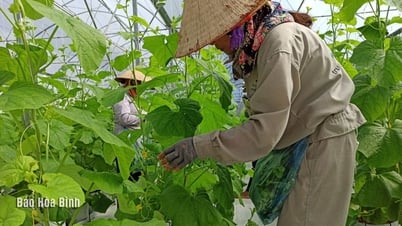
Over the years, Trung Thanh commune has focused on transforming its economic structure with many new models, most notably the cultivation of ramie. In 2021, this crop was experimentally planted in the commune. To date, it has been expanded to many other hamlets, with a total area of approximately 50 hectares. Nearly five years ago, Mr. Luong Van Dung's family in Trung Tam hamlet converted nearly 3 hectares of land previously used for growing corn and cassava to ramie cultivation. This direction has helped Mr. Dung's family achieve a stable income. Mr. Dung shared: "Before, my family only grew corn and cassava, but the yield was not high. Since switching to ramie, the economic efficiency has increased many times over. Ramie is planted once but yields harvests for many years."
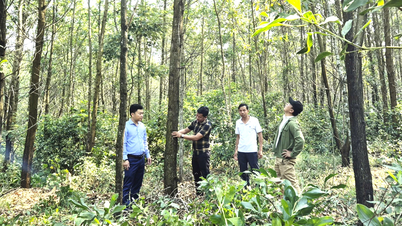
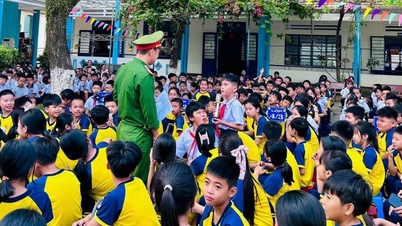
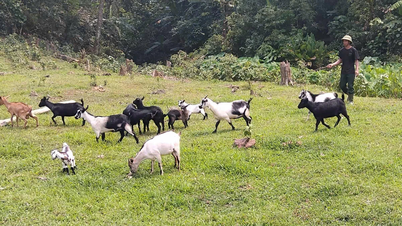
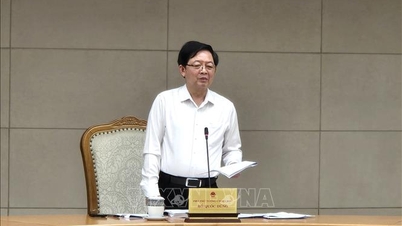
Comrade Luong Thi Tho, Chairwoman of the People's Committee of Trung Thanh commune, said: Along with promoting economic development, the commune has always focused on educating about revolutionary traditions. In 2024, the commune achieved many important results with an economic growth rate of 6.75%, and an average per capita income of 36 million VND. The economic structure has shifted positively, and key crops such as corn, cassava, ginger, and Shan Tuyet tea have all exceeded targets. Livestock farming is stable, and forest planting and protection have exceeded 130%. These results are a solid foundation for Trung Thanh commune to continue overcoming difficulties and building a more prosperous life.
Cao Viet
Source: https://baohoabinh.com.vn/12/200717/Chuyen-minh-บน-vung-dat-cach-mang-Da-Bac.htm
![[Photo] General Secretary and President To Lam meets with National Assembly delegates from ethnic minorities.](https://vphoto.vietnam.vn/thumb/1200x675/vietnam/resource/IMAGE/2026/04/20/1776696701056_a1-bnd-8331-3342-jpg.webp)



![[Image] National Assembly discusses the implementation of the socio-economic development plan.](https://vphoto.vietnam.vn/thumb/1200x675/vietnam/resource/IMAGE/2026/04/20/1776696707422_ndo_br_img-20260420-185419-jpg.webp)




































































Comment (0)