

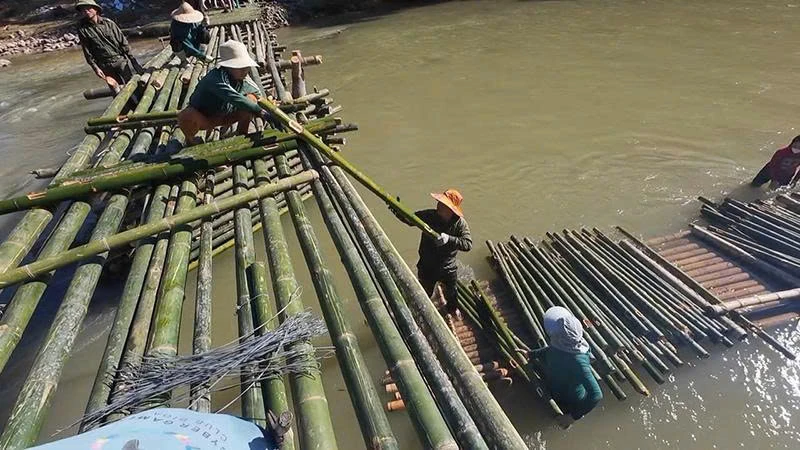
Residents of Chung Son village, Son Thuy commune, contribute to building a temporary bridge across the Luong River. Photo: Bui Dong
At the end of the year, the reeds bloom profusely, bursting forth with clusters of pristine white blossoms, adding a poetic and unspoiled beauty to the border mountains and forests. Chung Son village is located there, the center of Son Thuy border commune, where nearly 150 houses of the Thai ethnic minority are neatly arranged at the foot of the majestic Pha Dua mountain range, facing the Luong River which has just left Laos to enter Vietnamese territory.
During the dry season, the gentle river reflects the deep green forest, bringing the villagers fish, shrimp, and water for irrigating their crops. But during the rainy season, the water turns red like the faces of the villagers after drinking alcohol, roaring and rushing, making it impossible for anyone to venture upstream or downstream to fish.
The house of Lo Van Muon (born in 1985), the Party Secretary and Head of Chung Son village, is located on a high mound, inside a small alley. He recounted: “Some years we lose less, some years we lose more. But there isn't a single flood season when the people of Chung Son village don't suffer damage from the raging floodwaters pouring down from upstream. The difficulty is that all of the more than 400 hectares of production forest land and 20 hectares of rice fields belonging to the villagers are on the other side of the river. While there is no bridge or solid concrete road, the villagers used to wade across the river to go to work. It was very dangerous!”
It's easy to imagine the dangers faced by the people of Chung Son village as they cross the river to earn a living during the flood season. Here, they work hard, depending on the season, but the harvest season is incredibly difficult. People carry their rice on their backs, wading across the river, and hardly a grain of rice gets wet on the way home. Some people, after packing the rice into sacks and carrying them across the river, stumble and fall, getting both themselves and the rice wet. Strong men cling to rocks and get back up to retrieve their sacks of rice. But the women and the elderly face a different situation.
A few years ago, during the cold season, before the bridge was built, Mrs. Lu Thi Phuong (63 years old) carried a basket on her back and waded across the river to harvest winter vegetables to sell. But before she could cross back to the other side, she tripped and fell, and her entire basket of cabbage, lettuce, coriander, garlic, etc., was swept away by the water. She cried then, lamenting that all her hard work over the past few months had been taken away by the river just as she was about to enjoy it.
"We can't avoid crossing the river to work. Not many people in the village have a secondary occupation. All our food, clothing, and school supplies for our children depend on the other side of the river. But building a temporary bridge requires a lot of thought, decisions, and even breaking the rules, all for the sake of the people's lives," Secretary Muon asserted.
The "breaking the rules," as Secretary Muon said, refers to the fact that building the bridge could obstruct the river's flow, especially during the rainy season. Even building a temporary bridge requires permission from the competent authorities...
“The more we think about it, the more confused we become. The bridge only exists during the dry season when the water level is low, not for personal gain or benefit, but entirely for the livelihood of 137 households with 688 people. At the beginning of the next rainy season, the villagers can dismantle it, so it won't obstruct the flow of water. Meanwhile, waiting for the government to invest in building a bridge and road would take time and be very costly,” Secretary Muon explained.
The story of building the first temporary bridge by the Party branch, the management board, the Fatherland Front working committee, and influential people in Chung Son village more than 10 years ago is like this. Every small detail is meticulously considered, reflected in the determined gaze and firm words of the young Party branch secretary.
Without considering the right or wrong of the matter, for a long time in the mountainous areas, people have had to build waterwheels themselves, placing them along rivers and streams, relying on water power to bring water up to their scattered, high-lying fields to irrigate their crops. At the beginning of the flood season, they voluntarily dismantle them so as not to obstruct the water flow. But without those waterwheels, a huge amount of resources would be needed to invest in an irrigation system. The temporary bridge in Chung Son village is also a vital source of livelihood for the people.
Thanks to practical and people-friendly policies, from the first bridge to the present day, the people of Chung Son village have enthusiastically participated in contributing their labor and resources. There was no need for the Party branch, the management board, or the village's Fatherland Front committee to go door-to-door to spread the word; simply announcing it over the loudspeaker system was enough to get the villagers to eagerly contribute bamboo, large and small, with each household contributing 11 pieces, which they brought to the Ta Phay wharf to help build the bridge. The village management board publicly and transparently accounted for every bamboo piece and strand of material contributed. Each time a bridge was built, more than 1,000 bamboo pieces were contributed.
Recently, in mid-December 2025, as the dry season arrived, the people of Chung Son village eagerly gathered at Ta Phay wharf. Some cut, some sawed, and others waded into the river to drive stakes to create abutments and build a stilt bridge across the river. Members of the village management board were responsible for the "technical" aspects, marking the locations for the bridge abutments, while the villagers, strong enough, carried stones and transported the stilts to the middle of the river, and the women sawed the stilts on the bank... Not a single household was left out of the work, and the riverbank was filled with the sounds of laughter and chatter.
That day was a weekend, and local officials and teachers from nearby schools also came to help. The leaders of Son Thuy commune also came to witness the work firsthand and encourage the villagers to build the bridge.
Mr. Ha Van Luong (69 years old) smiled brightly: “Apart from the Muong Xia Festival and the Lunar New Year, my village has never been more lively than this. We are happy because the whole village is united, self-reliant, building a temporary bridge to develop the economy , escape poverty, and not rely on or depend on government support.”
In just two days, a bridge over 100 meters long was built across the Luong River during the dry season. On the bridge, the path is wide enough for people and motorbikes to pass, and the people of Chung Son are bustling about, tending to their lush, green fields.
According to Mac Van Toi, Chairman of the People's Committee of Son Thuy Commune: "Previously, when it was still under district-level administration, the Quan Son District People's Committee requested the competent authorities to consider and decide on investing in a road from National Highway 16 to Thuy Thanh village on the other side of the river, creating favorable conditions for the people of Chung Son village to develop their economy. However, the road has not yet been invested in. The construction of the temporary bridge stems from a practical need, so after the village launched the initiative, the people enthusiastically participated. Before the next rainy season, the commune will request the village to organize a force to dismantle the bridge to avoid obstructing the flow of the Luong River and to ensure conditions for disaster prevention and control."
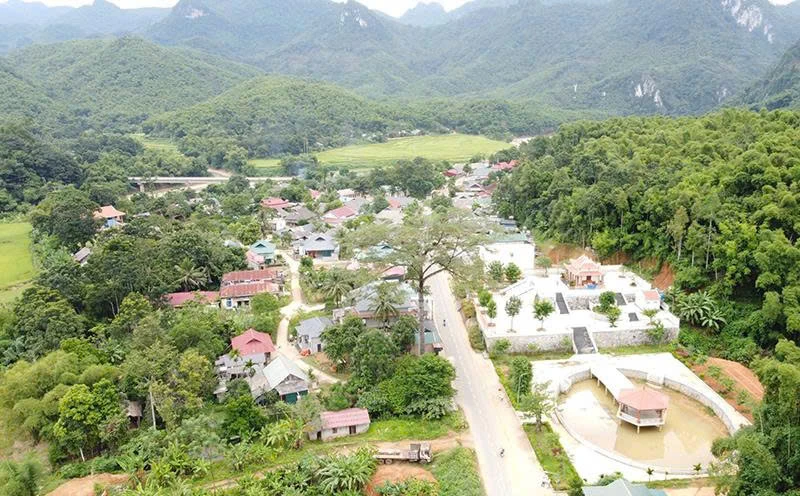
A view of Chung Son village, Son Thuy border commune.
Built with bamboo, reeds, gravel, manual labor, and safety requirements, the bridge's lifespan is only measured by the time between two rainy seasons. But on the Ta Phay ferry landing, for many years, the people of Chung Son village have joined hands to write a beautiful story of community solidarity, self-reliance, and the effort to overcome poverty. That bridge not only connects the two banks of rice paddies, connecting lives, but also connects hearts, strengthening the bonds of neighborly love, and together hướng towards a brighter future...
But it wasn't just the temporary bridge that needed building. Before that, after days of strong currents caused by the remnants of Typhoon No. 10, the Son Thuy bridge on National Highway 16, spanning the Luong River about a kilometer from Ta Phay ferry terminal, was severely damaged. The approach road collapsed and was washed away, leaving the bridge precariously unstable, with its underside exposed, making it impossible for people and vehicles to cross.
Following the commune's directive, the people of Chung Son village contributed bamboo, labor, and, together with local militia, border guards, and commune police, reinforced the bridge to create a temporary access route. Although the bridge was repaired just over a month later, the fact that traffic on National Highway 16 was restored during that time was invaluable.
This shows that contributing resources and effort to build a temporary bridge when the State lacked the funds to invest in a replacement project was a practical act, affirming the determination of the Party branch and the people of Chung Son village to escape poverty and eliminate the mentality of waiting and relying on others. Perhaps it is because of this determination that, to this day, Chung Son remains one of the few villages in the border area of the province to have achieved the status of a New Rural Village and is on its journey to building a model New Rural Village.
But in the long run, they still hope that the State will invest in building a road on the other side of the Luong River connecting to National Highway 16, to make their livelihoods easier...
Notes by Do Duc
Source: https://baothanhhoa.vn/chuyen-tren-ben-ta-phay-274361.htm

![[Photo] The General Secretary attends the groundbreaking ceremony for the construction of the Truong Ha Primary and Secondary Boarding School.](/_next/image?url=https%3A%2F%2Fvphoto.vietnam.vn%2Fthumb%2F1200x675%2Fvietnam%2Fresource%2FIMAGE%2F2026%2F01%2F28%2F1769604498277_vna-potal-tong-bi-thu-du-le-khoi-cong-xay-dung-cong-trinh-truong-pho-thong-noi-tru-tieu-hoc-va-trung-hoc-co-so-truong-ha-8556822-jpg.webp&w=3840&q=75)


![OCOP during Tet season: [Part 3] Ultra-thin rice paper takes off.](/_next/image?url=https%3A%2F%2Fvphoto.vietnam.vn%2Fthumb%2F402x226%2Fvietnam%2Fresource%2FIMAGE%2F2026%2F01%2F28%2F1769562783429_004-194121_651-081010.jpeg&w=3840&q=75)


![OCOP during Tet season: [Part 2] Hoa Thanh incense village glows red.](/_next/image?url=https%3A%2F%2Fvphoto.vietnam.vn%2Fthumb%2F402x226%2Fvietnam%2Fresource%2FIMAGE%2F2026%2F01%2F27%2F1769480573807_505139049_683408031333867_2820052735775418136_n-180643_808-092229.jpeg&w=3840&q=75)
![OCOP during Tet season: [Part 1] Ba Den custard apples in their 'golden season'](/_next/image?url=https%3A%2F%2Fvphoto.vietnam.vn%2Fthumb%2F402x226%2Fvietnam%2Fresource%2FIMAGE%2F2026%2F01%2F26%2F1769417540049_03-174213_554-154843.jpeg&w=3840&q=75)



Comment (0)