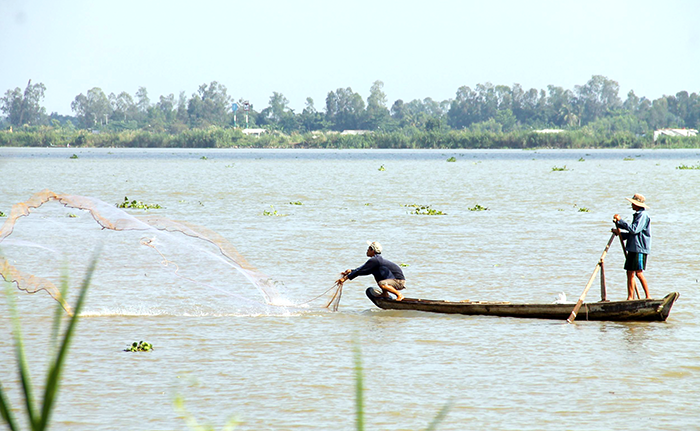
Fishing with nets on the river. Photo: DUY KHÔI
Interesting stories related to "starting a business"
The proverb "The buffalo is the foundation of one's livelihood" emphasizes the role of the buffalo in the traditional rice- farming agriculture . The buffalo is closely associated with the lives and work of farmers, so stories from the countryside often include interesting details related to buffaloes.
To achieve the image of "the buffalo leading, the plow following," farmers in the past often had "secret techniques" to get the buffalo to pull the plow exactly as they wanted. First, they trained the buffalo to obey commands like "ví, thá." Ví means in, thá means out. Buffaloes used by farmers in the countryside for plowing were usually trained to move counter-clockwise using "vọng ví." These two sounds were used by the farmers to control the plow's direction as desired.
When talking about buffaloes, one cannot forget "buffalo pulling"—an old term referring to the creation of a waterway, initially small, gradually widening. This involved using buffaloes to pull boats along a small, natural waterway. Over time, through repeated attempts, the waterway widened, becoming an internal water channel connecting the fields. In areas where conditions permitted, landowners, who were also buffalo owners, would agree on a common day to bring all their buffaloes to a designated point for a race. The race course would be the natural waterway (the "lung lạn"). Each buffalo would be driven by its own handler, hundreds of them racing noisily… Of course, the race had to be repeated many times for the waterway to become deeper and wider. Thus, a waterway was formed without the need for human labor.
During the flood season, farmers would hire people to herd buffaloes. In the past, the price for hiring someone to herd a pair of buffaloes was 5 bushels of rice per flood season. If a buffalo died of illness, its meat could be eaten, sold, or given away, as long as the horns and a piece of hide were kept as proof. The owner wouldn't question anything because farmers treated and trusted each other based on honesty. Each family, usually consisting of husband, wife, and children, who worked as professional buffalo herders, could manage to herd one or two hundred pairs of buffaloes during the flood season.

Fishing boats and gear on the river in Dong Thap Muoi. Photo: DUY KHOI
Stories of the products of the countryside
In stories from the countryside, there's often the saying, "The big snakehead fish living in the pond are very clever." This is because when a pond is drained and sinks (due to heavy rain lasting all night), the large snakehead fish will hide in pairs by leaping to the edge of the pond, where the bank is lower (perhaps they sense it because rainwater from the fields flows into the pond). Once out of the pond, these pairs will hide in small puddles (in uneven fields). They lie still, sometimes for several days without moving, waiting until the pond is drained and there's no more commotion before they try to escape (usually by returning to the drained pond). Professional pond keepers are naturally smarter than them, so when the pond sinks, they organize a search the next morning to catch the big snakeheads. The most aggressive among them are the "snakeheads with protruding lips." To catch these predators, the fisherman grabs them right over the head and immediately pushes them down into the mud until they reach solid ground. Because of the suddenness and the hard ground, the fish can't react in time and just lies still.
To catch snakehead fish, people used only "5-centimeter mesh nets," meaning they caught only large, evenly sized fish, so they only needed to count them instead of weighing them. In the old days, small fish were measured by baskets. They would agree on the price per basket. The largest basket was called a "seven-basket," meaning its capacity was equivalent to seven regular baskets, which typically held about 25 kg of fish. For larger fish, they counted them, not weighed them as they do now, because back then only small scales were used, only capable of weighing a few kilograms at most; the larger scales were very expensive, and few ordinary people could afford them. The fishermen were very skilled at catching snakehead fish, using both hands simultaneously, each hand catching one fish from their own boat's hold and transferring it to the basket or the driver's boat's hold. They counted aloud as they caught the fish (so everyone could easily follow and check). Whatever they counted, they doubled the number, because each count represented a pair, or two fish. For example, 160 means 320 animals, and the price is calculated accordingly.
Catching eels is more elaborate. When the water has just flooded the fields to a depth of a few inches, farmers go out into the fields and look around. If they see a patch of green grass that is taller than the surrounding grass, they use their feet to probe around for a while. If their heel can fit through, that's the eel's burrow. At this point, the first action of the eel catcher is to bend down, clench their fist, and thrust it into the mouth of the burrow. If the fist fits, the eel weighs about 700g; if it's tighter, it's about half a kilogram – of course, a wider burrow means a bigger eel. If the fist can't fit, the eel is small, under half a kilogram, which the ancients considered too small and didn't catch.
Once the location of an eel burrow weighing half a kilogram or more is identified, a handful of grass is tightly wrapped around it and inserted into the burrow, about three or four inches deep, until the fork in the burrow is reached. The grass is then placed in the main burrow (if not quickly packed in, the eel will retreat and hide in this very deep burrow, sometimes a meter deep), and then the "snap" motion is performed. The eel in the side burrow clearly hears the "snap," mistaking it for the sound of prey, and scurries upwards. At that moment, the eel catcher slightly opens their hand, their fingers curling slightly, close together and all pointing towards the center, waiting. In an instant, the eel's head will touch the palm of their hand. Immediately, the fingertips grip, and the eel nimbly slides down, slippery and slimy, but unable to escape because its gills are trapped by all five fingernails of the farmer! All that's needed is to pull the eel up.

Buffaloes carrying straw carts. Photo: DUY KHÔI
In the old days, the produce of the countryside was also linked to marriage customs. For less affluent families, whenever a child got married, the whole family would work together to build a "fishing channel" to help their children start a business. This channel was created by buffaloes wading back and forth many times, cleared of grass, and slightly deep. When the water was about to recede, all the fish in the fields would retreat to this "fishing channel." When the water level was almost completely dry, people could simply build a "boat" to catch the fish. If they were diligent and knew how to utilize the "fishing channel," the newlywed couple could make a living.
Another interesting aspect of daily life is the "vầy," also known as "chợ rổi." This refers to the designated meeting point for those who work in fish ponds, bringing their freshly harvested fish to sell to "lái rổi" (fish traders). "Vầy" here means "market"—a type of specialized fish market held in the middle of the fields, also called a "chợ rổi."
The stories I tell about my time in Dong Thap Muoi become increasingly fascinating, as I recount many interesting details that reveal the abundant produce and the intelligence and adaptability of the people to life there...
NGUYEN HUU HIEP
Source: https://baocantho.com.vn/chuyen-xua-o-dong-thap-muoi-a190850.html


































































































Comment (0)