

 |
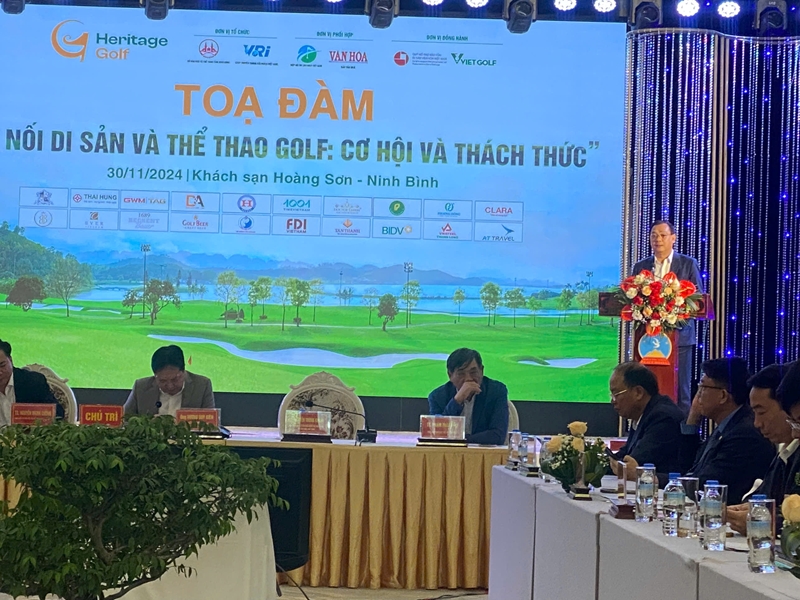
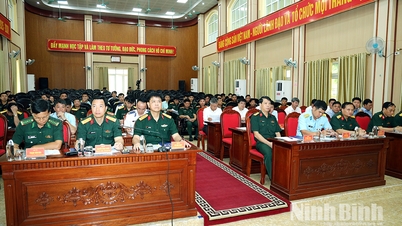
| The comrades chairing the seminar. |
Promoting economic development, tourism, and heritage preservation.
On November 30th, in Ninh Binh, the Ninh Binh Department of Culture and Sports, in collaboration with other units, organized a seminar titled "Connecting Heritage and Golf: Opportunities and Challenges".
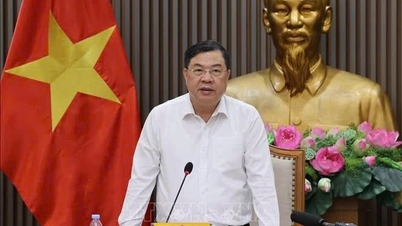
Speaking at the seminar, Dr. Nguyen Manh Cuong, Director of the Ninh Binh Department of Culture and Sports, said: "In the context of increasingly intertwined economic and cultural development, exploiting the potential of modern sports like golf to preserve and promote heritage values is a direction that many countries are interested in. Vietnam, with its rich natural and cultural heritage, especially Ninh Binh with its many valuable heritage sites, is facing a great opportunity to utilize golf as a new, unique product, combining sports and heritage tourism ."
The goal of the "Heritage Golf" product is to harmoniously combine the sport of golf with local cultural and natural heritage, thereby promoting economic development, tourism, and heritage preservation. Developing this type of tourism will not only contribute to attracting international tourists to Ninh Binh but also create a sustainable economic model for the entire local community.
"Heritage Golf" is not only a high-class recreational sport, but also brings immense cultural value. Through it, it opens up opportunities to promote the image of Vietnamese heritage to the world, while preserving and promoting the historical and cultural values of the locality…
 |
| Dr. Nguyen Trung Khanh, Director of the Vietnam National Tourism Administration, spoke at the seminar. |
Speaking at the seminar, delegates also stated that golf tourism is currently a strength of Vietnamese tourism. According to Mr. Vuong Duy Bien – former Deputy Minister of Culture, Sports and Tourism, developing golf tourism in Vietnam, especially in areas with cultural heritage, is a strategic direction to attract international tourists. Studies and international experience have shown that the combination of golf and cultural heritage elements will create sustainable tourism products, attracting high-spending tourists who stay longer.
However, to achieve high effectiveness in developing golf tourism linked to heritage, clear strategies are needed for preserving and promoting cultural heritage, ensuring harmony between economic development and environmental protection. It's not just about developing golf courses to international standards, but also about linking them with cultural exploration activities and heritage tourism experiences to create sustainable appeal.
Dr. Nguyen Trung Khanh – Director of the Vietnam National Tourism Administration – also added that from 2020 to the present, many specialized golf training programs have been incorporated into formal education, contributing to providing professional human resources for the golf tourism industry. The intensive golf Bachelor of Physical Education and Sports training courses at Bac Ninh University of Physical Education and Sports and golf tourism training courses at Hanoi College of Tourism from 2024 will significantly improve the quality of human resources in this field.
In the first nine months of 2024, Vietnam welcomed 13 million international tourists, including 1.5 million golf tourists. This number is expected to continue to increase in the coming years, as Vietnam increasingly establishes itself as an attractive golf destination. The growth of both the international and domestic markets not only boosts the golf tourism industry but also contributes to the local economy, creating jobs and improving the quality of life for local people. With strong infrastructure development, opportunities for international cooperation, and increasing demand for sports tourism, Vietnam is facing great opportunities to develop its golf tourism industry, transforming itself into one of the world's leading golf destinations.
Furthermore, delegates also stated that: Golf and local heritage preservation: Golf not only plays a role in promoting economic development but is also an effective tool for preserving and promoting the value of local heritage. In Ninh Binh, a place with many precious heritage sites, combining golf and heritage not only brings benefits to tourism but also helps raise community awareness of the importance of heritage preservation. This requires close coordination between local cultural, sports, and tourism management agencies and investors in building golf courses and appropriate tourism infrastructure, creating products that are sustainable economically and culturally.
International golf events held in heritage areas will be a great opportunity to promote Vietnam's image to the world, while also fostering cultural and economic exchange. The development of golf courses and tourism infrastructure will create many new jobs and increase income for local people. At the same time, it will also create opportunities to develop supporting tourism services, thereby promoting the socio-economic development of the entire region.
By expanding cooperation with countries that have a strong foundation in golf, Ninh Binh can attract investment capital, advanced technology, and learn from foreign partners in organizing professional tournaments and building golf courses that meet international standards. These international Heritage Golf tournaments will be an important bridge to promote the image and unique value of Ninh Binh's heritage to the international community. At the same time, these events will attract the attention of global media, creating momentum for the development of golf tourism and strengthening the brand of Vietnamese heritage tourism. These strategic steps in international cooperation and promoting the "Heritage Golf" brand will bring sustainable value to Ninh Binh, not only economically but also in the preservation and promotion of the local unique cultural heritage.
 |
| Discussion corner. |
Ensuring a balance between economic development and the preservation of valuable heritage.
However, at the seminar, delegates also pointed out that alongside the advantages, we also face challenges related to the management, planning, and preservation of heritage when implementing large-scale projects such as golf courses. Organizing international golf tournaments in heritage areas like Ninh Binh requires ensuring a balance between economic development and the preservation of valuable heritage values.
“When organizing this, we need to ensure that this development process does not harm the living environment of the local community, does not erode traditional cultural values, and ensures that all citizens have the opportunity to benefit from this development,” emphasized Comrade Vuong Duy Bien, former Deputy Minister of Culture, Sports and Tourism.
According to Dr. Nguyen Trung Khanh, Director of the Vietnam National Tourism Administration, despite its potential, Vietnam's golf tourism currently faces several challenges that need to be overcome: High taxes: A 20% special consumption tax applied to golf-related services makes it more difficult to compete on price compared to other Southeast Asian countries such as Thailand and Malaysia. Currently, most tourism companies have not yet invested heavily in developing golf tours, leading to the underutilization of the market potential. Golf tourism products in Vietnam are still simple and not diverse, lacking accompanying services such as cultural experiences, heritage exploration, shopping, and culinary experiences. Lack of connection between components of the tourism industry: Golf courses, travel companies, hotels, and attractions lack strong connections to create comprehensive product packages for tourists. Communication in this sector is weak, lacking widespread and strategic promotion. Many opportunities to promote golf tourism through television and social media channels remain underutilized. Golf tourism personnel are not adequately trained. Golf tourism products are still monotonous: Currently, Vietnam's golf tourism products are not diversified and remain quite simple, mainly focusing on golf packages without fully exploiting the potential for combining them with cultural activities, heritage visits, or culinary experiences. This lack of creativity has reduced the attractiveness of Vietnamese golf tourism, especially compared to regional competitors such as Thailand or Malaysia. Technology has not yet been applied to golf tourism…


![[Photo] First session of the 14th Congress of the Vietnam Trade Union](https://vphoto.vietnam.vn/thumb/1200x675/vietnam/resource/IMAGE/2026/06/03/1780465947883_ndo_br_img-3852-jpg.webp)

![[Photo] Secretary of the National Assembly Party Committee, Chairman of the National Assembly presides over the meeting of the Standing Committee and Executive Committee of the National Assembly Party Committee.](https://vphoto.vietnam.vn/thumb/1200x675/vietnam/resource/IMAGE/2026/06/03/1780480353201_ndo_br_bnd-2585-jpg.webp)
![[Photo] General Secretary and President To Lam presides over a meeting with the Central Organizing Committee.](https://vphoto.vietnam.vn/thumb/1200x675/vietnam/resource/IMAGE/2026/06/03/1780482764658_a1-bnd-4741-3342-jpg.webp)

![[Infographics] Functional groups of digital applications in Thanh Hoa](https://vphoto.vietnam.vn/thumb/402x226/vietnam/resource/IMAGE/2026/06/03/1780479770325_infographics-ca-w1200t0-di2622d199d3163702t11359l1-cac-nhom-chuc-n3.webp)









































![[Video] Sunset at Lap An Lagoon – Where the sun sets over the fishing nets](https://vphoto.vietnam.vn/thumb/1200x675/vietnam/resource/IMAGE/2026/05/31/1780192137701_beach-landscape-sea-water-nature-grass-745871-pxhere-com.jpeg)


































Comment (0)