

In the past, sticky rice cooked in bamboo tubes (com lam) was a staple food for the Thai ethnic minority in Son La province , often taken on long trips to the forest and fields. It was convenient for preservation and retained the fragrant flavor of the sticky rice grains. Today, com lam has become a specialty dish, made year-round by locals and sold at local markets and central markets for prices ranging from 10,000 to 30,000 VND per tube.

Visiting the home of Mrs. Luong Thi Luong in Giang Lac village, To Hieu ward, and witnessing firsthand the process of making sticky rice in bamboo tubes, from preparing the ingredients to the finished product, one can truly appreciate the meticulousness of the maker. Mrs. Luong said: "Sticky rice in bamboo tubes is a traditional dish of the Thai ethnic group. I usually choose the best quality glutinous rice, with round, even grains and a strong aroma of fresh glutinous rice, to make sticky rice in bamboo tubes."

To make sticky rice in bamboo tubes, you must choose tubes that are neither too young nor too old, with a dark green outer shell and a moderate size, and cut them into tubes about 30 cm long. One end of each tube is sealed with a notch connecting the tubes, while the other end is left open.
To make delicious and fragrant sticky rice cooked in bamboo tubes (com lam), meticulousness and skill are required, starting from soaking the glutinous rice in plain water for about 4 hours, then draining it. Next, put the rice into bamboo tubes, fill them with water, and press them tightly. Seal one end of the bamboo tube with a banana leaf. Bake the bamboo tubes over low heat for about 30-45 minutes, depending on the amount of rice and the size of the tube.

Grilling the sticky rice in bamboo tubes is the most important step; the charcoal fire must be heated until it's glowing red so the rice cooks evenly. The bamboo tube shouldn't be placed directly on the charcoal; one end must rest on a horizontal bar, and the other end should touch the ground at a 45-degree angle. The challenge lies in controlling the fire to a low, steady level, and continuously rotating the bamboo tube to ensure the rice cooks evenly without burning, until the tube's outer shell is dry. When you smell the fragrant aroma of sticky rice emanating from the end of the tube, the rice is cooked.

Once cooked, the burnt outer layer of the bamboo tube is peeled off, leaving only the thin inner membrane clinging tightly to the rice, forming a natural coating. The pristine white, hot, fragrant rice, infused with the aroma of forest leaves, is cut into small pieces and eaten with sesame salt. Sticky rice cooked in bamboo can be kept for 2-3 days without spoiling.

Mr. Hoang Tuan Anh, from Hoang Mai ward, Hanoi , shared: "As someone from the Northwest region who has been working far from home for many years, what I miss most is the aroma of banana leaves and bamboo tubes intertwined with sticky rice. The more you chew sticky rice cooked in bamboo, the more you can appreciate the fragrant, rich, and chewy taste hidden in each grain."
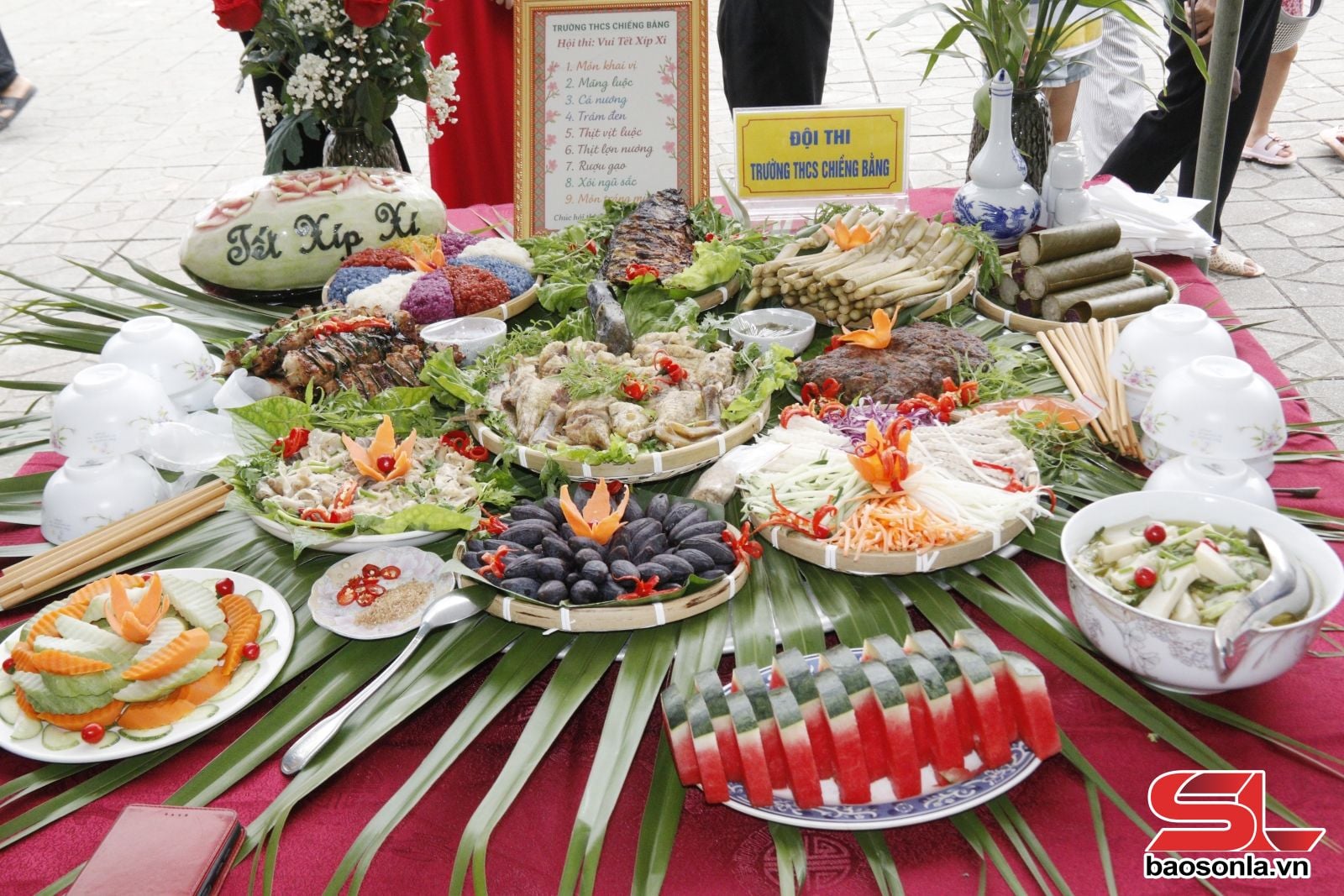

For generations, sticky rice cooked in bamboo tubes (com lam) has been an indispensable dish in the meals of the Thai ethnic minority, a simple dish yet one that leaves an unforgettable impression on those who have tasted it. When visiting Son La, whether in Thai community tourism villages or at ethnic restaurants , tourists should try the sweet and sticky rice, along with the rich and savory flavor of grilled meat, the spicy kick of cham cheo (a local dipping sauce), and more, to experience the captivating flavors of dishes that embody the spirit of the Northwest mountains.
Source: https://baosonla.vn/van-hoa-xa-hoi/com-lam-huong-vi-nui-rung-KWmBCFGvg.html




































































Comment (0)