

Perched on the first-floor balcony, six-year-old Giang Hoa Xinh opens her lunchbox containing white rice and a piece of potato chip for lunch.
Hoa Xinh, of the Mong ethnic group, is a student in class 1A1 at Tung Qua Lin Ethnic Boarding Primary and Secondary School, Phong Tho district, Lai Chau province.
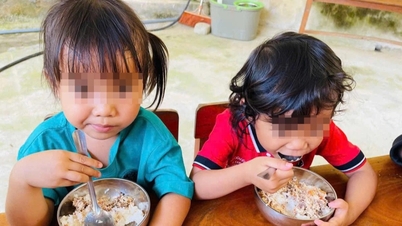
Xinh's house is halfway up the hill, a walk of over 40 minutes, so she brings her own lunch to eat at school. Almost every day, she only has plain rice, accompanied by a spicy snack stick, or "bim bim" as the students call it. Each time she takes a bite of rice, Xinh sucks on the spicy stick for added flavor. The girl, nearly 1 meter tall and weighing 15 kg, eats heartily, occasionally giggling shyly at her "meager menu" when a friend runs past.
About 10 meters from Xinh, Giang A Chinh, a student in class 2A1, squatted in the corner of the hallway, also eating white rice and stir-fried pumpkin. With a spoon in each hand, Chinh ate continuously, occasionally wiping his nose.
In the teachers' temporary housing area, about 10 students were huddled together, eating instant noodles from a pot. These were students who didn't have lunch, or only had plain rice, so their homeroom teacher helped them cook noodles with eggs.
"Sometimes the students ask the teachers to boil water to pour over their rice, but I can't bring myself to do it, so I cook instant noodles for them instead," said Mr. Dong Van Phong, homeroom teacher of class 5A2.
Teacher Phong said that the money for instant noodles and eggs for each meal for his students is about 50,000 VND, sometimes more, so on average it fluctuates between 1.5 and 2 million VND per month.
"No individual or organization is supporting this, so teachers who care about their students should pitch in and help them," Mr. Phong said, handing out bowls and chopsticks for the students to eat noodles.
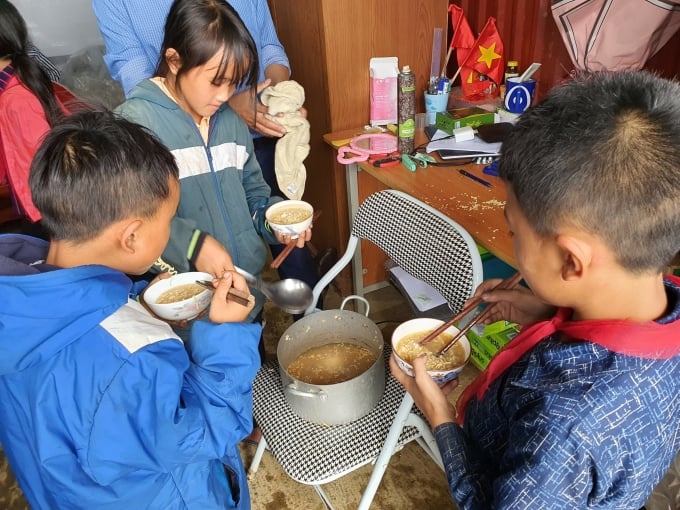
Students take noodles and eggs and eat them standing up. Photo: Thanh Hang.
Tung Qua Lin Ethnic Boarding Primary and Secondary School is located in the commune of the same name. Situated amidst the high mountain ranges of the Vietnam-China border, Tung Qua Lin is one of the particularly disadvantaged communes in Phong Tho district. Most of the students at the school are Hmong, with a small number of Ha Nhi people.
Principal Cù Thị Lan Hương said that about one-third of the more than 380 elementary school students bring their own lunch and stay at school during lunchtime. However, having meat in their lunch is a luxury for them. The common menu consists of stir-fried pumpkin and radishes, and dried fish; many students eat plain rice with spicy seasonings like Xinh or with boiling water. On one occasion, Ms. Hương caught a student eating rice with rat meat. The children often eat lunch "each in their own corner," embarrassed to let their friends see their empty lunchboxes.
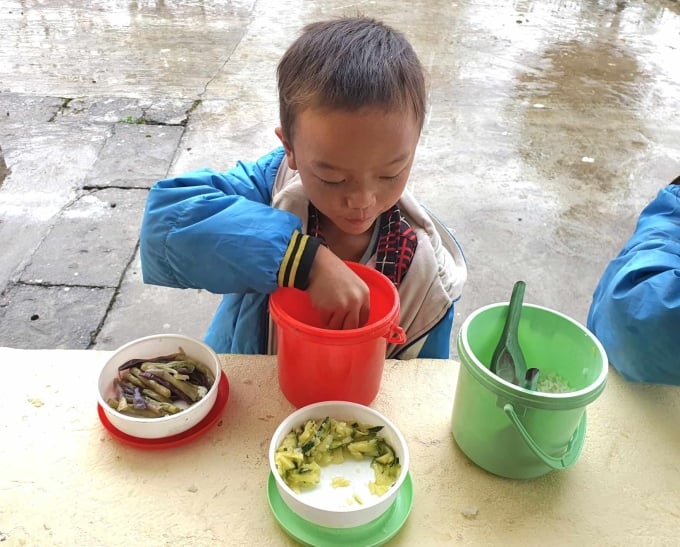
A meatless lunch for students at Tung Qua Lin school. Photo: Thanh Hang.
Prior to the 2019-2020 school year, most students in Tung Qua Lin were eligible for boarding school meals. According to Government Decree 116 of 2016 on policies supporting students in particularly disadvantaged communes, primary school students are entitled to boarding school meals if their homes are within 4 km of the school. Each month, they receive a food allowance equivalent to 40% of the basic salary, or 720,000 VND (effective from July 1st of this year), and 15 kg of rice.
Since the concrete road connecting the Hờ Mèo village, located at the foot of the mountain, to the Tung Qua Lìn school at the mountaintop was completed, the distance from home to school for students has been shortened. No student lives more than 4 km from the school, which means they no longer receive the boarding school subsidy.
Therefore, students either walk home at lunchtime and walk back to school in the afternoon, or they bring their lunch in the morning and stay at school.
Ms. Huong said that no teacher wanted students to choose the first option. Although the route was shortened, it was very difficult to travel due to the steep slope. Most of the students were Hmong – an ethnic group that still practices consanguineous marriage – and therefore had small physiques. A fifth-grade student typically weighs only about 20 kg and is just over 1 meter tall. Therefore, it took them almost an hour to traverse the 2 km of steep road.
"If the children walk home at lunchtime and then go back to school in the afternoon, they won't have enough time to rest. Many of them get tired and lazy, so if they go home at lunchtime, they won't go to school in the afternoon," Ms. Huong said.
According to the principal, sunny days are "bearable," but whenever it rains, the roads become slippery, making it dangerous for students to go up or down the mountain. When winter comes, the weather is bitterly cold, and the children will come to class with their heads soaked with dew, barefoot, and shivering.
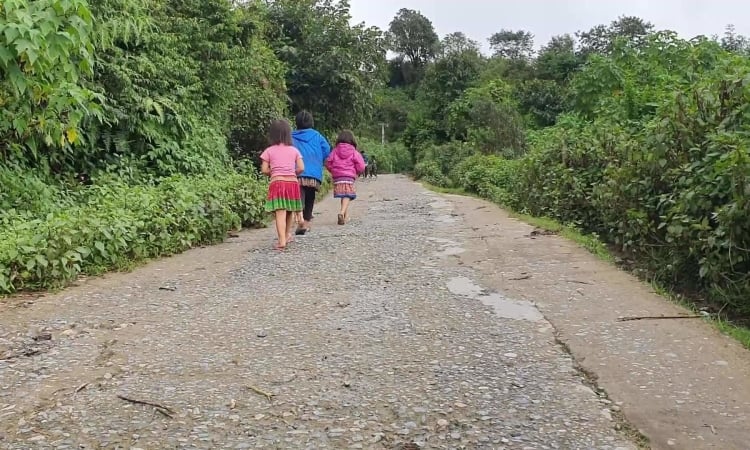
The route to school for students in Tung Qua Lin. Video : Thanh Hang
Concerned about this situation, the leaders of Tung Qua Lin commune have repeatedly petitioned for students here to be granted boarding and meal allowances in accordance with Decree 116.
"Every year we submit petitions, sometimes to the provincial delegation, sometimes during meetings with constituents, but we have never received a response," said Mr. Ma A Gà, Vice Chairman of Tung Qua Lìn commune.
According to the commune leader, policies should be applied according to the practical conditions of each locality. Mr. Ga noted that students in mountainous areas all walk, and the 2 km distance "sounds close," but it's a steep slope, making it very difficult. Not to mention that in the long run, inadequate nutrition will affect the physical and intellectual development of an entire generation.
"I just hope the students will soon be able to have lunch at school," Mr. Ga said.
Hoa Xinh, A Chinh, and 380 other elementary school students were unaware of the policy changes. They continued to regularly carry their lunchboxes and walk to school every day.
She always finishes all her rice at every meal, but when asked "is it delicious?", Xinh mumbles, "I prefer it with eggs, or vegetables would be fine too."
To further motivate children in mountainous areas to have the opportunity to improve their lives, the Hope Fund – VnExpress newspaper continues to accept donations for the "Light for Education" program. Every contribution from our readers is another ray of light for the future generation. Readers can find information about the program here.
Thanh Hang
Source link


![[Photo] Prime Minister Pham Minh Chinh presides over the conference announcing the establishment of the International Finance Centre in Vietnam.](/_next/image?url=https%3A%2F%2Fvphoto.vietnam.vn%2Fthumb%2F1200x675%2Fvietnam%2Fresource%2FIMAGE%2F2025%2F12%2F21%2F1766309817714_ndo_br_dsc-3400-jpg.webp&w=3840&q=75)
![[Photo] Prime Minister Pham Minh Chinh presides over a meeting on private sector economic development.](/_next/image?url=https%3A%2F%2Fvphoto.vietnam.vn%2Fthumb%2F1200x675%2Fvietnam%2Fresource%2FIMAGE%2F2025%2F12%2F20%2F1766237501876_thiet-ke-chua-co-ten-40-png.webp&w=3840&q=75)




























































Comment (0)