

A robot rickshaw with a passenger drives through the streets of Austin. Photo: Reuters . |
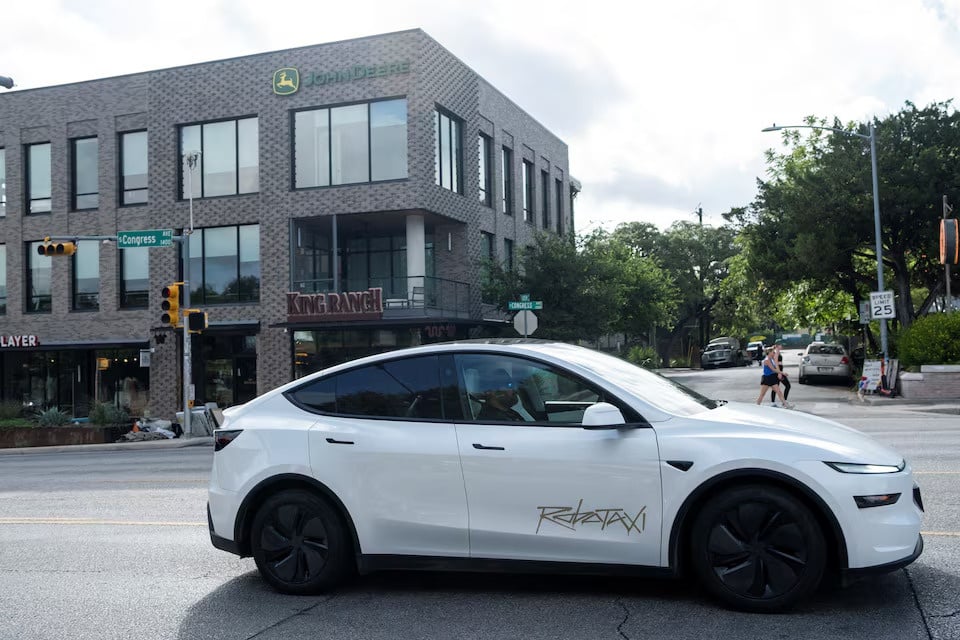
On the morning of June 22nd, residents spotted self-driving Tesla Model Y vehicles moving through the streets of Austin, Texas. Shortly afterward, CEO Elon Musk posted on his social media platform X that Tesla's robotaxi launch would begin that afternoon, with a fixed price of $4.20 per ride.
Tesla plans to still have a person in the front seat, acting as a safety supervisor. However, it remains unclear to what extent this person will have control over the vehicle. Videos of self-driving Teslas have also been posted on social media, but it is unclear whether these vehicles carry passengers.
Meanwhile, lawmakers in Texas have begun enacting regulations for self-driving vehicles in the state. On June 20, Governor Greg Abbott, a Republican, signed into law legislation requiring a state permit to operate self-driving vehicles.
This law will not take effect until September 1st. According to Reuters , the approval shows that state officials from both parties want the self-driving car industry to proceed cautiously. A group of Democratic lawmakers in the state also asked Tesla to postpone testing its robotaxi due to this new law.
Previously, a 2017 Texas law prohibited cities from enacting their own regulations for self-driving cars. This new law marks a loosening of the state's earlier anti-regulation stance.
Operators of self-driving vehicles must obtain approval from the state's Department of Transportation before operating on public roads. The state government has the authority to revoke licenses if the self-driving vehicle is deemed to "pose a danger to the community." The company is also required to provide guidance to police and emergency services on how to handle self-driving vehicles in emergency situations.
Autonomous vehicles capable of self-driving must achieve at least "Level 4". Level 5 is the highest level, allowing the vehicle to drive completely autonomously in all conditions and in all locations.
Reuters notes that the process in Texas remains much easier than in some other states, particularly California. The most populous state in the U.S. requires companies to submit detailed vehicle testing data under state supervision.
Tesla's launch of its robotaxi fulfills CEO Elon Musk's promise after more than a decade. Many industry analysts believe that much of Tesla's stock value depends on its ability to realize robotaxi and humanoid robot services. The company is now the world's most valuable automaker.
Musk said Tesla would be “extremely vigilant” about safety during its deployment in Austin. The company plans to operate vehicles only in areas it deems safest. Other restrictions include avoiding bad weather, complex intersections, and not carrying passengers under 18. Musk affirmed he is prepared to postpone the deployment if necessary.
Tesla fans are creating a wave of excitement after the launch. “Wow. We’re about to get to sit in self-driving Teslas, in just a few days,” wrote Omar Qazi, who has 635,200 followers on X.
Commercializing self-driving cars is a risky and costly process. Cruise, a GM subsidiary, was shut down after a fatal accident. Regulators are closely monitoring Tesla and rivals such as Alphabet's Waymo and Amazon's Zoox.
Tesla is also going against the prevailing standards in this nascent self-driving car industry. Instead of using multiple sensor technologies like its competitors, they are using only cameras to "read" the road. According to Musk, this approach is still safe and much less expensive than integrating LiDAR and radar systems.
Source: https://znews.vn/cot-moc-moi-cua-tesla-va-elon-musk-post1562908.html

![[Photo] Hanoi is ready for the "National Festival"](https://vphoto.vietnam.vn/thumb/1200x675/vietnam/resource/IMAGE/2026/03/12/1773305846167_ndo_br_z7612336508628-14627dc7d18cc27532ffea5d4089713b-4105-jpg.webp)

![[Photo] Trial run of the election process at polling stations in Dong Da ward (Hanoi)](https://vphoto.vietnam.vn/thumb/1200x675/vietnam/resource/IMAGE/2026/03/12/1773306146728_ndo_br_van-hanh-thu-to-bau-cu-4070-755-jpg.webp)













































Comment (0)