

French politics has plunged into chaos following President Emmanuel Macron's call for early parliamentary elections after his centrist Renaissance Party lost to far-right MP Marine Le Pen's National Rally (RN) in the recent European Parliament elections. The results of the French general election could create a political "earthquake" in Europe, according to an analysis by Politico yesterday (June 25).
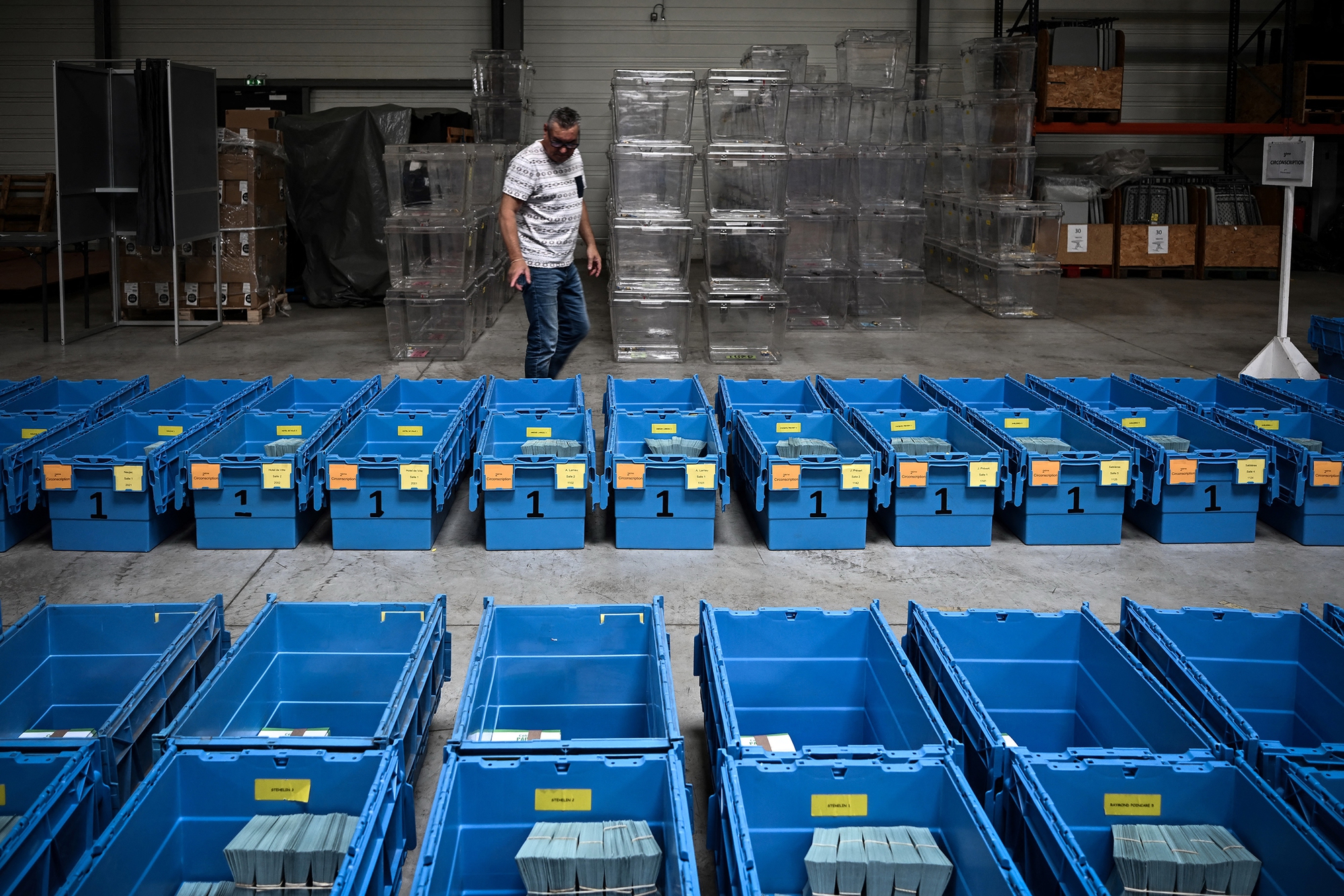
Ballots were prepared to be delivered to polling stations in Bruges, southwestern France, on June 24.
The risk of civil war
France will hold its first round of elections on June 30. AFP, citing polls conducted over the weekend, predicts the RN party could win 35-36% of the vote, followed by the left-wing coalition with 27-29.5%. Meanwhile, Macron's party is expected to come in third with 19.5-22%. A second round will be held on July 7 in constituencies where no candidate secured more than 50% of the vote in the first round.
President Macron unexpectedly warns of civil war, prompting a reaction from the French opposition.
President Macron warned that the RN party and the left-wing New People's Front (NPF) coalition are pushing France to the brink of "civil war," according to AFP yesterday. Speaking on the French podcast "Generation of Self-Action," President Macron attacked both the RN and the France Unbowed party, part of the left-wing coalition, which he said is causing serious internal divisions in the country.
If the centrist party loses the election, President Macron will be the most severely affected, according to Politico's analysis. While he has rejected the possibility of resigning if the parliamentary election results are known, Macron will find it difficult to continue pursuing his ambitious agenda, which includes strengthening the EU, seeking a sustainable balance between Europe and the US, and implementing reforms to build new internal strength for France.
The budget is on the verge of default.
On June 24, AFP reported that Jordan Bardella, leader of the RN party, had announced the party's agenda should it win the upcoming election. Specifically, the RN wants to tighten borders to prevent illegal immigration, make it difficult for children of undocumented immigrants to obtain French citizenship, implement measures to reduce inflation (including lowering fuel taxes), lower the retirement age, and increase wages.
Although no plans have been announced, the left-wing coalition is also expected to pursue a similar agenda to the RN, hoping to win against President Macron's Renaissance Party. The commitments of both campaigns threaten to push the French government budget to the brink of default, raise borrowing costs, and strain relations between France and the EU.
Macron acknowledged that the RN party's economic commitments "may make people happy," but at a cost of up to 100 billion euros per year. Meanwhile, the left's plan is likely to result in losses four times greater than the RN's.
Economist Brigitte Granville of Queen Mary University in London (UK) predicts on the Project Syndicate website that the snap election could see the rise of a government from political parties that refuse to adhere to sound fiscal principles.
Previously, France had faced pressure to improve its budget deficit, which exceeded EU regulations. France's public debt is estimated at 112% of the size of its economy, compared to less than 90% in the eurozone and 63% in Germany. France's budget deficit in 2023 was 5.5% of GDP, while the European Commission recommends that member states keep it below 3% of GDP, according to the Financial Times on June 24.
Are the far-right threatening the European economy?
Is the success of the far right threatening the European economy? That's the question investors are asking, according to the Financial Times on June 24, after the RN party won the European Parliament elections against President Macron's Renaissance party.
France's most important stock index, the CAC 40, fell to its lowest level in two years this week. And French Finance Minister Bruno Le Maire warned that the country is nearing a financial crisis. German Chancellor Olaf Scholz also expressed concern on June 24th about the prospect of the far-right winning elections in France, after the Berlin government weakened in the face of the rise of the far-right in Germany.
Source: https://thanhnien.vn/cuoc-bau-cu-song-con-o-phap-185240625223239045.htm
![[Photo] General Secretary and President To Lam works with the Party Committee of the Ministry of Health on the work of Vietnamese traditional medicine.](https://vphoto.vietnam.vn/thumb/1200x675/vietnam/resource/IMAGE/2026/05/20/1779294323718_a1-bnd-2978-3319-jpg.webp)

![[Image] "Journey of Hope" promotes the organ and tissue donation movement in Vietnam.](https://vphoto.vietnam.vn/thumb/1200x675/vietnam/resource/IMAGE/2026/05/20/1779294400833_1-8910-jpg.webp)
![[Photo] National Assembly Chairman Tran Thanh Man working with the Standing Committee of the National Assembly's Delegation Affairs Committee.](https://vphoto.vietnam.vn/thumb/1200x675/vietnam/resource/IMAGE/2026/05/20/1779294340023_ndo_br_1-1691-jpg.webp)









































































Comment (0)