

From a strategic perspective, considering capital, real estate, and access to land resources, billionaire Tran Dinh Long's move may not be about the tons of steel sold from the project. What Hoa Phat is aiming for could be a much larger shift: from its position as the "king of steel" to the role of a national-scale urban and infrastructure developer.
It's not just about steel; it's about land and urban development.
For many years, Hoa Phat was known as Vietnam's largest steel producer. However, looking at the group's development structure in recent years, it's clear that the leadership has quietly expanded into areas with the potential to generate longer-term added value, such as industrial parks, real estate, and infrastructure.
Hoa Phat's participation in the joint venture with Dai Quang Minh and THACO to propose investment in the Red River Landscape Boulevard Project is not a spur-of-the-moment decision. This project, spanning approximately 11,400 hectares with a total investment of 714,000 to over 737,000 billion VND, stretches from Hong Ha Bridge to Me So Bridge, encompassing a riverside boulevard, landscaped parks, urban redevelopment, and a series of resettlement areas. The project is expected to be implemented from 2026 to 2038.
If you only look at the transportation infrastructure, this investment seems enormous. But in the world of real estate investors, the most attractive thing is not the road itself, but what lies on either side of that road.
According to initial proposals, the consortium of investors requested to be reimbursed with reciprocal land funds totaling over 5,000 hectares in various locations across Hanoi. This is one of the largest land areas ever proposed in a Build-Transfer (BT) project in Vietnam.
For any investor, especially those with strong financial resources, land is the asset that generates the greatest value. A highway project might take decades to recoup its investment if it relies solely on usage fees or infrastructure value. However, land that benefits from infrastructure development can appreciate many times over.
That's the logic that has built some of the world's biggest real estate empires: build roads to open up land, and develop infrastructure to unlock urban value.
What is Mr. Tran Dinh Long seeing beyond the Red River?
If we consider the project within the context of Hanoi's development, it's clear that the Red River is the "last remaining waterfront" whose potential has yet to be fully exploited.
For decades, Hanoi's development has primarily been westward, with growth centers such as My Dinh, Cau Giay, Nam Tu Liem, and Hoa Lac. Meanwhile, the area along the Red River, despite its central location, has been hampered by flood control plans, construction restrictions, and a lack of integrated infrastructure.
As the city decides to restructure its riverside urban space, the economic value of the area could change completely. For Hoa Phat, this is a rare opportunity to participate in the formation of a "new Hanoi".
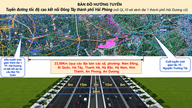
Investors often follow a principle: money isn't found in already developed areas, but in areas poised for future development. If the project succeeds, thousands of hectares of riverside land today could become modern urban areas, commercial centers, service zones, and tourist spaces in the future. The value generated won't be measured in a few percent of construction profits, but in decades of land exploitation.
That is why many experts believe that Hoa Phat is not entering this project as a steel manufacturer, but as a long-term investor in Hanoi's development.
It's also worth remembering that Hoa Phat already owns many large-scale industrial parks in Hung Yen, Bac Ninh, and other locations. Participating in a large-scale urban development project will help the group complete its ecosystem, from industry and infrastructure to real estate.
If successful, this could be a turning point that helps Hoa Phat break free from its image as a cyclical company dependent on global steel prices.
A huge opportunity, but also the biggest gamble in Hoa Phat's history.
However, the larger the project, the greater the risks. The first challenge lies in the project's scale. With a total investment of tens of billions of USD, this is one of the largest infrastructure and urban development projects ever proposed in Vietnam. The implementation period, spanning over a decade, means investors will face numerous fluctuations in the economy, interest rates, real estate market, and regulatory policies.
The second challenge is the land clearance issue. According to initial research documents, the project affects hundreds of thousands of residents living in the riverside area. The investment consortium itself had to propose the construction of numerous resettlement areas to accommodate the displaced residents.
This is not just a technical issue, but also a highly significant social one. In fact, there have recently been conflicting opinions from a segment of the project area regarding the preservation of villages, livelihoods, and existing communities. While information on social media needs to be approached cautiously and verified, it shows that achieving social consensus will be one of the biggest tests for the project.
The third challenge lies within the real estate market itself. What is attractive today could become a burden in the future if the real estate cycle reverses.
History has shown that many industrial businesses, when venturing into the real estate sector, often face significant shocks. The difference between steel production and urban development lies not only in the industry but also in the mindset regarding cash flow management.
A steel mill can be measured by its output and profit margin. But a metropolis is defined by its market absorption rate, planning, legal framework, and the purchasing power of its people.
Finally, there's the issue of capital. Even for Hoa Phat – one of the largest private sector companies in Vietnam in terms of asset size – participating in a project spanning over 10 years requires enormous financial resources. This means the group must balance its ambition to expand into infrastructure with the need to invest in existing steel projects, industrial parks, and manufacturing facilities.
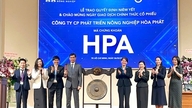
But this is where another perspective emerges. It's possible that Hoa Phat won't participate to lead the project. That role is more likely to go to Dai Quang Minh – a company with experience in large-scale urban development, while THACO possesses strong organizational, construction, and financial capabilities. Hoa Phat could contribute with its construction materials capabilities, capital, and experience in implementing large-scale industrial projects.
Looking at it from a broader perspective, this is a game of vision. As the steel market becomes increasingly competitive, profit margins tend to narrow, and industry cycles become more unpredictable, finding a new engine of growth is inevitable.
For Tran Dinh Long, the Red River Landscape Boulevard may not simply be an infrastructure project. It could be Hoa Phat's ticket to a new playing field, where value is not measured by the number of tons of steel sold each year, but by the ability to control future development spaces.
If successful, this deal would mark a transformation from an industrial conglomerate to an infrastructure and urban development powerhouse. But if it fails, it could also become the biggest gamble in the history of the Hoa Phat steel empire.
Source: https://daibieunhandan.vn/cuoc-doi-vai-cua-ong-tran-dinh-long-10419269.html














































![[Video] Sunset at Lap An Lagoon – Where the sun sets over the fishing nets](https://vphoto.vietnam.vn/thumb/1200x675/vietnam/resource/IMAGE/2026/05/31/1780192137701_beach-landscape-sea-water-nature-grass-745871-pxhere-com.jpeg)



























Comment (0)