

The patient was admitted with severe shortness of breath, progressively worsening acute heart failure, and acute pulmonary edema due to severe mitral valve regurgitation following an acute myocardial infarction. In addition to heart disease, the patient also had a stroke, making treatment significantly more challenging.
Upon admission, the patient underwent a comprehensive assessment to determine the severity of the condition. Doppler echocardiography revealed severe mitral valve regurgitation due to papillary muscle rupture, causing blood to flow backward, overloading the heart, leading to pulmonary congestion, pleural effusion, and acute pulmonary edema. Furthermore, laboratory results showed signs of severe heart failure with elevated test results, a brain MRI revealed areas of cerebral infarction, and coronary angiography showed severe coronary artery stenosis causing myocardial ischemia. These factors placed the patient at high risk for surgery, requiring an optimal treatment strategy to ensure safety.
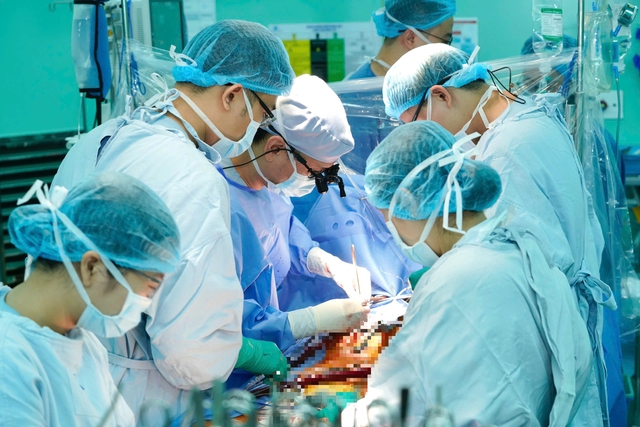
Dr. Cao Dang Khang, Head of the Cardiovascular Surgery Department at the University Medical Center Hospital, performed the surgery on the elderly man.
Photo: BVCC
Following consultations with multiple specialists at the hospital, the doctors decided to apply intensive preoperative medical treatment to control heart failure, optimize kidney and respiratory function, and improve the patient's overall health. This medical treatment helps reduce the risk of surgical complications and improve post-operative recovery.
Once the patient's condition stabilized, the cardiovascular surgical team proceeded with a biological mitral valve replacement and coronary artery bypass grafting. The choice of a biological valve minimized the risks associated with anticoagulant medication and was suitable for elderly patients. Simultaneously, the coronary artery bypass grafting improved blood flow to the myocardium, reducing the risk of future myocardial infarction recurrence.
Dr. Cao Dang Khang, Head of the Cardiovascular Surgery Department at the University Medical Center Hospital, said: "Elderly patients often have multiple underlying conditions, so it is crucial to develop a suitable treatment strategy, optimize the patient's condition before surgery, and choose the safest surgical strategy. Combining pre-operative medical treatment, optimizing surgery, and anesthesia and resuscitation has helped patients undergo successful surgeries."
Following the surgery, with careful preparation of cardiovascular anesthesia and resuscitation, the patient recovered quickly. Just two days after the operation, the patient was able to sit up, walk gently, and resume normal activities. The shortness of breath completely disappeared, and heart function improved significantly. Importantly, kidney and respiratory functions were restored, with no signs of acute renal failure, respiratory failure, or pneumonia – common complications in elderly patients after heart surgery.
According to Dr. Dang Khang, cardiovascular surgery is no longer impossible for elderly patients as it once was. With advances in cardiovascular surgery and anesthesia, combined with modern medical treatments, those with complex conditions requiring heart surgery still have a chance of recovery and significantly improved quality of life.
Source: https://thanhnien.vn/cuu-cu-ong-suy-tim-nhoi-mau-nao-185250329163003533.htm

![[Photo] Prime Minister Pham Minh Chinh presides over a meeting on private sector economic development.](/_next/image?url=https%3A%2F%2Fvphoto.vietnam.vn%2Fthumb%2F1200x675%2Fvietnam%2Fresource%2FIMAGE%2F2025%2F12%2F20%2F1766237501876_thiet-ke-chua-co-ten-40-png.webp&w=3840&q=75)

























































































Comment (0)