


For centuries, the Buon Don Elephant Festival has been one of the unique festivals, deeply rooted in the long-standing cultural traditions of the M'nong ethnic people living in Buon Don district, Dak Lak province. This year's Buon Don Elephant Festival will take place on March 11th and 12th, as part of the 9th Buon Ma Thuot Coffee Festival 2025, with many attractive and unique activities, promising to attract a large number of locals and tourists.
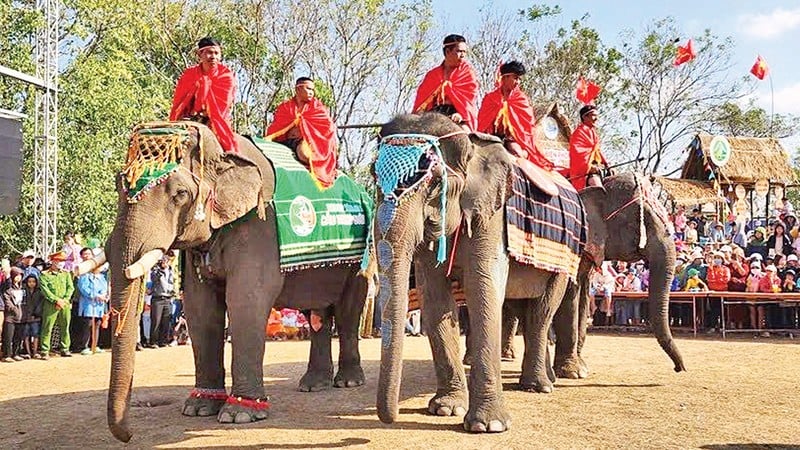 These elephants participate in the Buon Don Elephant Festival.
According to historical documents at the Dak Lak Museum, Y Thu K'Nul (also known as Khu Sa Nup, born in 1827, died in 1938) was one of the first M'nong people to establish the profession of hunting and taming wild elephants into domesticated elephants. Throughout his life, he captured and tamed nearly 500 wild elephants, earning him the title of "King of Elephant Hunters." Originating from Y Thu K'Nul's elephant hunting and taming tradition, Buon Don gradually came to be considered the elephant capital. The Buon Don Elephant Race was born from this tradition and became a famous festival in the Central Highlands. The elephant race not only demonstrates a spirit of chivalry but also conveys a message about the strong lifestyle and long-standing traditions of the Central Highlands villages. However, due to activities affecting the health of the domesticated elephants, the Buon Don Elephant Race has been discontinued in recent years. The Buon Don Elephant Festival takes place every two years in early March, along with many other unique festivals of the ethnic minority groups in the Central Highlands.
This year's Buon Don Elephant Festival, held at the Krong Na Commune Festival Center in Buon Don District, Dak Lak Province, consists of two parts: the ceremonial part and the festive part. The ceremonial part includes the Water Blessing Ceremony at Bay Rong Wharf, Buon Don, Krong Na Commune, Buon Don District; the Health Blessing Ceremony for the elephants before the festival at Bay Rong Wharf, Buon Don, Krong Na Commune, Buon Don District; the opening and closing ceremonies of the Elephant Festival; and the ceremony of offering prayers and bathing the elephants after the elephants have finished their activities. The festive part includes an elephant grooming contest; a contest for beautiful photos of elephants and elephants greeting and interacting with tourists; and an elephant football goal-scoring competition. The elephant buffet, combined with interactive programs involving guests, audience members, and tourists buying food and feeding the elephants, also takes place during this time. The Traditional Culture Festival of the Ethnic Groups of Buon Don District is also held with many vibrant cultural and artistic activities such as: gong performances, brocade weaving, basket weaving, new rice harvest ceremonies, traditional ball throwing competitions, archery, etc., creating a joyful, exciting, and enthusiastic festival atmosphere.
Chairman of the People's Committee of Buon Don District, Pham Trung Nghia, said: Elephants are rare animals of the ethnic groups in Buon Don District, becoming a cultural symbol of the area. Elephants are closely associated with the development of the ethnic groups, deeply ingrained in social relationships, impacting culture, art, beliefs, customs, festivals, and many other forms of community life of the ethnic groups in the Central Highlands. Speaking of Buon Don, one cannot fail to mention the Elephant Festival, a unique festival found only in Dak Lak. Since ancient times, elephants have always been companions, a means of transporting ammunition and food, and pulling timber from the forest, helping the soldiers and people of the Central Highlands defeat imperialist invaders and rebuild their villages. Today, elephants have become a type of tourism that attracts tourists to Buon Don. The Elephant Festival and the Traditional Culture Festival of the Ethnic Groups of Buon Don District aim to introduce and promote the potential for cultural and eco-tourism development of the district; To honor the cultural values of the ethnic groups in the Central Highlands, particularly their traditions of hunting and taming wild elephants, and their gong culture, this creates an attractive environment for socio-economic investment in general and tourism in particular, gradually transforming tourism into a high-growth and sustainable economic sector.
Source: https://baodaknong.vn/dac-sac-hoi-voi-buon-don-243294.html






![[Infographic] Strategic Resolutions Leading Vietnam into a New Era](https://vphoto.vietnam.vn/thumb/402x226/vietnam/resource/IMAGE/2026/03/01/1772371472793_ky-nguyen-vuon-minh-1920x800-copy.jpeg)
![[Infographic] Official list of candidates for the 16th National Assembly in Cao Bang province](https://vphoto.vietnam.vn/thumb/402x226/vietnam/resource/IMAGE/2026/03/01/1772371167639_anh-bia-1-copy-qh.jpeg)






































Comment (0)