

Many universities plan to open 4-5 new majors this year, with some even launching 20 new programs in just two years.
In 2024, a number of universities, both public and private, are expected to open five or more new majors, such as the University of Banking Ho Chi Minh City (5 majors), National Economics University (6 majors), Ho Chi Minh City University of Technology (7 majors), Phenikaa University (8 majors and training programs)...
The new programs offered by the universities cover a wide range of fields, from Information Technology to Business and Management, and Health.
The National Economics University, a renowned university specializing in economics, has opened six new majors, with five of them in technology and engineering, such as Software Engineering, Information Systems, Artificial Intelligence, and Information Security. Meanwhile, Phenikaa University, a private university strong in engineering, has added several health-related majors such as Medical Imaging Technology and Traditional Medicine.
In fact, since 2020, many universities have massively opened new majors. For example, the Water Resources University opened 14 majors in the three years from 2021-2023. The Mining and Geology University opened 20 majors in the two years from 2021-2022, with 12 majors in 2022 alone.
While the continuous opening of new majors and programs by universities is considered inevitable, it also raises many concerns about quality.
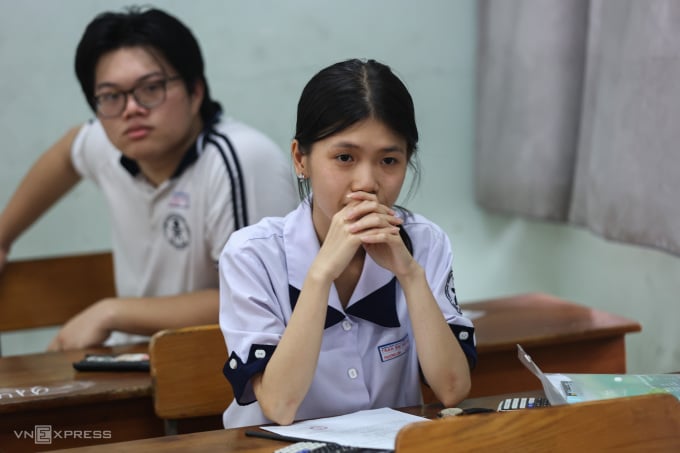
Students taking the 2023 high school graduation exam in Ho Chi Minh City. Photo: Quynh Tran
The 2018 Higher Education Law allows universities to independently open new majors. Previously, most universities wishing to open a new major had to develop a program, prepare documentation for approval by the scientific council, have the Department of Education and Training check the practical conditions, then have a professional council evaluate it before submitting it to the Ministry of Education and Training for review and approval.
This change has facilitated the opening of more and more new majors at universities. Statistics from the Ministry show that the number of new majors opened by universities from 2019 to August 2023 is nearly 1,200.
An expert on higher education in Hanoi believes that the trend of expanding academic programs to become multidisciplinary universities is inevitable and part of the development strategy of many institutions. This helps create competition, encourages universities to improve quality to attract students, and gives students more choices.
Furthermore, even though universities have the autonomy to open new programs, the law clearly stipulates the conditions and standards. This must be based on the market's demand for human resources; the university's internal capabilities (teacher system, facilities, training programs); and societal acceptance...
To meet this demand, universities often open new majors based on existing ones. For example, at the University of Banking Ho Chi Minh City, the new Financial Technology major this year was developed from the Finance - Banking major, and the Data Science major was developed from Management Information and Business Analytics.
Associate Professor Dr. Nguyen Duc Trung, the Rector, stated that the newly opened majors are based on the core group of business and management disciplines, integrating technology and digital transformation. This major was opened in 2019, and after accumulating resources including faculty, curricula, laboratories, and business connections, the university separated it into an independent major.
"With 72 new PhD and Master's degree holders recruited in the last two years, plus the existing staff, the school is confident in its ability to open five new majors simultaneously," Mr. Trung said.
However, not all universities are cautious when opening new programs. In August 2023, the Ministry of Education and Training's inspection revealed that some universities, despite not meeting the requirements for autonomy, still opened new training programs. Many universities opened programs without ensuring they met all the necessary conditions.
Pham Thai Son, Director of the Admissions and Communications Center at the University of Industry and Trade, observes that many universities are chasing trends, competing to open popular majors to easily attract students, because the main source of revenue for universities currently comes from tuition fees.
"To meet the Ministry's requirements when opening new majors, universities are competing to attract lecturers with PhDs in the relevant fields. But whether the university can maintain the conditions and training capacity after opening the major is another matter," Mr. Son said.
The Ministry's inspectors have previously penalized several schools for failing to maintain the necessary conditions after a period of opening a new program. Some schools had to close down the program and transfer their enrolled students to other schools.
According to experts, opening new academic programs without thorough preparation can lead to several negative consequences. For example, the quality of training may not be guaranteed, a competitive brand may not be built, resulting in insufficient student enrollment and wasted time, effort, and money for both the school and the students.
Therefore, the Ministry of Education and Training needs to exercise stricter quality control over the autonomy granted to universities in opening new academic programs.
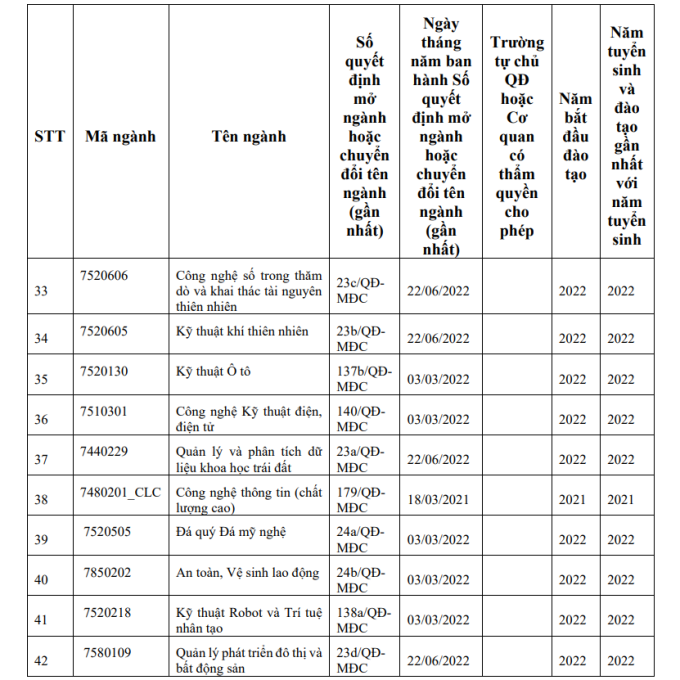
The start date of a new program is indicated in a school's admissions plan.
From a state management perspective, Deputy Minister of Education and Training Hoang Minh Son noted that when opening new majors, universities must determine whether those majors are in line with current and future societal trends and needs.
Another important point is that the school must have sufficient capacity to ensure quality. Schools must publicly and transparently disclose all admissions data, from faculty, facilities, programs, and admission methods, so that prospective students can make informed choices.
"Currently, the Ministry manages the admissions and opening of new programs at universities through this data, while also strengthening inspection and supervision," the Deputy Minister said.
Speaking about the trend of expanding academic programs, Mr. Nguyen Duc Trung noted that all professions are integrating technological elements, the boundaries between specialized fields will gradually blur, and the interdisciplinary and multidisciplinary trend will become increasingly evident. That is why technical and technology schools will gradually train students in economics and social sciences, and vice versa.
"There's no need to close down traditional fields of study, because those job positions haven't changed, but they require additional knowledge and skills. Schools must innovate their training to keep up with the demands of the labor market," Mr. Trung commented.
From the perspective of students, Mr. Pham Thai Son advises candidates and parents to carefully research information about new academic programs and the strengths of training offered by schools, and not to choose a profession simply because of trends.
Duong Tam - Le Nguyen
Source link


![[Photo] General Secretary To Lam receives President of the European Council Antonio Costa](/_next/image?url=https%3A%2F%2Fvphoto.vietnam.vn%2Fthumb%2F1200x675%2Fvietnam%2Fresource%2FIMAGE%2F2026%2F01%2F29%2F1769697816651_a1-bnd-5216-9741-jpg.webp&w=3840&q=75)


![OCOP during Tet season: [Part 3] Ultra-thin rice paper takes off.](/_next/image?url=https%3A%2F%2Fvphoto.vietnam.vn%2Fthumb%2F402x226%2Fvietnam%2Fresource%2FIMAGE%2F2026%2F01%2F28%2F1769562783429_004-194121_651-081010.jpeg&w=3840&q=75)


![OCOP during Tet season: [Part 2] Hoa Thanh incense village glows red.](/_next/image?url=https%3A%2F%2Fvphoto.vietnam.vn%2Fthumb%2F402x226%2Fvietnam%2Fresource%2FIMAGE%2F2026%2F01%2F27%2F1769480573807_505139049_683408031333867_2820052735775418136_n-180643_808-092229.jpeg&w=3840&q=75)





Comment (0)