


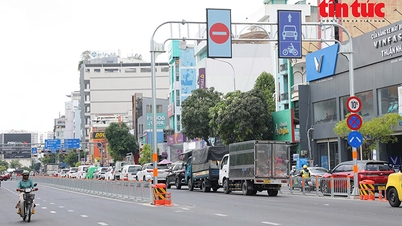
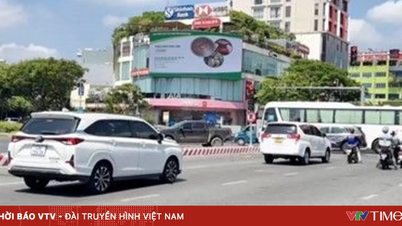
At the beginning of the traffic reversal section on Cong Hoa Street near Ut Tich Street, there are two LED signs indicating a one-way lane during morning rush hour to prevent vehicles from going against the flow of traffic - Photo: TRI DUC
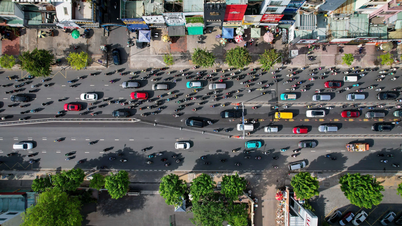
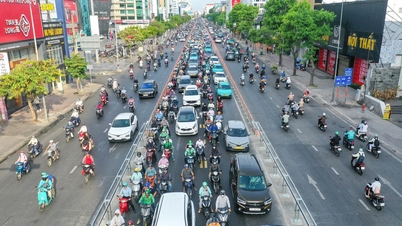
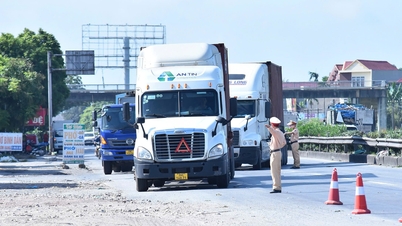
Around 7 AM every day, at the intersections of Tan Ky Tan Quy, Ap Bac, 18E..., traffic police officers are stationed to regulate traffic according to the new traffic organization plan on Cong Hoa Street.
Other major roads should be used.
Two electronic signs located near the C12 road display a notice allowing cars and motorbikes to go straight into the reverse lane heading towards Ut Tich road.
Conversely, two electronic signs in the Ut Tich area display a one-way warning to prevent vehicles from entering this lane in the opposite direction. Every day, people are allowed to use four lanes to enter and exit the city center in the morning and afternoon, while the opposite direction has only two lanes.
After the initial implementation, the traffic organization plan was gradually adjusted to be more flexible and suitable to the reality. Some sections of the median strip were opened to allow pedestrians to cross the road more easily, while also creating a passage for vehicles in the reversing lane to exit when necessary.
Ms. Thuy Mai (a resident of Xuan Thoi Son commune), who frequently travels along Cong Hoa road to work in the center of Ho Chi Minh City, said that after a few days of commuting, she noticed an improvement in traffic conditions on some sections.
"The two outermost lanes on the right are now less congested. Many sections of the median have been opened to allow vehicles from the middle lane to move into the right lane. However, traffic is still congested and moving slowly on the slope of the Hoang Hoa Tham overpass when descending towards Ut Tich Street," Ms. Mai observed.
Meanwhile, Ms. Thy Nga (who lives on Hoang Hoa Tham Street, Tan Binh Ward) said that traffic has clearly improved recently compared to before.
"For the past two days or so, with the reversing lane operating more smoothly, traffic jams have eased considerably. Morning rush hour traffic has also decreased, although there is still congestion near the end of the reversing lane, close to Ut Tich Street," said Ms. Nga.
Ms. Nga suggested that other major roads in Ho Chi Minh City should also implement reverse lanes like Cong Hoa Street to address the current traffic congestion problem in the short term.
Many residents who commute daily in this area have also suggested that authorities continue to adjust the plan by adding more gaps in the median strip to allow vehicles to change lanes more easily when needed, thus preventing traffic from being concentrated in one direction.
Continue to refine the plan.
According to a representative from the Center for Traffic Management and Technical Infrastructure (Ho Chi Minh City Department of Construction), the reverse lane model on Cong Hoa Street was developed based on international experience in organizing traffic flexibly according to traffic volume.
However, the infrastructure conditions in Ho Chi Minh City differ from many countries that use "flexible" median barriers and specialized vehicles that can move them instantly. "We are adopting ideas from abroad, but we must design them to suit the actual conditions of the city," a representative from the center stated.
Some suggestions from residents have been incorporated by the unit, such as pedestrian crossings. Authorities will also conduct a comprehensive assessment soon to further refine the plan in the coming time.
Further discussing the reversing lane, Dr. Nguyen Bao Thanh, a planning and construction expert from Van Lang University, explained that, in essence, this is a way to "borrow" lanes over time, instead of investing in road expansion, which is very costly, especially on routes with high population density like Cong Hoa Street.
He assessed that the flexible lane reversal model currently being applied on Cong Hoa Street can help optimize the existing road surface, reduce the need for costly road widening, and improve traffic efficiency.
"The current trend is shifting from 'hard' control to 'dynamic' control, meaning it no longer relies entirely on the initial lane design but relies more heavily on real-time traffic data."
"Traffic management, therefore, should not only be based on signs or fixed regulations, but also take into account factors such as time, vehicle density, and the potential for changes throughout the day," he said.
Some experts argue that implementing reverse lanes is merely a temporary solution to utilize existing road space and is unlikely to completely solve the traffic congestion problem if traffic volume continues to increase.
According to experts, the biggest risk is that traffic congestion will not disappear but will simply shift from one location to another. Specifically, when the heavy traffic on Cong Hoa Street is "quickly relieved," it could inadvertently create additional pressure on surrounding or nearby roads.
Therefore, in the long term, Ho Chi Minh City still needs fundamental solutions such as developing public transportation, building elevated roads, and synchronizing infrastructure connecting around Tan Son Nhat airport.
Ensure clear identification
Architect Ngo Viet Nam Son noted that reverse lanes are a common model in many countries around the world , but it is necessary to ensure connectivity and clear identification for road users.
He assessed that the city's use of electronic traffic signs combined with median barriers is necessary to reduce the number of vehicles entering the wrong lanes. However, he believes further monitoring is needed to evaluate the actual effectiveness of this approach under the specific traffic conditions of Ho Chi Minh City.
Countries are using vehicles and robots to move median strips.

A remotely controlled "robot" traffic barrier has been put into service in Shenzhen city - Photo: CCTV
China: This country has implemented the flexible lane model most systematically and extensively. In September 2013, Beijing put into operation the first reversing lane on a 3km section of Chaoyang Road.
According to the Global Times, during peak hours from 5 PM to 8 PM, the third lane is temporarily used for vehicles leaving the city – the section from Jingguang Bridge to Ciyunsi Bridge – increasing the total number of exit lanes to three, while the other direction remains at one. This solution helps reduce pressure on Chang'an Avenue – one of the capital's main traffic arteries.
The route features traffic lights, electronic signs updating lane status, and traffic police stationed at key intersections.
Wang Hongjun, a representative of the Chaoyang City Traffic Police Department, said that drivers who violate regulations related to reversing lanes will be severely punished.
According to China Daily, after only a short period of operation, rush-hour traffic congestion on the Chaoyang Line has significantly improved.
By October 2016, Shenzhen became the first city in China to implement "zipper lanes"—a type of reversing lane using specialized vehicles to move the median barrier. These vehicles, approximately 15 meters long, have a mechanical arm that travels along the route at a speed of 8 km/h, lifting and shifting sections of the median barrier to widen the lane for higher traffic volume.
According to the SCMP, by 2017, Shenzhen further upgraded the system by replacing tow trucks with "robot" median barriers that could move autonomously on command from a control center.
The success in Beijing and Shenzhen has laid the groundwork for the model to be replicated. By 2025, dozens of cities in the world's most populous nation will be operating at least one flexible lane, with Beijing leading the way with more than 20 lanes.
South Korea: Since 1981, major cities like Seoul have implemented flexible lane systems as a solution to reduce congestion caused by "tidal flow"—the asymmetrical flow of traffic in both directions during peak hours. The results show that the model is remarkably effective, especially during morning rush hour.
Currently, the system in South Korea is still under research and upgrade, aiming towards a mobile barrier transfer system (BTS) model similar to Shenzhen's.
Singapore: Instead of deploying physical lane reversals, the island nation optimizes its existing infrastructure capacity through the GLIDE intelligent traffic signal coordination system.
According to the Singapore Land Transport Authority, sensor loops are installed beneath the road surface to detect vehicles and analyze traffic conditions in real time. Based on the data collected, the system automatically adjusts green light times, prioritizing the direction with higher traffic volume.
Source: https://tuoitre.vn/dai-phan-cach-tu-cung-sang-dong-2026052008002326.htm


![[Photo] National Assembly Chairman Tran Thanh Man working with the Standing Committee of the Law and Justice Committee](https://vphoto.vietnam.vn/thumb/1200x675/vietnam/resource/IMAGE/2026/05/21/1779378929214_ndo_br_1-4610-jpg.webp)
![[Photo] General Secretary and President To Lam presides over a working session with the Central Policy and Strategy Committee on the development of the materials industry.](https://vphoto.vietnam.vn/thumb/1200x675/vietnam/resource/IMAGE/2026/05/21/1779359935432_a3-bnd-3129-1412-jpg.webp)









































































Comment (0)