

The conflict between Israel and Hamas unexpectedly flared up after a period of calm that seemed poised to subside following numerous efforts by all parties involved. However, 100 days have passed and there is still no sign of a glimmer of light at the end of the tunnel.
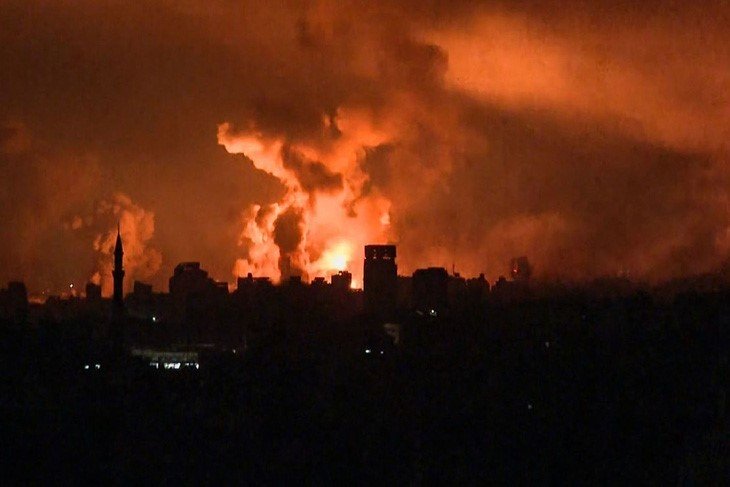 |
| The Hamas-Israel conflict erupted after Hamas forces launched a surprise attack on Israeli territory on October 7, 2023. (Source: Al Jazeera) |
Since the Hamas Islamic movement in the Gaza Strip launched a surprise attack deep into Israeli territory on October 7, 2023, sparking a fierce conflict in Gaza, more than 100 days have passed. Over the past three months, fighting has claimed the lives of more than 25,000 people on both sides, mostly civilians, and plunged the entire Middle East into a complex and chaotic crisis. Even more serious is the increasingly dire humanitarian catastrophe.
Heavy losses for all parties involved.
Conflict has returned to the Gaza Strip after years of relative calm, beginning with an unprecedented attack by the Hamas Islamist movement that killed at least 1,200 people, the majority civilians, and took around 240 hostage.
The "fire" in Gaza subsequently escalated into conflict when Israel launched a retaliatory campaign against Hamas forces in the Gaza Strip, causing heavy casualties on both sides and a worsening humanitarian crisis. Following the declaration of martial law, Tel Aviv launched Operation "Iron Swords," mobilizing large forces, including reserve troops, and preparing all resources to bring weapons and equipment to the border.
The situation in the Middle East has become extremely tense following Israel's large-scale offensives by sea, air, and land in the Gaza Strip. According to the United Nations Office for the Coordination of Humanitarian Affairs (OCHA) on January 14, 2024, a total of 359,000 homes have been damaged or destroyed to date, meaning that six out of every ten homes in the Gaza Strip have been damaged or destroyed.
After seven weeks of continuous fighting, Israel and Hamas finally agreed to a temporary ceasefire, beginning on November 24th and extended twice, expiring on the morning of December 1st, 2023. This ceasefire was positively received and seemed poised to be a major turning point in the conflict, facilitating humanitarian aid and the release of hostages and prisoners from both Israel and Palestine. During the seven-day ceasefire, 110 hostages, including foreign nationals, were released to Israel by Hamas forces. During this time, aid and fuel from the international community were delivered to Gaza, albeit in small quantities.
Following a brief temporary ceasefire, the fighting resumed. Hamas repeatedly expressed its desire for an extension of the ceasefire, but Israel refused, resuming military attacks against Hamas in both northern and southern Gaza Strips.
The situation reached a breaking point after Hamas's deputy leader, Saleh Al-Arouri, was killed in an Israeli attack in Lebanon on the evening of January 2, 2024. The very next day, January 3, 2024, Hamas announced it was halting negotiations with Israel. Meanwhile, the Israeli military continued its airstrikes, shelling, and missile attacks on the Gaza Strip. In his latest statement, Israeli Prime Minister Benjamin Netanyahu said that no one could prevent Israel from achieving victory in the war against Hamas in Gaza.
Spreading increasingly
More worryingly, the Hamas-Israel conflict, after more than three months, not only shows no signs of de-escalation but also risks spreading as Hamas is receiving support from allies such as the Houthi in Yemen and Hezbollah in Lebanon.
These forces regularly carry out attacks on Israeli and American forces stationed in the region, causing violence to continue to escalate in Lebanon, Syria, and Iraq. Recently, conflict has escalated in the southern border region of Lebanon, bordering Israel, after Hezbollah fired missiles towards Israel in support of a surprise Hamas attack in Israel.
The Israeli army responded with artillery fire targeting several areas in southeastern Lebanon. Analysts believe the current concern lies with Hezbollah forces in Lebanon, given the frequent cross-border attacks with Israeli troops. In particular, the death of Hamas deputy leader Saleh Al-Arouri in an Israeli airstrike on Lebanon on the evening of January 2, 2024, has escalated the conflict between the Israeli army and Hezbollah in Lebanon. Hezbollah views this incident as a sign of "a dangerous development" in the current conflict between Israel and Hamas.
More concerning are the Houthi forces in Yemen and the Palestinian Islamic Jihad (PIJ) in Gaza and other areas. The Houthi forces have officially revealed themselves with drone and long-range missile attacks targeting the southern Israeli city of Eilat. The US has coordinated with partners in the Middle East to prevent the conflict in the Gaza Strip from escalating. However, no viable political solution has yet emerged to end the fighting and find a comprehensive peace resolution for the Middle East.
 |
| The seizure of the cargo ship Galaxy Leader has heated up tensions in the Red Sea for nearly two months. (Source: AP) |
Furthermore, another dangerous consequence of the war in the Gaza Strip is the serious increase in instability in the Red Sea region. About a month and a half after the outbreak of fighting in Gaza, starting in late November 2023, the Houthi Islamist armed group – which controls large swathes of territory in Yemen – repeatedly launched long-range missile attacks towards Israeli territory. At the same time, this force frequently launched attacks using missiles, drones, and directly targeted commercial vessels navigating the Red Sea that the group considered to be linked to Israel, demonstrating support for the Palestinians and the Hamas movement.
By mid-January 2024, it was estimated that the Houthi had carried out over 20 attacks in the Red Sea, forcing major shipping companies such as MSC, Maersk, CMA CGM, and Hapag-Lloyd to divert cargo around the southern tip of Africa, avoiding the Gulf of Aden and the Suez Canal.
The Houthi forces openly declared that these attacks were aimed at pressuring Israel to stop its campaign of killing Palestinians in the Gaza Strip. The tension peaked on January 8, 2024, when the armed group launched a large-scale attack with 18 drones and 3 anti-ship missiles against a US ship in the Red Sea. Three days later, on the night of January 11, 2024, the US military and its allies in the naval coalition "Prosperous Guardian"—established in late 2023 in the Red Sea to counter the threat from the Houthi forces—conducted airstrikes against numerous Houthi targets in Yemen, officially opening a new front of military confrontation in the Middle East.
Faced with Houthi attacks, the US, UK, and several other countries could not stand idly by. On the night of January 11, 2024, the US-UK coalition launched a surprise attack on Houthi rebels in Yemen to "show solidarity with the Palestinian people in Gaza." US President Joe Biden affirmed that this military operation by the two countries was "successful" and that they were ready to take further measures to "protect the freedom of global trade." According to analysts, such attacks by the US and its allies will only "add fuel to the fire," increasing the risk of conflict in the region and further complicating the situation in the Middle East.
Furthermore, some analysts argue that the conflict is creating opportunities for terrorism to flourish in the Middle East, led by the self-proclaimed Islamic State (IS) – the perpetrator of the bloody terrorist attack in Iran on January 3, 2024, which resulted in over 300 casualties…
Humanitarian crisis
While the situation in Gaza remains tense and unresolved, one consequence is already evident: a severe humanitarian disaster for the people as the blockade and violence hinder international aid efforts. Shortages of fuel, clean water, and sanitation, along with attacks on healthcare facilities and mass displacement, are creating a tragedy.
According to the latest statistics from the Hamas-run Health Department in Gaza on January 14, the total casualties in the Israeli military's all-out offensive in the territory since October 7, 2023, have reached nearly 25,000 dead and at least 60,000 injured.
More seriously, among the victims of the conflict, the majority of casualties are civilians, with children and women accounting for up to 70%. According to statistics from the Gaza Health Agency, to date, more than 8,600 children and over 6,300 women have been killed. This means that for every 100 people in Gaza, 3 have been injured. In addition, approximately 7,000 people are missing and are likely to have died under the rubble caused by the airstrikes. This is the highest number of casualties from the fighting in the Gaza Strip in the last three-quarters of a century.
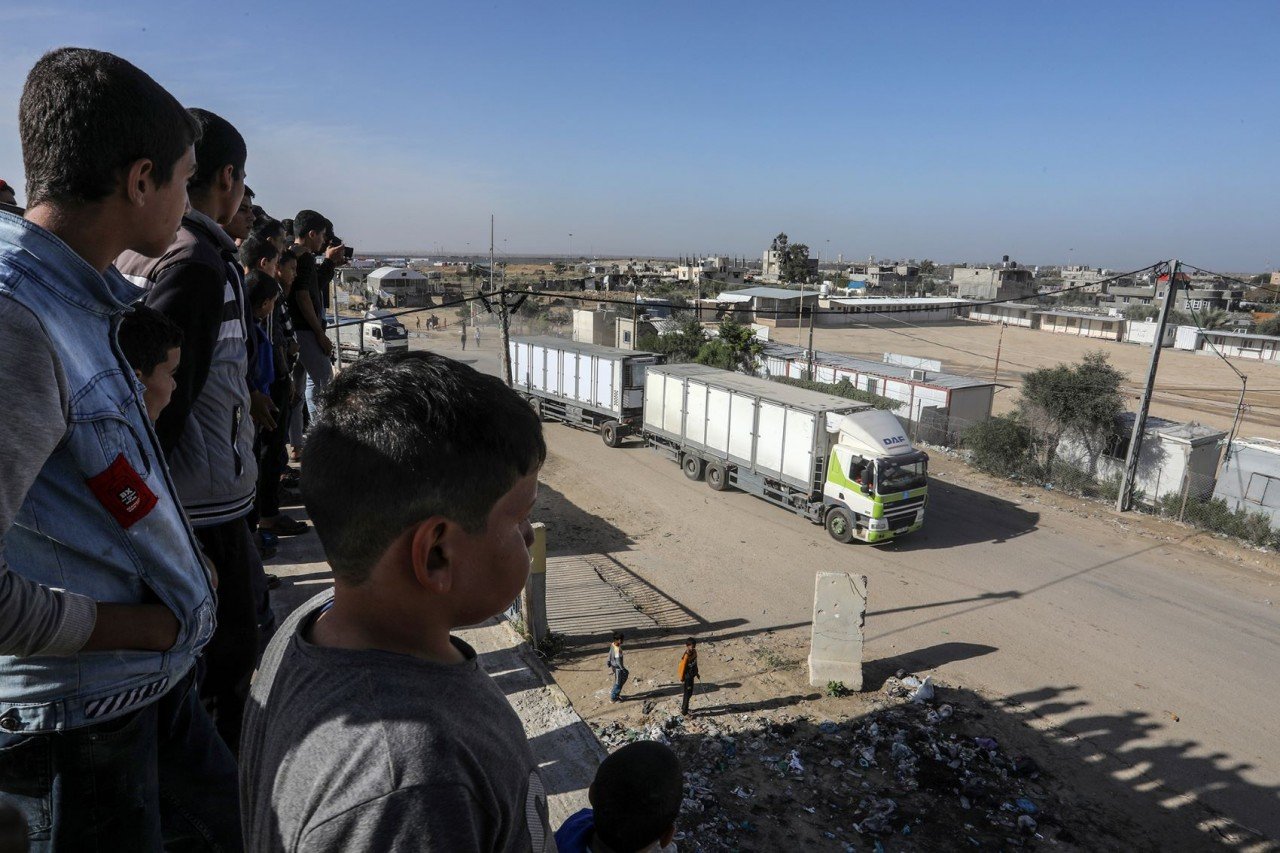 |
| Trucks carrying humanitarian aid enter Gaza through the Rafah border crossing on November 24. (Source: AP) |
Furthermore, the offensive, along with Israel's policy of encirclement and blockade of the Gaza Strip, has left more than 2.3 million residents living in extremely difficult conditions, lacking electricity, clean water, food, medicine, and access to healthcare. Regional and international media report that since the beginning of the conflict, all economic activity in Gaza has been paralyzed, and 100% of children are out of school. The humanitarian situation in Gaza is at an unprecedented low.
Since the conflict erupted, approximately 1,300 Israelis have been killed. Of the 240 hostages held so far, about 100 have yet to be released by Hamas. Significantly, for the first time in half a century, the entire country of Israel is in a state of war, severely impacting all aspects of the nation's economy, society, security, defense, diplomacy, and education.
According to the Israeli Ministry of Finance, Israel's military spending in 2023 was approximately $23.6 billion, more than the combined military spending of Egypt, Iran, Lebanon, and Jordan. If the war continues, Israel's military spending in 2024 will be close to $26 billion, meaning Israel is spending millions of dollars on the conflict every day.
On January 10, 2024, the United Nations once again warned of the worsening humanitarian situation in the Gaza Strip as airstrikes continued, causing further casualties and damaging vital civilian infrastructure. Stephane Dujarric, spokesperson for UN Secretary-General Antonio Guterres, stressed that humanitarian aid agencies and partners are increasingly concerned about the impact of restrictions, particularly in the northern areas of the territory.
Many humanitarian aid organizations are now warning that health services in the Deir al Balah and Khan Younis regions are almost paralyzed. Increased tensions in these areas are leading to a rise in casualties, and escalating security is hindering the delivery of humanitarian aid.
 |
| Protesters call for the release of hostages and an end to the conflict in front of the Opéra Bastille in Paris, France, on January 14, 2024. (Source: REUTERS) |
A United Nations report stated that, as of January 9, 2024, the number of available hospital beds was only sufficient to meet one-fifth of the total need of 5,000 emergency beds. More than three-quarters of the 77 medical facilities in the Gaza Strip had ceased operations, leaving many residents without access to basic medical care when needed.
The current humanitarian crisis also impacts patients with chronic illnesses and mental health conditions. Approximately 350,000 people with chronic illnesses and 485,000 with mental health disorders in the Gaza Strip continue to experience disruptions to their treatment. Precarious living conditions, overcrowded tent camps lacking water and sanitation, put them at high risk of contracting infectious diseases.
In fact, thanks to the shuttle diplomacy efforts of regional and international countries, Israel and Hamas ceased fire to create a safe corridor for humanitarian operations. However, the seven-day temporary ceasefire (from November 24 to December 1, 2023) was insufficient for humanitarian aid efforts. The World Food Programme (WFP) warned of the risk of famine in the Gaza Strip if humanitarian food supplies were disrupted.
As for the Gaza Strip, the cost of rebuilding this Mediterranean strip is considered immeasurable. Experts estimate that the cost of rebuilding Gaza could reach $50 billion due to the severe devastation caused by the war. The conflict has not only caused damage to Israel and Palestine, but has also inflicted economic losses on neighboring Arab countries including Lebanon, Egypt, and Jordan exceeding $10 billion this year and pushed more than 230,000 people into poverty.
Deep divisions, a bleak future.
According to many regional and international experts, although the conflict is far from over, the impacts and consequences over the past 100 days, coupled with the deep divisions in opinion among international parties, have made the security and geopolitical landscape in the Middle East increasingly chaotic, complex, uncertain, and unpredictable in the future.
Analysts argue that the most fundamental political solution to this conflict must be based on a two-state solution. The conflict between Israel and the Palestinians, which has lasted for decades, has become one of the world's most complex hotspots, requiring a comprehensive political solution, the most important of which is a two-state solution. International efforts to promote this through diplomatic activities since the early 1990s have been unsuccessful for decades.
Following the outbreak of the Israel-Hamas conflict, the administration of US President Joe Biden reaffirmed its support for a two-state solution but has not yet outlined a concrete roadmap to revive negotiations. The most recent round of peace talks failed in 2014. White House spokesman John Kirby said that the US and its partners are still discussing a future governance structure for Gaza.
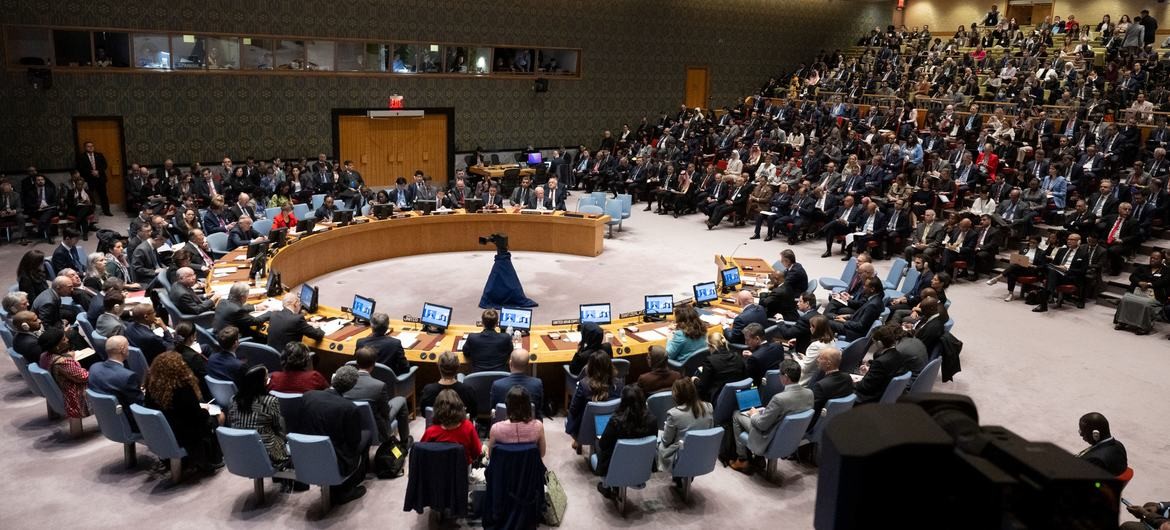 |
| The United Nations Security Council during a session on the Gaza Strip conflict. (Source: UN News) |
In fact, since the outbreak of the Hamas-Israel conflict, the international community has continuously pressured both Israel and the Hamas forces controlling the Gaza Strip to cease fire and end the fighting. For over three months, the international community has relentlessly pushed for efforts to achieve a ceasefire and end the conflict, yet the United Nations Security Council has been unable to agree on a resolution to this conflict.
While the international community has yet to find a comprehensive solution to the current Hamas-Israel conflict, one fact remains clear: no one can imagine how many more innocent civilians will perish by the end of this war, due to both bombs and bullets, as well as the lack of basic necessities such as food, clean water, and medicine.
In a message marking 100 days since the outbreak of the Hamas-Israel conflict, the World Health Organization (WHO) once again called on all sides to cease hostilities, avoid bloodshed, release hostages, and call for an immediate ceasefire. On January 14, 2024, people around the world, from London, Paris, Kuala Lumpur to Johannesburg, took to the streets to protest and demand a ceasefire.
However, despite all this, the smoke of war continues to linger in the Gaza Strip and threatens to spread further. Meanwhile, hope for a fundamental solution that could de-escalate tensions and pave the way for peacebuilding in the region remains a distant prospect.
Source
![[Photo] General Secretary and President To Lam works with the Party Committee of the Ministry of Health on the work of Vietnamese traditional medicine.](https://vphoto.vietnam.vn/thumb/1200x675/vietnam/resource/IMAGE/2026/05/20/1779294323718_a1-bnd-2978-3319-jpg.webp)


![[Image] "Journey of Hope" promotes the organ and tissue donation movement in Vietnam.](https://vphoto.vietnam.vn/thumb/1200x675/vietnam/resource/IMAGE/2026/05/20/1779294400833_1-8910-jpg.webp)






























































































Comment (0)