

Elaborate and intricate, each garment used to transport and preserve gongs is like a work of weaving, infused with the artisan's talent. And strangely enough, the most skilled craftsmen are concentrated in the village of Mít Jep.
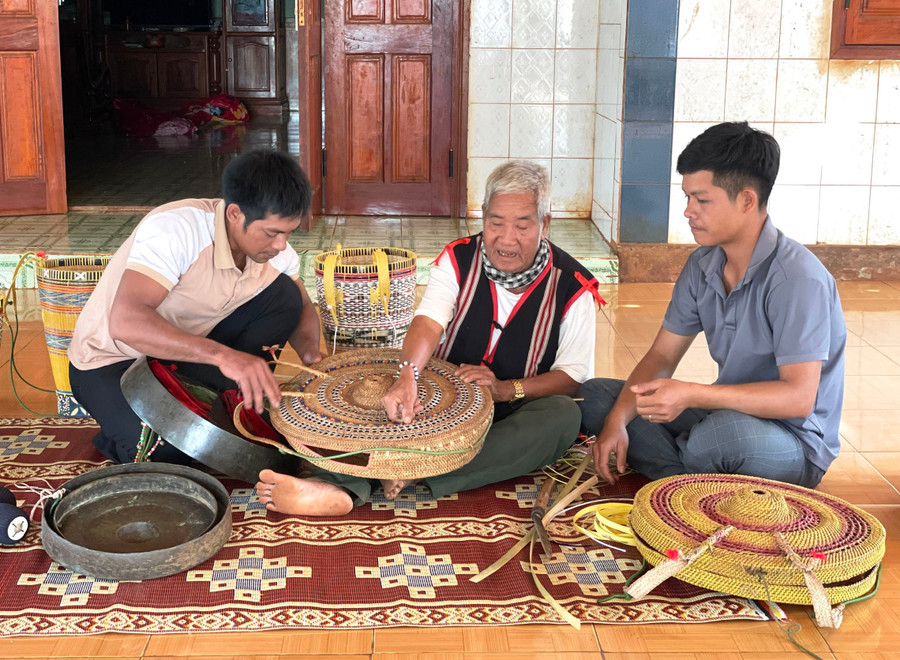
At 80 years old, Elder Hyai remains passionate about the craft of "knitting" gongs and passes it on to younger generations. Photo: PD
As inhabitants of a forest-village civilization, the people of the Central Highlands are highly skilled at transforming natural materials such as bamboo and rattan into essential everyday items. For generations, weaving has been a traditional craft, and one of the measures of a man's dexterity.
I recall that in his book *The Enchanted Land*, Jacques Dournes, a French ethnologist who spent many years in the Central Highlands, recorded a rather interesting legend of the Srê people about their weaving craft.
According to this legend, originally, baskets were the "fruit" of bamboo, which grew naturally and people simply picked them for use. Similarly, mats were the "fruit" of the sedge plant. But since the great flood, everything has changed. Baskets, sieves, mats... no longer grow like fruit on trees; people have to make them themselves.
However, out of compassion, the gods entrusted the task of teaching humans how to do it to the plants. Perhaps that is why, in the Ia O border region today, weaving is not only a livelihood but also a way for the people to preserve the teachings of the forest, passed down through generations.
"Dressing up the gongs"
This season, cashew trees along the border are laden with ripe, red fruit. The sweet aroma of cashews lingers on the road to Mít Jep village (Ia O commune), around the airy house of old Rơ Châm Hyai.
Having resigned from his position as village elder due to his age of 80, Elder Hyai focused on his favorite work: weaving, including "weaving garments" for gongs and passing on this "master technique" to the next generation.
Elder Hyai learned weaving from his own grandfather and father, and over many farming seasons, countless unique products have taken shape from those hands, including exquisitely crafted garments for gong players that we had never seen anywhere else.
There are two types of gong covers: The first type is simply woven with hexagonal interlocking strips, similar to loosely woven baskets, usually used to store ordinary gongs. The second type is intricately woven, skillfully fitting the shape of a knobbed gong, used to store precious gongs such as Pom gongs, Pat gongs, etc.
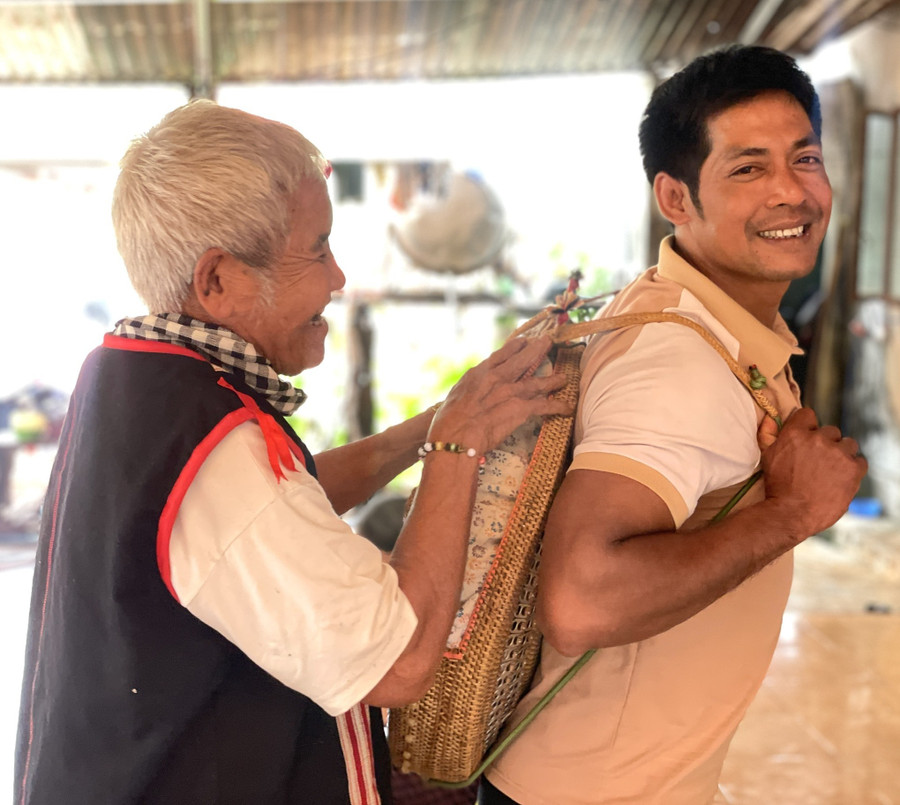

Elder Hyai said: "Among these, the Pat gong is the most valuable because it is entirely cast in bronze. I currently own a set of 11 Pat gongs that have been passed down from my grandparents."
Try striking the "mother gong" (the largest gong), and the resounding sound spreads in waves, making you feel as if the air itself is vibrating in all directions. You truly feel as if you are encountering the sound of the gong.
Elder Hyai cherished this set of gongs like a treasure, so in the past, he spared no effort going into the forest to find rattan vines to "weave clothes" for the gongs. The first step always began with the most difficult part on the front, which was the protruding part where the gong knob would be placed, requiring careful calculation to ensure a perfect and precise fit.
From here, the circles are gradually woven wider with patterns that are sometimes sparse and sometimes dense, so that the product looks aesthetically pleasing and the gong has room to breathe. The back is woven similarly but is flat; the two sides are connected by a base, with an opening at the top to insert the gong. Finally, two straps are attached, like those used for carrying baskets, for easy carrying on the shoulders during transport.
Explaining the process to me, old Hyai said: Each woven jacket can hold several gongs from the same set; sets with more than 10 gongs require two jackets. It takes 4-5 days of continuous weaving to complete one product. Besides weaving for personal use, he also accepts orders from people in his village and neighboring villages.
If customers bring their own rattan, the artisans only charge 3-4 million VND per piece; if the rattan is sourced by the weavers themselves, the price is 5 million VND per piece. The durability of a gong cover can last for decades.
Preserve for the future.
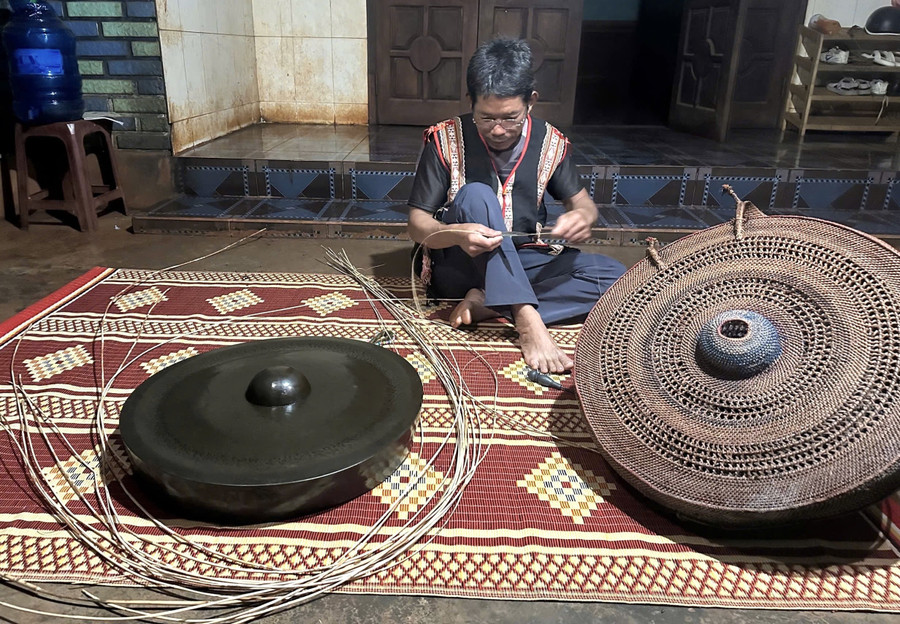
Accompanying us on a visit to about 5-6 other artisans in Mít Jep village who still possess the technique of making such special products, Ms. Hà Thị Hường - a Culture and Social Affairs official of Ia O commune - shared: Before the province's merger, the entire commune had over 500 sets of gongs, the most in the former Ia Grai district - the border district that still preserved the most gongs in the province.
All nine villages in Ia O commune currently possess an invaluable heritage of approximately 160 precious gong sets. "But in Mit Jep village alone, the people own about one-third of these precious gongs," Ms. Huong revealed.
Living in a region where gongs are precious, and preserving these valuable artifacts worth hundreds of millions of dong, the locals don't hesitate to spend extra money to buy beautiful covers for their gongs.
For the people here, preserving precious gongs is protecting something extremely sacred. And this is perhaps the reason why the craft of "weaving gong covers" has been created, perfected, and passed down in this region for so many years.
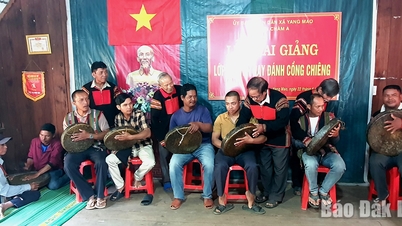
One of Elder Hyai's outstanding students is Mr. Puih Thớk (born in 1977) - the captain of the gong ensemble in Mít Jep village. Mr. Thớk also owns a valuable set of 11 gongs, which he bought from a villager in a neighboring village for over 300 million VND. "I was so fascinated by them that I bought them!" he explained with a hearty laugh.
Having acquired a gong, he went to the elderly Hyai's house to learn how to weave baskets. Having a background in weaving, he learned very quickly. From being proficient, he has now woven dozens of covers for precious gongs; some months he makes up to five. Besides traditional techniques, he is also very creative, using other materials for decoration.

Puih Glíu (from Mít Jep village) happily shared: His family inherited a precious set of gongs from his parents, so they decided to ask Mr. Thớk to weave a beautiful rattan basket to hold the gongs.
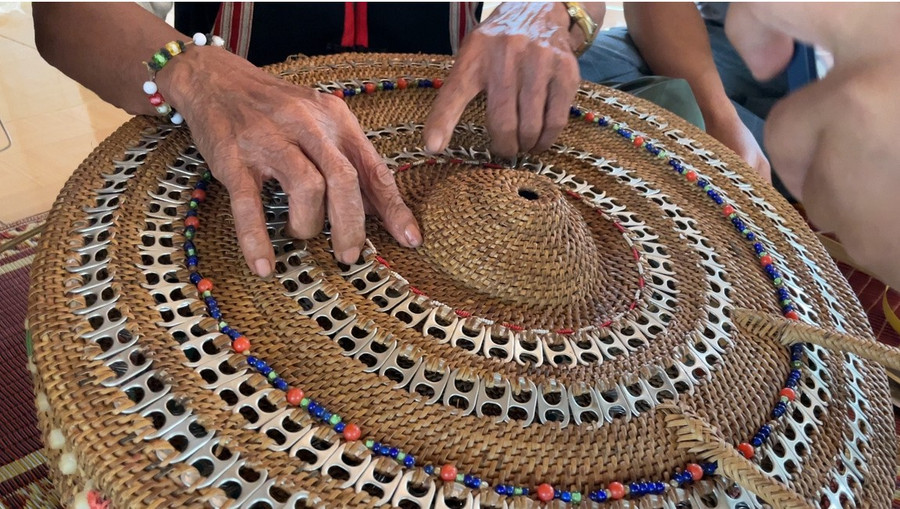
When we asked, "Sitting and knitting in silence day after day, does the artisan ever feel bored?", both old Hyai and Mr. Thớk laughed: "No, once you're focused, you never get bored."
Clearly, the weaving revealed the slow-paced, unhurried lifestyle of the people of the Central Highlands. They work slowly, taking things as they come, knowing when it's finished... The conversation with the artisans also gave us joy about the self-generated inspiration passed down within the community.
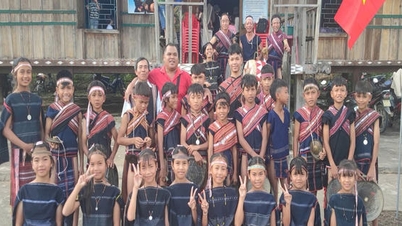
Mr. Rơ Châm Xê, Head of the Front Committee of Mít Jep village, said: “Even without the commune's involvement, the village has independently organized the teaching of gong playing and weaving, including 'weaving garments' for gongs, thereby contributing to the preservation of the Central Highlands gong culture. In the future, we will continue to encourage elderly artisans to pass on their knowledge to the next generation.”
Source: https://baogialai.com.vn/dan-ao-cho-cong-chieng-post581020.html















































![[Video] Sunset at Lap An Lagoon – Where the sun sets over the fishing nets](https://vphoto.vietnam.vn/thumb/1200x675/vietnam/resource/IMAGE/2026/05/31/1780192137701_beach-landscape-sea-water-nature-grass-745871-pxhere-com.jpeg)


























Comment (0)