

08:42, 10/09/2023
The communal house (nhà rông) is the epitome of architectural and sculptural art of the ethnic groups of the Northern Central Highlands such as the J'rai, Bhanar, Xê Đăng, and Giẻ-Triêng.
The people utilize readily available materials from the forest such as wood, thatch, bamboo, reeds, leaves, and rattan to create a house with a majestic and imposing appearance, its roof shaped like an axe blade soaring high into the blue sky.
A truly authentic communal house (nhà rông) is usually distinguished by its roof. The roof of a communal house not only has a beautiful shape but also serves as a canvas for artisans to showcase their artistic talent in decorating, carving, and shaping the roof ridge. Only the most skilled weavers in the village are brought together to create a truly beautiful and perfect roof for the communal house.
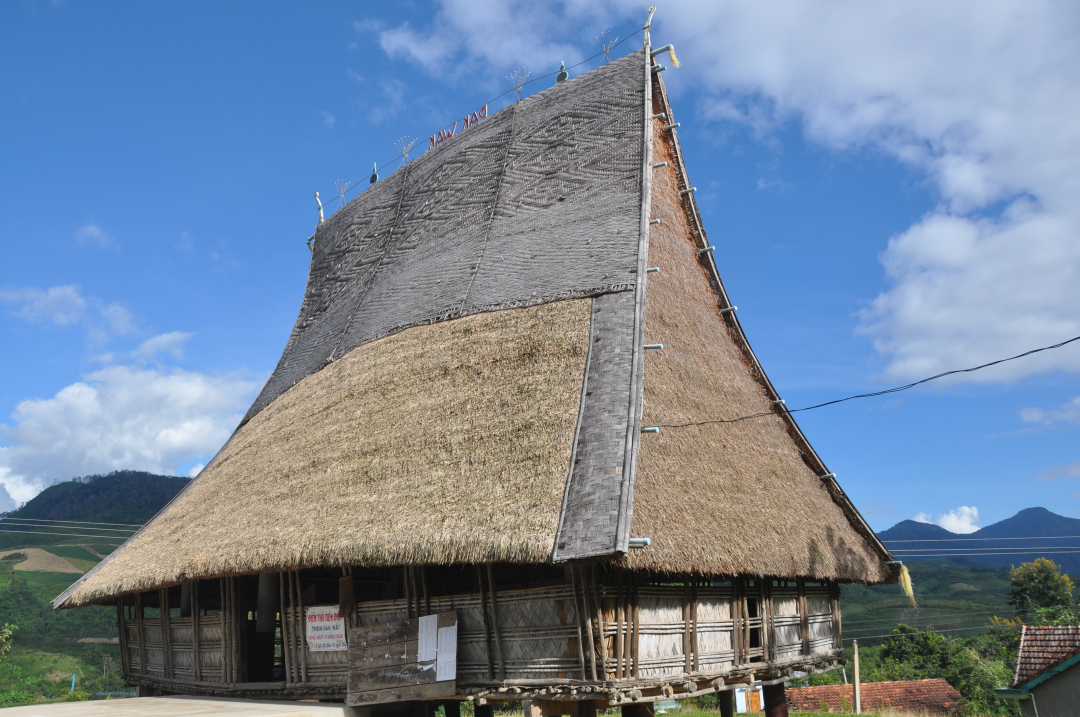 |
| The garment covers part of the top and sides of the communal house roof of the Gie-Trieng ethnic group in Dak Glei district, Kon Tum province. |
The criterion for recognizing a beautiful communal house is that it must always have a "new coat." As soon as the roof is finished, the people weave a large mat made entirely of rattan, bamboo, and reeds, just large enough to cover the front and back roofs of the communal house. When completed, everyone gathers and works together to pull the mat up high, covering both sides of the roof with a fresh coat of colorful rattan.
This is arguably the largest and most beautiful garment created by the most skilled weavers to celebrate the village's new communal house. The front roof is decorated with geometric patterns of interconnected and symmetrical squares, giving the impression of a more spacious roof.
At the apex of the roof are delicate decorative panels consisting of interconnected rhombuses, symbolizing the rolling, vast mountains and hills. In many places, the people weave small slats to cover part of the roof, usually from the top down about 1/2 to 1/3 of the roof, and small slats to support the edges of the roof.
By doing this, the people save time, effort, and materials in creating a roof covering. This covering, which is both open and closed, serves the function of reinforcing and ensuring the durability and strength of the roofing material, preventing damage or tearing, while also providing appropriate decoration in necessary areas and focal points. This creates various decorative elements, resulting in balance, harmony, and rhythm on the roof of the communal house.
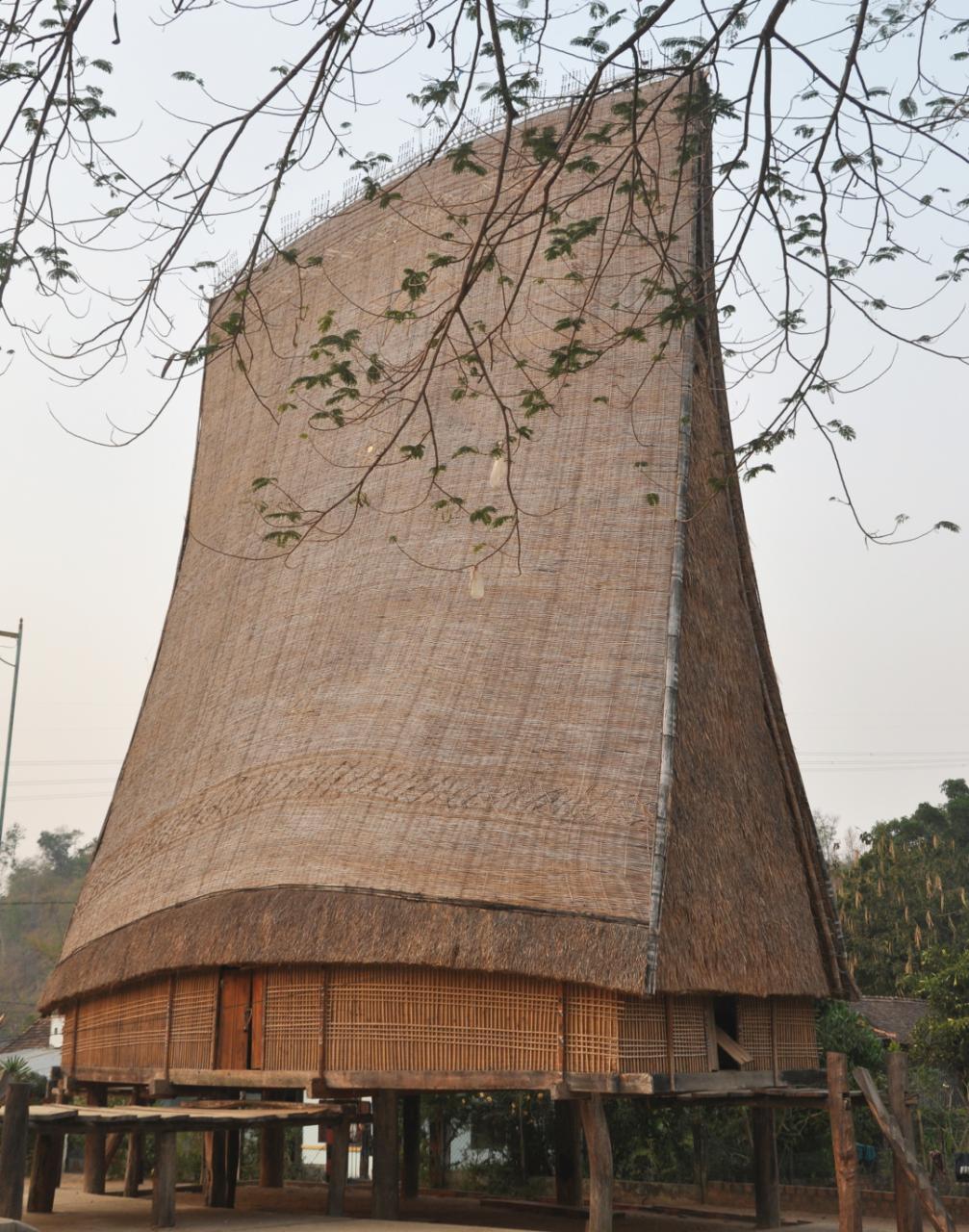 |
| The protective covering covers the roof of the communal house of the Bhanar ethnic group in Kon Tum province. |
In the past, due to the abundance of natural materials such as bamboo, rattan, and wicker, and the presence of many skilled artisans knowledgeable in weaving and decorative arts, the communal houses of the ethnic minorities always had a complete and beautiful appearance.
In the documentary photographs taken by Marcel Ner in the early 20th century in Kon Tum, or by Jean-Marie Duchange in 1955 in Kon Tum, many impressive types of ancient communal houses appear. Particularly, in Jean-Marie Duchange's photo collection "Central Highlands - A Land of Enchantment," there are several images of communal houses with unique architecture, featuring oval-shaped entrances built vertically. The entire front roof is decorated with eye-catching patterns.
Or, as documented in photographs of the Bahnar-Rơngao communal house, taken by Father Daniel Léger during his work in the Kon Tum diocese in the 1960s, the communal house also served as a "chapel" for religious ceremonies. The entrance and roof of the communal house often featured a wooden cross or a woven pattern.
On the roof of the communal house, vibrant paintings with familiar motifs such as waves, rhombuses, triangles, squares, windmills, and most notably, the eight-pointed star pattern, characteristic of the Central Highlands style, are subtly displayed. The bamboo and rattan woven panels on the roof are works of art, meticulously carved and polished.
Nowadays, it is difficult for the owners of this unique architectural heritage to recreate the traditional communal houses with perfectly finished roofs as before. The communal houses found in museum photographs serve as models for research and recreation, showcasing architectural and decorative features characteristic of the Central Highlands. Recently, the Bhanar people in Kon Ktu village, Kon Tum province, restored an ancient communal house with a rather large "coat" (roof). Thanks to the investment of effort and the creative spirit of contemporary artisans in the village, the people here have recreated and restored the communal house with its ancient appearance, a testament to its former glory.
Tan Vinh
Source




























































































Comment (0)