

A drone attack caused a fire near the United Arab Emirates' (UAE) only nuclear power plant, Barakah, on May 17.
Authorities in the country described it as "an unprovoked terrorist attack." It remains unclear who was behind the attack, but the incident has fueled concerns about the risk of renewed hostilities, with both the US and Iran signaling a readiness for confrontation.
Dangerous escalation
The UAE Ministry of Defence said three drones crossed the western border with Saudi Arabia, while the other two were intercepted. Authorities are investigating who was behind the attack. Iran and its allied Shiite militias in Iraq have previously been accused of carrying out drone attacks against Gulf states during the conflict.
"Whether carried out by the primary perpetrator or through proxy forces, this attack is a dangerous escalation," Anwar Gargash, diplomatic advisor to the UAE president, wrote on social media.
Saudi Arabia condemned the attack and later announced that it had intercepted three drones that had intruded from Iraqi airspace.
The $20 billion Barakah nuclear power plant, built by the UAE with assistance from South Korea, became operational in 2020. It is the only nuclear power plant in the Arab world and can meet a quarter of the UAE's energy needs.
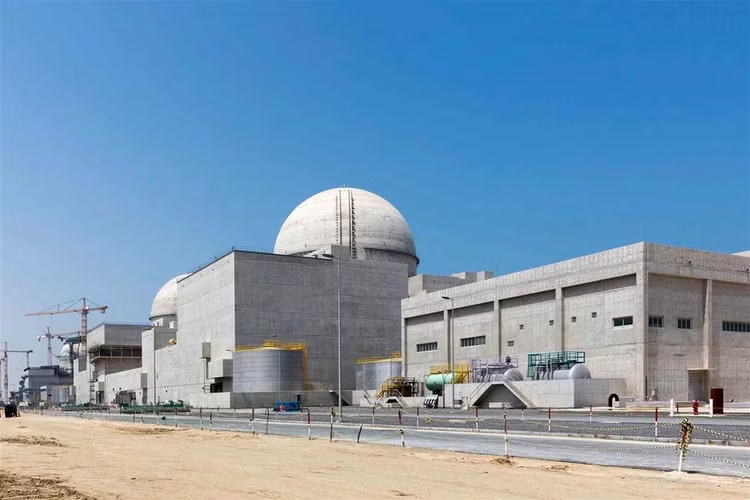
According to AP , the attack on the nuclear power plant in the UAE caused no casualties or radiation leaks.
The UAE nuclear regulator said the fire did not affect the plant's safety and "all units are operating normally." The United Nations' International Atomic Energy Agency (IAEA) confirmed the attack caused a fire in a generator, and one reactor was using an emergency diesel generator.
This is the first attack on the Barakah plant, which has four reactors, since the conflict between the US and Iran broke out on February 28. The Iranian-backed Houthi forces in Yemen had previously claimed responsibility for attacking the plant during construction in 2017, but Abu Dhabi denied this.
The UAE's nuclear program differs from those of Iran and Israel.
The UAE signed a strict agreement with the US regarding nuclear power plants, known as the “123 agreement,” under which the UAE committed to not enriching uranium domestically and not reprocessing spent fuel in an effort to alleviate concerns about nuclear proliferation. The UAE's uranium is imported.
This is quite different from Iran's nuclear program, which has been the focus of ongoing tensions with the United States and Israel.
Iran maintains that its nuclear program is for peaceful purposes, but it has enriched uranium to near weapons-grade levels. Iran has also frequently restricted the activities of UN inspectors, particularly since the 12-day war with Israel in 2025.
Israel is believed to be the only country in the region to possess nuclear weapons, but has never confirmed or denied this. Iran attacked near Israel's Dimona nuclear facility during the war.
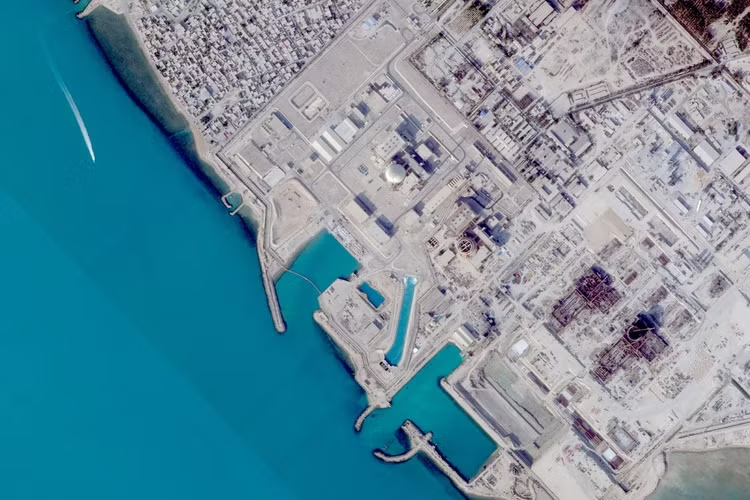
Nuclear power plants have increasingly become targets in recent conflicts. During the US-Iran war, Tehran repeatedly claimed that its Bushehr nuclear power plant had been attacked, even though there was no direct damage to the reactor or radiation leaks.
US warns Iran, ceasefire fragile.
The ceasefire between the US and Iran remains fragile, while diplomatic efforts to achieve lasting peace have stalled. Meanwhile, fighting between Israel and the Iranian-backed Hezbollah militant group in Lebanon continues to escalate, despite a nominal ceasefire.
"For Iran, time is running out, they should act quickly or there will be nothing left," US President Donald Trump warned Iran on social media, shortly after a phone call with Israeli Prime Minister Benjamin Netanyahu.
In response, Iran declared that its armed forces were ready to open fire.
"Our armed forces are ready to fire, while diplomatic efforts continue," Mohsen Rezaei, military adviser to Iran's Supreme Leader, said on state television.
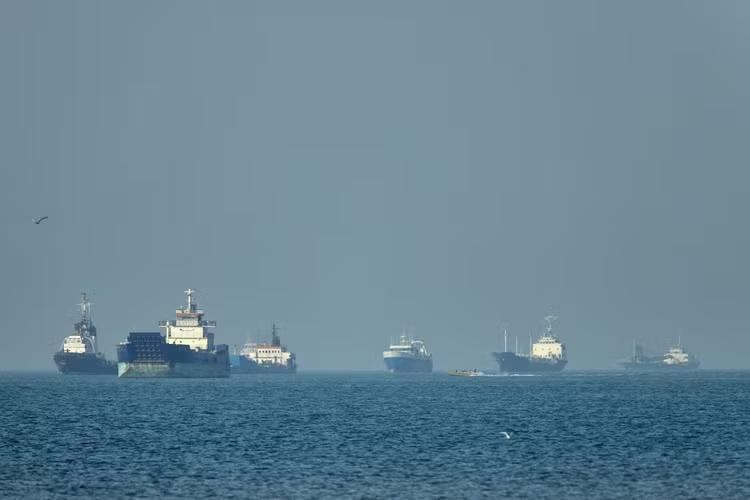
Israel is reportedly coordinating with the U.S. on the possibility of resuming attacks on Iran, according to two sources familiar with the situation, including an Israeli military officer. They requested anonymity because the discussions are confidential military plans.
Speaking to the cabinet on May 17, Prime Minister Netanyahu said: "We are also wary of Iran and are prepared for all scenarios."
On Iranian state television, presenters on at least two channels appeared with weapons during live broadcasts.
In one channel, Mobina Nasiri stated that she received the weapons from a gathering at Vanak Square in Tehran. “I declare my readiness to sacrifice myself for my country,” she said.
>>> Readers are invited to watch the video: US-Iran negotiations at a standstill
Source: https://khoahocdoisong.vn/dang-sau-vu-tan-cong-nha-may-dien-hat-nhan-o-uae-post2149100629.html

















![[GALLERY] Elon Musk shocks with the statement that people may not need to go to work.](https://vphoto.vietnam.vn/thumb/402x226/vietnam/resource/IMAGE/2026/05/24/1779625359765_el-png.webp)




































































Comment (0)