


At the end of the first semester, Ms. Hoang Thi Thanh Van, residing in Thai Thinh Ward, Dong Da District, Hanoi , decided to look for additional classes in Literature, Math, and English for her child, who is in 7th grade. While chatting with friends, Ms. Van learned that the student assessment methods had changed, with the title of "excellent student" now being higher than "good student," adding to her anxiety given the increasingly fierce competition for admission to public high schools.
"In my child's class, for example, five students achieved excellent grades, and over 20 students were recognized as good students. Hearing that they are good students, the children easily become complacent with their achievements. Therefore, I want a stricter system so that the children know their academic level and strive to improve," Ms. Van said.
Circular No. 22 of 2021 issued by the Ministry of Education and Training, which regulates the assessment of secondary and high school students, has been in effect since the 2021-2022 school year, corresponding to the implementation roadmap of the new textbooks. Students' academic and behavioral performance is assessed at the following levels: unsatisfactory, satisfactory, good, and excellent.
Regarding awards, the principal will present certificates of merit at the end of the school year to excellent students (those with good academic and behavioral performance, with an average score above 8 in 6 out of 8 subjects) and outstanding students (with an average score above 9).
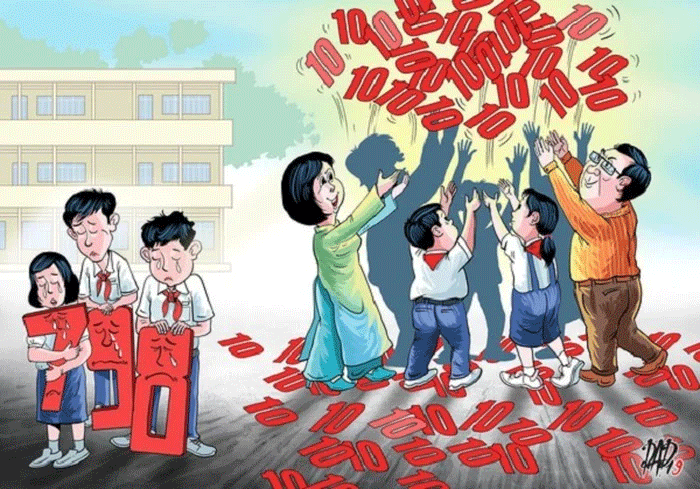
Genuine evaluation is the way for schools and the education sector to definitively cure the "disease" of achievement obsession, preventing illusory achievements from derailing the "train" of innovation (Illustrative image).
Thus, the difference compared to before is the elimination of the "advanced student" title and the division of "excellent student" into two levels. Although most parents support this new assessment method to overcome the "achievement-oriented" mentality in education, there are still quite a few concerns.
"Even if your child hasn't achieved the highest level of excellence, if they've made progress compared to their previous performance, they should still receive a certificate of merit. My workplace does the same; every year we encourage and reward children who receive certificates of merit."
"The 'inflation' of certificates of merit diminishes the value of effort, leading students to disregard those achievements."
According to Ms. Nguyen Thi Viet Nga, a member of the National Assembly's Committee on Culture and Education, the student assessment under Circular 22 shows many improvements compared to before, including assessment using comments instead of grades in some subjects.
"For physical education, arts (music, fine arts), experiential activities, career guidance, etc., teachers assess students based on their abilities to determine whether they have achieved the goal or not. This assessment method does not put pressure on students. As for other cultural subjects, they are assessed using grades, similar to how we have been doing it for many years."
"Parents are still getting used to the removal of the 'advanced student' title, but in my opinion, Circular 22 is appropriate. When 100% of students are awarded certificates of merit, that reward no longer serves as a form of encouragement for them to strive for excellence," said Ms. Nguyen Thi Viet Nga.
At Tay Mo Secondary School in Nam Tu Liem district, Hanoi, the number of certificates of merit has decreased significantly compared to previous years since the implementation of the new evaluation method.
According to Ms. Do Thi Thu Thuy, the school's vice principal, having the title of outstanding student motivates students to strive harder: "In our assessment, the teaching and learning process is more realistic. Students will no longer focus on rote learning or neglecting certain subjects because all subjects are evaluated equally. Our school currently has no subjects considered minor, creating opportunities for students to fully develop their abilities."
At Thanh Nhan High School in Tan Phu District, Ho Chi Minh City, Principal Nguyen Dinh Do shared that teachers, especially subject teachers, faced considerable difficulties in the initial stages of implementing Circular 22, but things became easier later thanks to the software. Mr. Do believes that the new assessment method helps teachers better understand students' abilities by eliminating the need for specific assignments, allowing them to assess students' application of knowledge through various tasks.
However, according to experts, even with the right policy, if the implementation is not serious, the "disease" of focusing on achievements could return, and then the titles would not accurately reflect the students' abilities.
Associate Professor Tran Thanh Nam, from the University of Education, Vietnam National University, Hanoi, assessed that Circular 22 has reduced societal prejudices in classifying students, aiming for a more holistic education. However, implementation may face obstacles if parents, students, and teachers still place too much pressure on academic achievement.
"Regarding solutions, we need to understand and adhere to the new mindset. The goal of assessment is not to categorize or 'label' a student as good or poor, but to determine where they are and how far they are from their goals so that they can find a suitable path forward."
Excellence is not solely reflected in grades; in the future, employers will no longer place as much emphasis on academic qualifications, but rather on the awareness of the community. We also need to strengthen training on effective and substantive assessment techniques so that teachers can apply them flexibly."
Agreeing with this viewpoint, Ms. Nguyen Thi Viet Nga suggested that, in order for Circular 22 to be truly effective, it is necessary to further strengthen communication efforts to create consensus among teachers, parents, and students, avoiding the mentality of prioritizing grades and certificates of merit.
The education sector also needs to change the way it evaluates educational institutions so that schools are not pressured to achieve high scores, but instead focus on genuine teaching, genuine learning, and genuine grades.

The education sector also needs to change the way it evaluates educational institutions so that schools are not pressured to achieve high scores, but instead focus on genuine teaching, genuine learning, and genuine grades. (Illustrative image: Lao Dong newspaper)
Implementing the new 2018 general education program has truly been a challenge for the entire education sector over the past three years, as administrators, schools, and teachers have had to "learn as they go" about the new textbooks, new teaching methods, and new assessment approaches.
Circular 22 of the Ministry of Education and Training has provided a "measuring stick" for schools to assess students' learning and training results, as well as the effectiveness of the teaching and learning process. The challenge is to measure accurately and precisely so that both teachers and students truly know where they stand, avoid the long-standing "achievement-oriented" mentality, and truly create a quality workforce for the future.
Certificates of merit for outstanding and excellent students have been associated with generations of students for decades. And now, as parents, the fact that their children achieve average grades without receiving such certificates is truly surprising to many, even though the new assessment method has been in operation for three years.
Children feel inferior to their friends, parents are disappointed when they have nothing to "contribute" to the company or neighborhood committee on occasions of awarding children's achievements, and the conversations with colleagues and friends become more subdued as the "achievement-oriented" mentality has infiltrated society, and is no longer just a matter for schools or teachers.
In reality, the obsession with achievements appears wherever there is competition and rewards, but it is more dangerous in the field of education, which creates the human resources for the country's future. Therefore, the new provision in Circular 22 regarding the abolition of certificates for outstanding students is necessary in the fight against this "disease," as the phrase "100% of students are good and excellent" has become a sarcastic joke, and the mass awarding of certificates will no longer have any encouraging value.
However, that's a necessary condition, but not sufficient. Stories about classes with over 50% excellent and outstanding students sound problematic at first glance, because, by rule, in a large group, the number of excellent and poor students is always small, while those in the middle range are the majority. Is it because the students are truly excellent, or are the teachers being lenient in grading and evaluating because they feel sorry for them or for some other reason? Those involved surely already have the answer.
Educational reform is an urgent requirement to create high-quality human resources – one of the three breakthroughs in the national development strategy. In this context, genuine learning and genuine assessment are among the prerequisites for successful reform.
Circular 22 has provided a new, appropriate "measurement tool" for schools implementing the new curriculum. In this new context, the question is how to "measure" accurately, which depends on the responsibility and dedication of the teachers.
Genuine evaluation is the most appropriate way to show love to students, helping them truly understand their strengths and weaknesses, preventing complacency, and motivating them to strive for better results.
Effective assessment is the best way for teachers to accurately assess the teaching and learning process, its effectiveness, and to promptly address shortcomings or make adjustments for continuous improvement.
Realistic evaluation is also a way for schools and the education sector to definitively cure the disease of focusing on achievements, preventing illusory achievements from derailing the "train" of innovation, and ensuring that certificates for excellent students now are not merely on par with those for advanced students in the past.
Besides honest feedback, the education sector also needs to provide timely support and encouragement, creating conditions to improve teachers' incomes and stabilize their lives, so that they can maintain their passion for the profession. The efforts of teachers and staff in implementing the new general education program over the past three years are highly commendable, including the assessment of students, as giving grades as before is much easier than the meticulous comments currently provided.
Parents' responsibility in their children's education is indispensable. They need to get used to the fact that their children may not receive certificates of merit; they should care for, remind, and encourage their children instead of pressuring them, creating pressure, or resorting to negative methods to achieve success.
The collective efforts of the entire society are the most effective "cure" for the long-standing problem of focusing solely on achievements and will promote a more effective and substantive teaching and learning process.
MINH HIEU (VOV-Traffic)
Source





























![[Photo] Prime Minister Pham Minh Chinh receives the Director General of TASS News Agency (Russian Federation)](https://vphoto.vietnam.vn/thumb/1200x675/vietnam/resource/IMAGE/2026/02/25/1772024599891_dsc-8041-jpg.webp)




























































Comment (0)