


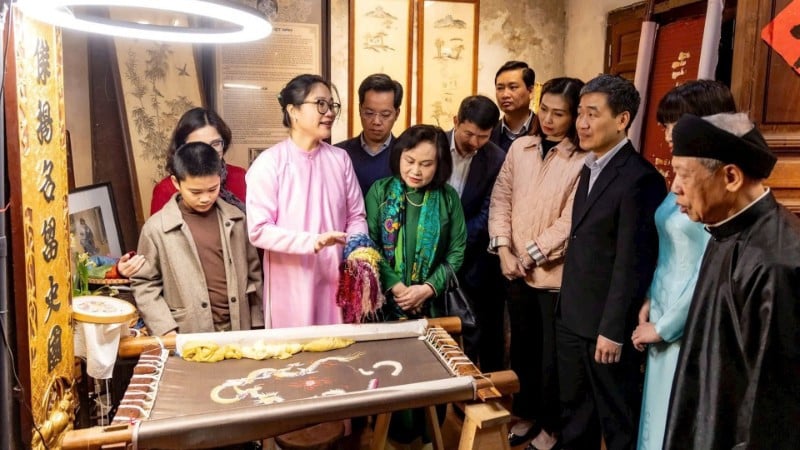
The program aims to contribute to the effort of "transforming heritage into assets" to serve the cultural industry of the Capital, linked with human resource training and expanding international cooperation.
The project "Heritage Tourism Routes in Hanoi" is part of the FEF-R Patrimoine program, funded by the French Ministry of Europe and Foreign Affairs , in collaboration with diplomatic agencies and numerous prestigious academic and research partners in Vietnam and France.
In reality, amidst the increasingly bustling pace of life and rapid urbanization in Hanoi , ancient historical and cultural relics quietly persist, some surrounded by high-rise buildings, others becoming hidden gems in the community's memory. Preserving and promoting the value of these heritage sites is no longer solely the responsibility of researchers, but requires new, more flexible approaches that are closer to contemporary life.
In this context, the launch of four heritage tourism itineraries is seen as a meaningful experiment, where heritage is revitalized through the language of technology and the developmental mindset of the cultural industry.
After more than a year of research and development, four unique heritage tours have officially launched in Hanoi, connecting 28 iconic historical sites through itineraries that integrate experiences and technology.
According to the research team, from over 100 surveyed historical sites in Hanoi, 28 representative sites were selected to develop four experimental itineraries linked to four important religious traditions in the spiritual life of Vietnamese people.
The project brought together nearly 40 experts in culture, history, and technology, along with about 100 students participating in field surveys, from the University of Social Sciences and Humanities, the School of Interdisciplinary Sciences and Arts - Vietnam National University, Hanoi; and the Hanoi University of Architecture.
Dr. Nguyen Thi Hiep, the project's principal scientific coordinator and representative of the French International Technical Cooperation Agency, stated: "The project has trained students in tourism, history, culture, and architecture on heritage survey methods and theory; organized group research with 10 in-depth topics; and developed a website, an interactive map, and a navigation application."
The four tours aim to serve both as sightseeing opportunities and as a data foundation for research and training.
The first leg of the journey, "Thang Long Four Guardian Temples," connects four sacred temples guarding the ancient capital: Bach Ma, Voi Phuc, Quan Thanh, and Kim Lien, corresponding to the four directions: east, west, south, and north.
The second leg of the journey, the Mother Goddess temple route, connects key locations including Dong Ha, Vu Thach, Ba Kieu, Xuan Yen, Den Dau, Vong Tien, Phu Tay Ho, and the incense tree at Long Bien train station, introducing the Tam Phu belief - an intangible cultural heritage recognized by UNESCO.
The third leg of the journey, the route to the ancestral temples of various crafts, passes through Hanoi's Old Quarter, visiting Kim Ngan (jewelry), Dong Lac (traditional Vietnamese blouses), Pha Truc Lam (leather shoes), Ha Vi (lacquerware), Phuc Hau (mirror coating), Tu Thi (embroidery), Lo Ren (blacksmithing), and Ngu Xa (bronze casting).
The fourth leg of the journey, the Hanoi temple route, is associated with the monk An Thien (Phuc Dien) - a prominent patriarch of Vietnamese Buddhism, taking visitors through landmarks such as Bao Thien (now only a memory), Lien Tri, Ham Long, and Lien Phai...
A key feature of the project is the digitization of a large volume of documents in French, Sino-Vietnamese, and Vietnamese. Each historical site is compiled into a complete electronic file, including scientific descriptions, historical and contemporary images, videos, excerpts from inscriptions, Sino-Vietnamese documents, architectural diagrams, and a catalog of related research. All data is integrated into an interactive electronic map, QR codes at the site, and the H-Heritage application, enabling residents, tourists, students, and researchers to access information via smartphones.
According to Pham Thi Diem, Chairwoman of the People's Committee of Ba Dinh Ward: "In recent times, the ward has piloted many cultural tourism products applying modern technology, which have initially yielded positive results. The implementation of this project contributes to making Ba Dinh a memorable destination for domestic and international tourists, in the spirit of civilization and modernity while still retaining its rich cultural identity."
Results from four pilot tours show that when heritage sites are organized in an accessible way, with synchronized digital data and linked to training activities, "awakening" the value of heritage goes beyond just sightseeing.
According to Dr. Nguyen Thi Hiep, the research team aims to further expand the model, researching and developing new itineraries about traditional craft villages, ancient French-era churches, old villas, Buddhist branches influenced by India and China, as well as craft villages on the outskirts of Hanoi; and simultaneously promoting these itineraries in the European market. She proposed further collaboration with the University of Culture, tourism faculties, the Hanoi Department of Tourism, and the Ministry of Culture, Sports and Tourism to gradually extend the "heritage network" nationwide.
Results from four pilot tours show that when heritage sites are organized in an accessible way, with synchronized digital data and linked to training activities, "awakening" the value of heritage goes beyond just sightseeing.
Professor, Dr. Hoang Anh Tuan, Rector of the University of Social Sciences and Humanities, affirmed that this is a completely new approach to heritage, helping to bring historical and cultural values closer to young people and international tourists; and expressed his hope that the project will continue to be expanded to other areas of Hanoi and many localities across the country.
Source: https://nhandan.vn/danh-thuc-di-san-giua-long-do-thi-post930120.html
![[Photo] General Secretary To Lam presides over a meeting with the Editorial Teams to summarize 100 years of the Party's leadership of the Vietnamese revolution and 40 years of implementing the National Construction Program.](https://vphoto.vietnam.vn/thumb/1200x675/vietnam/resource/IMAGE/2026/03/04/1772601288977_a1-bnd-8134-7576-jpg.webp)





















































Comment (0)