

Identifying new opportunities
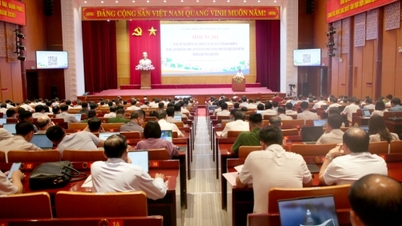
Speaking at the ceremony commemorating the 120th anniversary of Hanoi National University, General Secretary and President To Lam emphasized: The Party has issued very important strategic decisions such as Resolution 57 of the Politburo on breakthroughs in the development of science, technology, innovation and national digital transformation; Resolution 71 on breakthroughs in the development of education and training; Resolution 80 on the development of Vietnamese culture...
The direction is clear, the institutions are opening up, and resources are being prepared. The crucial issue now is that the education sector as a whole needs to act—act decisively, effectively, and thoroughly—to realize the aspiration for high development in the coming decades, aiming to lift the country out of backwardness and rise to the group of advanced developed nations by 2045.
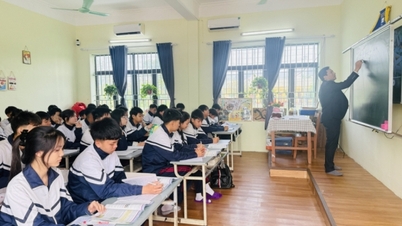
From a grassroots perspective, Ms. Nguyen Thi Van Hong - Principal of Chuong Duong Secondary School (Hong Ha, Hanoi ) - assessed that this is a very accurate and timely directive, especially for three reasons:
Firstly, the General Secretary and President placed education at the forefront, alongside science, technology, and culture (through Resolutions 57, 71, and 80). In practice, in managing secondary schools, teachers often teach according to the curriculum without connecting it with the country's creative and digital transformation requirements. That is, secondary education should not only teach knowledge but also develop problem-solving skills and introduce technology to students from an early age.

Secondly, the emphasis on "decisive and thorough action" serves as a warning against the problem of "good resolutions but poor implementation at the grassroots level." From a management perspective, Ms. Hong believes that the weakest aspects are organization, implementation, supervision, and accountability. The requirement now is to realize aspirations, meaning that it cannot be merely a formality; there must be a roadmap and measurable indicators.
"Thirdly, the 2045 deadline creates clear time pressure. For a school principal, this means that we must change our teaching methods, assessment methods, and collaboration with technology companies right now, otherwise today's students – primary and secondary school students – will not have the capacity to lead the country to become an advanced developed nation when they graduate in 2045," Ms. Van Hong emphasized.
Specific solutions
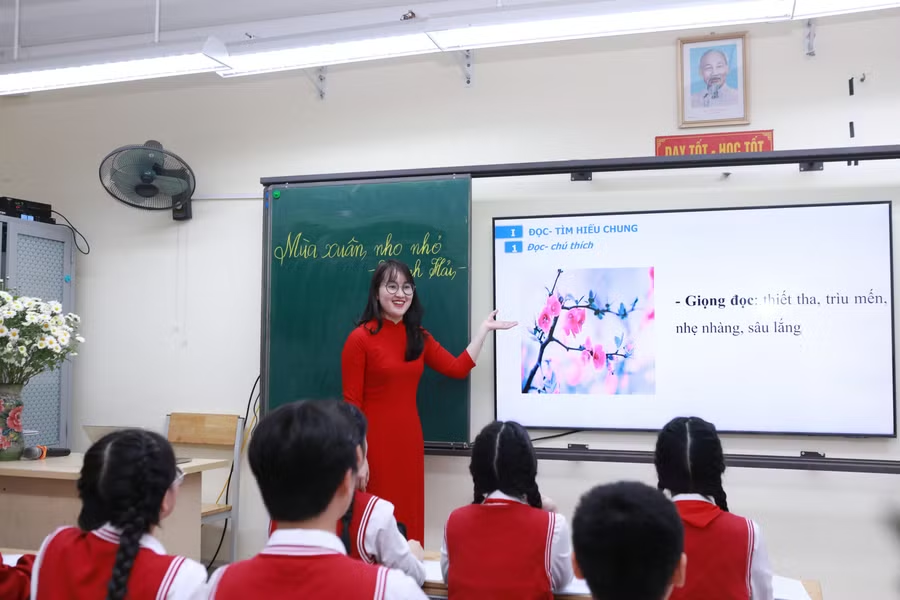
Based on that reality, Ms. Van Hong proposed three groups of solutions from a facility management perspective:
Regarding institutional management, a pilot mechanism should be implemented to hold schools accountable for innovation. Currently, principals are very afraid of making mistakes because inspectors and auditors can easily find fault when trying new models (for example, project-based learning, using AI in the classroom).
We propose that the Ministry of Education and Training and local authorities develop a "safe trial framework" – if a school registers for a pilot program and publicly announces its plan, it should be exempt from liability for minor errors, only being responsible for training objectives and professional ethics.
In particular, breakthroughs are impossible if the current teaching staff continues to be trained in the old way. In reality, many older teachers are still struggling with interactive whiteboards, let alone integrating digital thinking.
According to Ms. Van Hong's suggestion, the management agency should research opening up a recruitment pool for teachers who are engineers or IT experts (with short-term pedagogical training) to teach Technology, Informatics, and STEM subjects.
For existing teachers, there needs to be a policy of rewarding them based on their actual digital transformation capabilities (not just theoretical exams) and allowing them to reduce their teaching hours to participate in digital lesson design teams.
The directives of the General Secretary and President will be difficult to implement if the education sector is left to fend for itself. Ms. Hong suggested incorporating indicators of general education development (for example, the percentage of schools achieving digital transformation level 3 or higher, the percentage of students achieving practical problem-solving skills through independent assessment) into the criteria for evaluating key officials at the provincial and commune levels.
Only then will localities truly invest in network infrastructure and equipment, and create conditions for schools to collaborate with technology companies.
"In short, the approach is very correct; the problem lies in the implementation mechanism, the willingness to accept change, and accountability linked to resources at each management level. What we most expect is boldness from the macro level to allow schools to do things differently, to experiment, and not to use exam results as the sole measure," Ms. Nguyen Thi Van Hong expressed her wish.
Source: https://giaoducthoidai.vn/dat-giao-duc-cong-nghe-va-van-hoa-vao-truc-phat-trien-dat-nuoc-post778093.html





































































































Comment (0)