

Data from the Vietnam National Tourism Administration shows that in the first 10 months of 2023, the tourism industry recorded approximately 10 million international visitors and 99 million domestic tourists. This number of international visitors only reached 69% compared to the same period in 2019, before the COVID-19 pandemic broke out. To create a breakthrough in tourism development and attract international visitors, innovative strategies need to be implemented, along with enhancing the role of the tourism industry so that it truly becomes a key economic sector in line with the spirit of Resolution 08 of the Politburo .
Comprehensive and innovative tourism development strategy
Regarding the issue of tourists absconding abroad, from a state management perspective, the Tourism Law and its implementing regulations already contain provisions prohibiting and penalizing violations by travel businesses, as stipulated in Article 9 of the 2017 Tourism Law and Article 7 of Decree 45/2019/ND-CP concerning tourists absconding abroad. However, these regulations need to be reviewed and further adjusted to avoid creating difficulties for businesses. The target of these regulations is travel businesses whose customers abscond abroad; such absconding is considered a force majeure event beyond the reasonable control of the business. It is necessary to examine and investigate the direct causes of the incident, rather than focusing solely on penalizing the travel businesses.
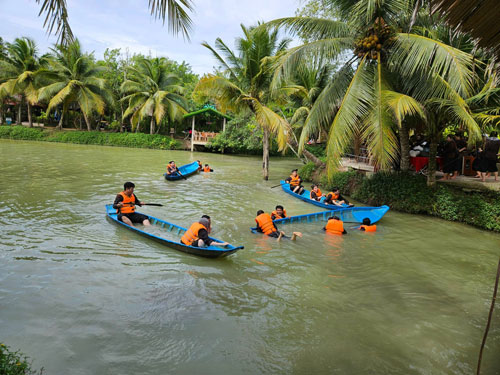
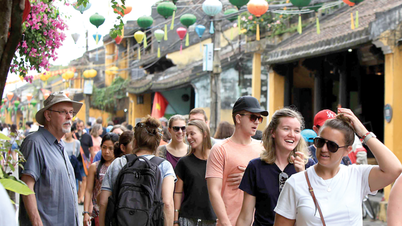
Setting ambitious goals can create breakthrough opportunities for tourism. (In the photo: Tourists enjoying themselves at a destination in Ben Tre. Photo: THAI PHUONG)
Regarding the Land Law and financial policies, the amended Land Law needs to be adjusted, paying attention to tourism issues, especially regulations on the development of tourist areas, to avoid overlooking the identification of land for tourism development. The Land Law must meet the objectives of Resolution 08 of the Politburo, which stipulates that by 2030, tourism will become a key economic sector, contributing 14%-15% to the national GDP.
Regarding Decree 132/2020/ND-CP, one of the bottlenecks causing difficulties for many businesses is the regulation capping the total interest expense (EBITDA) at 30%, as stipulated in point a, clause 3, article 16. This makes it difficult for many businesses to access capital, while banks have very favorable conditions for facilitating access to capital for tourism businesses.
Currently, tourism businesses primarily borrow capital from credit institutions through short-term loans, usually with a term of around 6 months. For long-term loans, besides high interest rates, collateral is required, but most assets of travel businesses are intangible products with low value; banks also tend to be risk-averse... making it almost impossible to access loan capital.
Therefore, it is necessary to focus on developing tourism in a sustainable direction, while simultaneously updating the tourism development strategy. The National Steering Committee for Tourism Development needs to be strengthened, starting with setting a target for international visitors in 2024. This target should not only be 12-15 million, but should aim for a higher figure of 18-20 million. Setting a high target can create opportunities for breakthroughs, coupled with the development of strong policies and incentives to promote the development of the tourism industry.
The boost from "event sets"
Regarding tourism promotion, a trade attaché mechanism, similar to what the Ministry of Industry and Trade is currently implementing, could be immediately put into effect. Simultaneously, it is proposed that the Prime Minister consider the Ministry of Foreign Affairs adopting a trade attaché mechanism in the field of tourism.
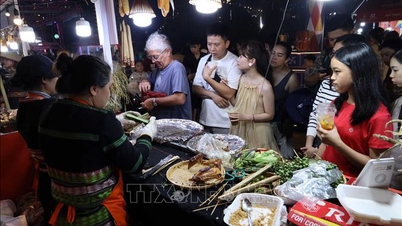
Regarding the night-time economy, many localities are still facing difficulties in implementing it. Most focus on activities such as pedestrian streets and food stalls, but fail to fully exploit the potential of the country's culture, history, unique characteristics, and especially the customs of local communities. This limits the full exploitation of tourism potential.
The night-time economy can be effectively integrated with cultural and sporting events. The recent Black Pink event is proof that culture has the potential to generate significant economic value, no less than sports. The tourism industry needs to propose and organize international-level events to attract tourists. Along with international and unique national events, authorities can review and adjust the current planning and management of domestic events.
Although ministries and agencies often organize large-scale national events, they have not yet been systematically organized into a set of events. It is necessary to establish a national set of events, announced annually, to create opportunities for tourism businesses to develop and integrate their products. Tourism products play a crucial role in the overall economy, and without this national set of events, businesses will struggle to develop and offer new products, leading to a lack of innovation in the industry.
For example, Vietravel has pioneered in coordinating with the People's Committee of Binh Dinh province to bring the F1H2O International Motorboat Championship to Binh Dinh in March 2024. With its multinational scale, this event attracted approximately 10,000-15,000 international tourists and about 3,500 athletes from various countries to compete. Simultaneously, when implementing international events, a well-planned and managed approach is essential to avoid unprofessional methods, lack of focus, and failure to fully utilize the event's potential and effectiveness.
Doing tourism with a Green, Clean, Bright, and Vibrant approach.
To manage destinations effectively, it is proposed to establish targets based on the GoGreen criteria with four main elements: Green - Clean - Bright - Lively, with the goal of creating a green, clean, bright, and enjoyable tourism environment not only for tourists but also for the local community.
Tourism, as a comprehensive economic sector, requires active attention and participation from relevant ministries and agencies. The story shared by the Ministry of Agriculture and Rural Development regarding agricultural tourism illustrates the positive connection between tourism and agriculture. When tourism is managed effectively, it can address the issue of agricultural product output.


Source
![[Photo] General Secretary and President To Lam presides over a working session with the Central Policy and Strategy Committee on the development of the materials industry.](https://vphoto.vietnam.vn/thumb/1200x675/vietnam/resource/IMAGE/2026/05/21/1779359935432_a3-bnd-3129-1412-jpg.webp)


![[Photo] National Assembly Chairman Tran Thanh Man working with the Standing Committee of the Law and Justice Committee](https://vphoto.vietnam.vn/thumb/1200x675/vietnam/resource/IMAGE/2026/05/21/1779378929214_ndo_br_1-4610-jpg.webp)
























































Comment (0)