

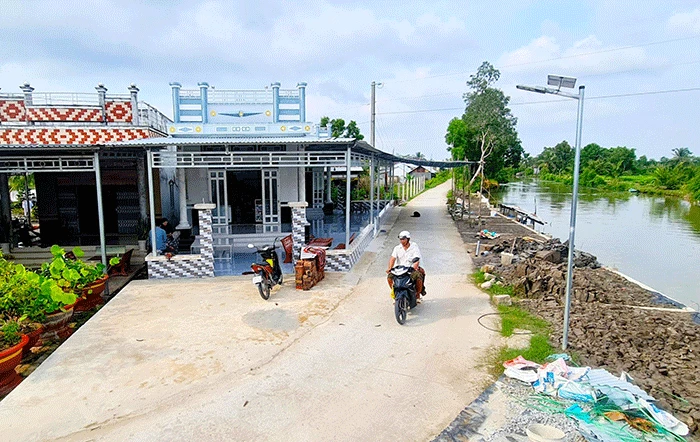
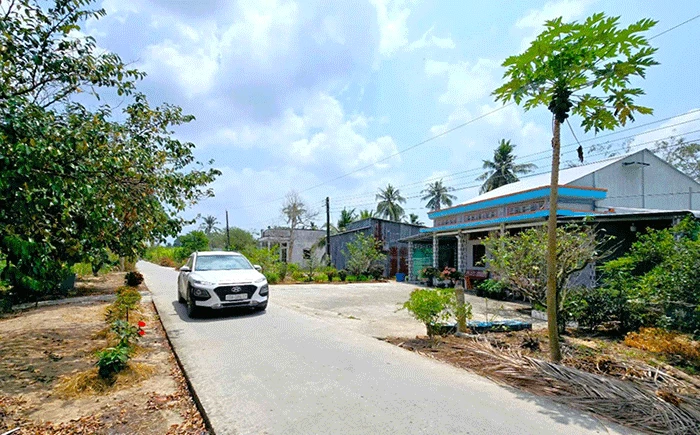
Khanh Lam commune has received investment in rural transportation infrastructure.
Heroic base area
From the center of U Minh town, we traveled along an 8-meter-wide paved road to Khanh Lam commune, U Minh district. On both sides of the road were rows of sturdy houses, behind which were rice and shrimp fields providing a stable income, and in the distance, lush green patches of melaleuca and acacia forests. Traveling with us to the Kinh Don Hang Gon area (Hamlet 3, Khanh Lam commune), Mr. Huynh Van Chien (Nam Chien, a guerrilla fighter in Khanh Lam commune during the resistance against the US) shared that during the war, enemy outposts surrounded the area. After each troop deployment and withdrawal, enemy artillery from the outposts and warships at sea would immediately bombard the area, and planes would continuously drop bombs from the air. Thus, the Kinh Don Hang Gon area suffered constant bombing, but the most heartbreaking was in 1969, when enemy B52 bombers caused immense losses to our people. The entire area, about 2km long and sprawling, was devastated and reeked of gunpowder. The bombing killed 65 people and injured more than 100. For example, Mr. Hai An's family lost all four members. Lacking wooden planks, the villagers gathered and used boat planks to make coffins, but there weren't enough to bury their loved ones, so many had to be buried together in one coffin.
“Loss and suffering only fueled the unwavering fighting spirit of our comrades. Back then, we didn't think about death; we just fought with all our might to liberate the nation. We shared the same ideal, and our people shared the same heart…” - said Mr. Nam Chien.
Mr. Duong Van Be (Ba Be, a local guerrilla fighter) recounted: “The women raised the soldiers like their own children. When soldiers were wounded, they sent them to the villagers to care for them, and the villagers always gave them whatever they had. The army and the people were closely bonded; it was thanks to the people's support that the soldiers were able to fight the enemy. Wherever they went, if the soldiers were hungry, the villagers would cook them food, day and night. The women were always wholeheartedly devoted; whenever they saw the soldiers, they would prepare chicken and duck for them to eat. It was very heartwarming!”
Mr. Ba Bé also recounted the heroic deeds of Mr. Phan Văn Thuấn with a voice full of pride. In a fierce battle, Mr. Thuấn's abdomen was covered in wounds, but he tied a cloth around his stomach and continued fighting until he fainted on the spot. His comrades carried him back, and luckily, they met a medic along the way, who performed surgery on him to repair nine perforated sections of his intestine. Mr. Thuấn survived, becoming a symbol of the brave soldier who fought the enemy, an example for the people of the U Minh forest region to follow.
"Land of Fire" is transforming.
Today, the Kinh Don Hang Gon area still bears the "monument of hatred." Every year on September 11th, the locals hold a ceremony to commemorate those who died in the B52 bombing raids. When veterans like Mr. Ba Be and Mr. Nam Chien gather, they remember their fallen compatriots, recount the fierce moments of the war... and then share effective economic models and good practices to help each other rise up. The revolutionary spirit of the soldiers of the past remains, but the will to overcome difficulties is now applied to the economic development front. Mr. Ba Be, nearly 80 years old, still raises livestock and cultivates his fields. "After the reunification of the country, I returned to live on the 2 hectares of land inherited from my grandparents. Farming and raising livestock bring in over 200 million dong annually. With peace in the country, the economy in this region has gradually stabilized and developed, and the lives of the people are much better than before," said Mr. Ba Be.
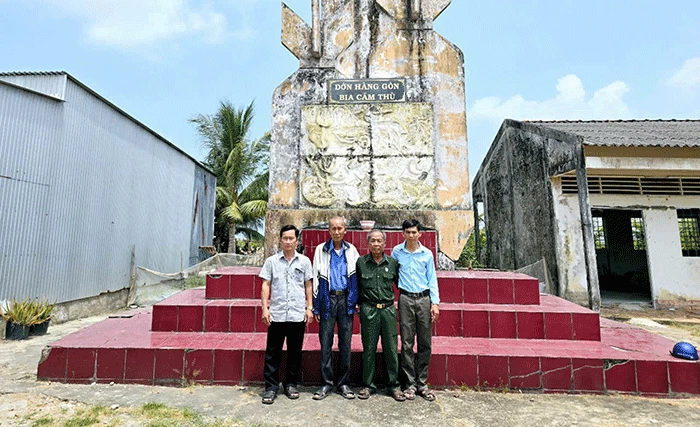
"Monument of Hatred" - a place to commemorate those who lost their lives in the B52 bombing raids in U Minh Ha.
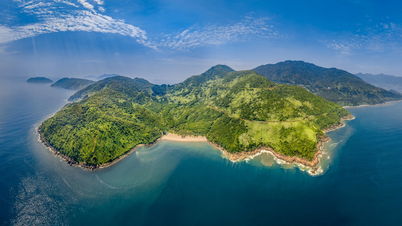
The revolutionary base area, encompassing the communes of Khánh Lâm, Khánh Hòa, Khánh Hội, and Khánh Tiến, has also seen comprehensive infrastructure development. Families who contributed to the revolution have received support in building houses of gratitude. Fifty years ago, the U Minh Hạ forest was heavily devastated by bombs and bullets, leaving villages in ruins and forests barren. However, with a spirit of self-reliance and resilience, the people of this forest land have embarked on the task of restoring and rebuilding their homeland. Today, vast green forests stretch out, intertwined with the traditional beekeeping profession – a national intangible cultural heritage; there are also picturesque canals and pristine melaleuca forests with great potential for ecotourism development, and these are already attractive destinations for tourists. U Minh Hạ also holds great promise for forestry development, along with its abundance of agriculture and fisheries.
Mr. Tran Quoc Su, Deputy Chief of the Office of the People's Committee of U Minh District, said: “During the war, U Minh was a revolutionary base area, and it also embodied the tradition and spirit of solidarity in fighting foreign invaders of our people. U Minh today continues to uphold this tradition, demonstrating unity and solidarity in development. When mentioning U Minh, people also think of the Khanh An Gas-Electricity-Fertilizer Industrial Park, one of the largest industrial parks in the province and the Mekong Delta region. Besides this industrial park, the district also focuses on socio -economic development, and the district's growth consistently meets targets.”
U Minh Ha has been experiencing a strong resurgence, becoming a land of great potential. The socio-economic development of U Minh district is quite comprehensive. From 2009 to the present, the district has built more than 3,000 houses for policy beneficiary households, poor households, and ethnic minority households. The poverty rate in the district was 16.7% in 2008; by the end of 2024, the district had only 723 poor households, accounting for 2.7%. The story of the U Minh Ha forest region's transformation is a testament to the strength of patriotism, solidarity, and the will to succeed of the people of this forest region in particular, and of the people of the southernmost region of Vietnam – Ca Mau, in general.
Mr. Nguyen Minh Luan, Vice Chairman of the People's Committee of Ca Mau province, said: During the two protracted wars against foreign invaders, U Minh Ha was a base area for the Provincial Party Committee, the Regional Party Committee, and the Central Committee of the Southern Region. The late General Secretary Le Duan, the late Prime Minister Vo Van Kiet, and many other high-ranking leaders stayed here to lead the revolutionary movement in the South during the most intense years of the war. Thousands of people from this forest region joined the army to fight the enemy, contributing to the defeat of the "limited war," "special war," and "Vietnamization of the war" strategies, breaking the "U Minh weed clearing" campaign of the US-puppet regime, leading to the liberation of the South and the reunification of the country. Resolution 15 of the Politburo – a historic resolution on the revolution in the South – was drafted by the late General Secretary Le Duan in the U Minh Ha forest region. |
Text and photos: HIEU NGHIA
Source: https://baocantho.com.vn/dat-rung-hoi-sinh-a185707.html


![[Photo] Prime Minister Pham Minh Chinh presides over a meeting on private sector economic development.](/_next/image?url=https%3A%2F%2Fvphoto.vietnam.vn%2Fthumb%2F1200x675%2Fvietnam%2Fresource%2FIMAGE%2F2025%2F12%2F20%2F1766237501876_thiet-ke-chua-co-ten-40-png.webp&w=3840&q=75)
![[Photo] Prime Minister Pham Minh Chinh presides over the conference announcing the establishment of the International Finance Centre in Vietnam.](/_next/image?url=https%3A%2F%2Fvphoto.vietnam.vn%2Fthumb%2F1200x675%2Fvietnam%2Fresource%2FIMAGE%2F2025%2F12%2F21%2F1766309817714_ndo_br_dsc-3400-jpg.webp&w=3840&q=75)






























































Comment (0)