


On November 9th, the Nguoi Lao Dong newspaper organized a seminar titled "Removing Legal Obstacles for Real Estate." Many opinions from managers, experts, lawyers, associations, and businesses suggested that legal bottlenecks must be resolved to help the real estate market recover more significantly.
The market has passed its bottom, and there is no shortage of capital.
Speaking at the seminar, many experts and association leaders agreed with the assessment that the real estate market has passed its most difficult phase, bottomed out recently, and is recovering, although challenges remain.
According to data cited by Dr. Can Van Luc, a member of the National Financial and Monetary Policy Advisory Council, the market has two relatively promising segments: residential real estate and industrial park real estate, which have been least affected recently. Regarding residential real estate, preliminary reports from the Vietnam Real Estate Brokers Association reflect a recovery, with each quarter surpassing the previous one. Approximately 20,000 products have been launched; transaction volume has gradually increased over the quarters, with a 56% increase in Q3 2023 compared to the previous quarter.
Regarding industrial real estate, the country has nearly 400 industrial parks, of which about 292 are operational with an occupancy rate of approximately 80% - 82%. The occupancy rate by the end of Q3 2023 was around 82% in the South and 80% in the North. Industrial park rental prices continued to increase by 7%-12% in Q3 2023 compared to the same period last year. New supply is still increasing, with strong prospects from FDI projects, and high demand for warehouses, factories, and social housing associated with industrial parks.
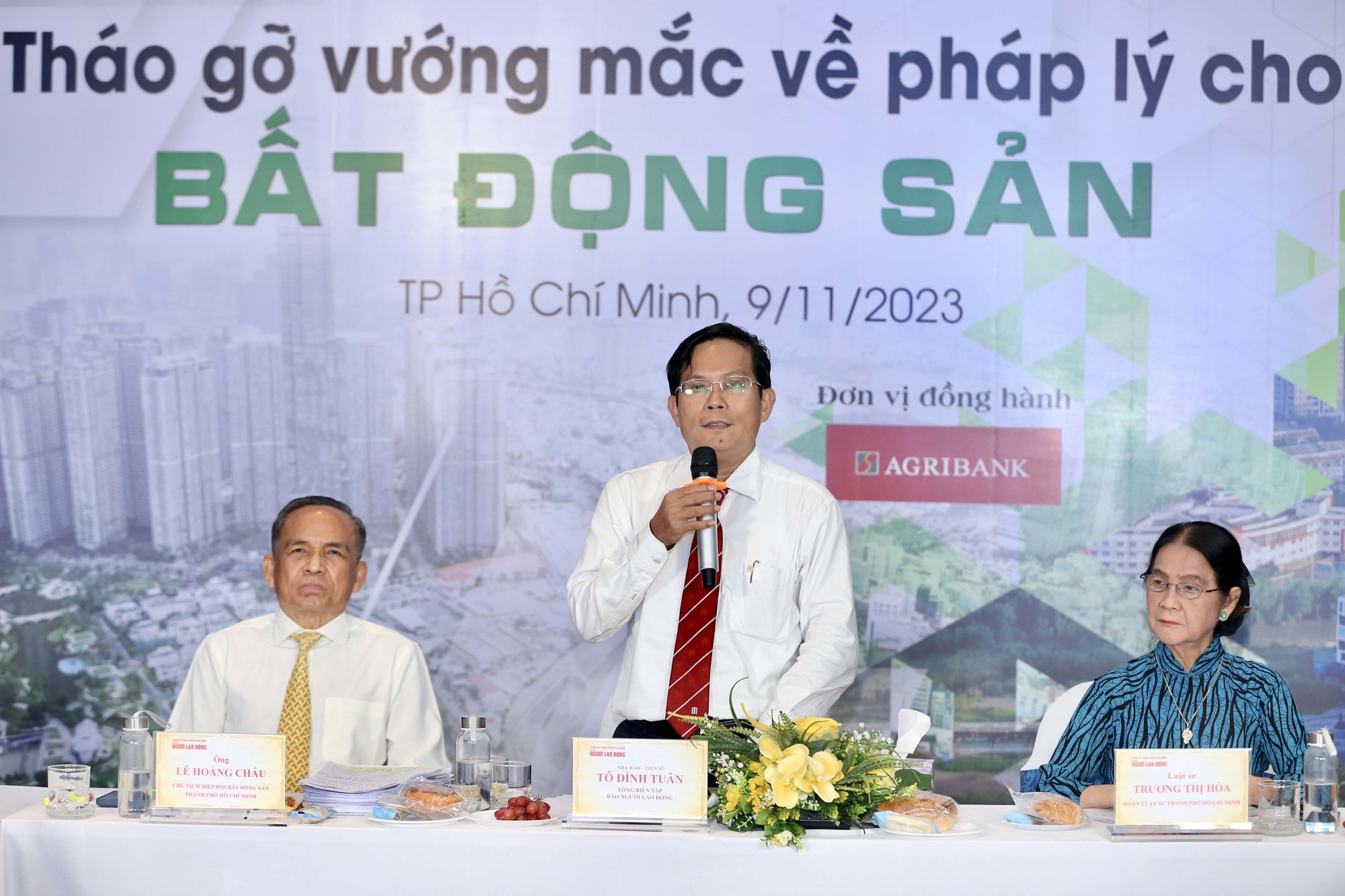
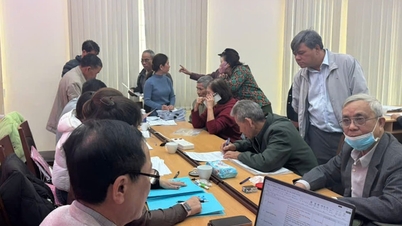
Journalist and Doctor To Dinh Tuan, Editor-in-Chief of Nguoi Lao Dong Newspaper, chaired the seminar. Photo: HOANG TRIEU
One of the previously discussed challenges in the real estate market – access to credit – is now gradually being addressed. Data released by the State Bank of Vietnam shows that credit for real estate investment and housing increased by approximately 4.7% in the first six months of 2023, despite declining incomes and high interest rates. Foreign direct investment (FDI) has been quite positive, with nearly $2 billion registered for real estate in the first 10 months of 2023, of which approximately $763 million has been disbursed. Real estate companies are also actively raising capital through bond issuance, negotiating maturing bonds, and repurchasing issued bonds.
Mr. Le Hoang Chau, Chairman of the Ho Chi Minh City Real Estate Association, also stated that the market has passed its bottom. Specifically, according to data from the Ho Chi Minh City Department of Construction, the bottom was reached in the first quarter of 2023, when the real estate sector experienced negative growth of 16.1%, but then gradually improved. At the end of the second quarter of 2023, real estate growth was still negative by more than 11%, but from the third quarter onwards it was only negative by more than 8%.
One of the credit packages expected to create momentum for the real estate market recently is the 120,000 billion VND loan package for investment in social housing development projects. The Vietnam Agricultural and Rural Development Bank ( Agribank ) stated that since the first day of implementing this credit package, 30,000 billion VND has been registered.
According to Mr. Pham Van Duong, Director of Agribank's Binh Trieu Branch (Ho Chi Minh City), Agribank is a 100% state-owned bank, so it must strictly comply with all regulations, including the 120,000 billion VND package. Agribank has been involved in social housing projects since October 2022 and has pursued them until now. Regarding credit capital, the bank has surplus funds and is ready to lend to businesses. However, the issue is that when providing capital to projects, it must also fully comply with state regulations. Currently, Agribank is coordinating with businesses to resolve difficulties and expedite disbursement for the projects.
"Interest rates for social housing loans are currently the lowest in many years. Agribank is currently offering loans to customers buying social housing at an interest rate 2 percentage points lower than the standard rate. With low interest rates and readily available capital, we're just waiting for businesses to complete the procedures for disbursement," Mr. Duong affirmed.
Strengthening the role of working groups
While there is no shortage of credit for social housing, businesses say that implementing these projects is very difficult.
Mr. Vo Minh Hoang, General Director of Ho Chi Minh City Social Housing Joint Stock Company, said that the government offers many incentives for social housing development, but many businesses have not been able to access them. Even before participating in social housing projects, businesses found it difficult, and once involved, it became even more challenging. Specifically, besides capital, businesses also face difficulties regarding land availability. Therefore, businesses hope the government will review the land available for lease and include it in the list of projects for social housing development, and conduct bidding to select investors. Afterward, businesses can participate in social housing development and include the land costs in the project development costs.
"Businesses undertaking social housing projects only make a 10% profit, but the selling price and target buyers must all be approved by the Department of Construction. Meanwhile, some costs cannot be included in the selling price. Building social housing takes longer and is more difficult than commercial housing, making businesses less enthusiastic. Waiting 2-3 years for banks to disburse loans is unacceptable for businesses. Therefore, we propose a mechanism for faster disbursement," Mr. Hoang suggested.
The aforementioned difficulties in the real estate market have been identified and discussed in the past. The remaining issue, according to experts and businesses sharing their views at the Nguoi Lao Dong newspaper's seminar, is to propose the most feasible solutions to expedite the removal of these difficulties.
Mr. Thai Doan Hoa, Deputy Head of the Housing Development and Real Estate Market Department - Dong Nai Provincial Department of Construction, said that through a review, Dong Nai has identified five groups of difficulties and obstacles in the real estate sector. The most prominent of these is the difficulty and obstacle regarding the procedures for approving investment policies and selecting investors. Some projects have received investment approval for many years, but now, inspection agencies are requiring them to comply with the Housing Law – meaning they must have residential land. Land valuation is also difficult. Some projects have been allocated but cannot be valued because consulting companies are hesitant to do so for fear of difficulty explaining to the authorities...
"There are many difficulties in implementing the task of building social housing in the project. Many projects were implemented according to old regulations, but later encountered obstacles when the planning was adjusted. For example, the Housing Law stipulates that localities must re-evaluate and require businesses to allocate 20% of the project area for social housing, which is very difficult," Mr. Hoa stated, describing the current situation.
To overcome these difficulties, Dong Nai province has planned to continue allocating land for commercial housing from now until 2030, with the remainder allocated to social housing. The planning process is complete and ready to attract investors, but challenges remain. Since 2022, the Provincial Party Committee and the People's Committee of Dong Nai province have directed the establishment of a working group to address requests and resolve difficulties for businesses.
From the beginning of 2023, Dong Nai province established three task forces to resolve obstacles for slow-moving projects, address difficulties for businesses, and develop social housing. All three task forces are headed by provincial leaders. Departments, specifically the Department of Construction, also established task forces to resolve difficulties within their jurisdiction, addressing issues in stages; if issues involve higher levels of authority, they will register to work with relevant ministries and agencies to resolve them for businesses.
Expectations are high for the three draft amendments to be passed soon.
One of the expected solutions is the three draft laws – including the Law on Real Estate Business (amended), the Law on Housing (amended), and the Law on Land (amended) – which are currently being discussed and commented on at the 6th session of the 15th National Assembly ; if passed, they will remove legal obstacles for the real estate market.
Lawyer Nguyen Tan Phong, Standing Committee Member of the Vietnam Real Estate Brokers Association, analyzed: The draft Housing Law (amended) raises the issue that some disputes will be resolved through commercial arbitration. Currently, disputes between investors, homebuyers, and apartment users still occur, with many projects failing to issue ownership certificates for many years. The new regulations in the draft law will help them understand this more clearly.
The draft Law on Real Estate Business (amended) also addresses improving the quality of real estate brokerage in the future...
"When these three laws are passed, they will contribute to the dissemination of legal knowledge and improve the quality of participants in the real estate market, especially brokers," lawyer Phong observed.
The authorities need to provide specific and clear guidance.
Regarding the legal and procedural aspects of social housing construction, many experts believe that businesses and associations need to specifically identify current obstacles and determine which procedures should be eliminated. In terms of approach, the government and relevant agencies need to provide clear and specific guidance on all current issues, overlaps, and inconsistencies; local authorities also need to clarify these issues, avoiding lengthy and ineffective consultations.
"Businesses and associations are making great efforts, but in my opinion, they need to strive for more accurate recommendations and more specific accompanying solutions," assessed Dr. Can Van Luc.
PARTNER ORGANIZATION

Source: https://nld.com.vn/kinh-te/toa-dam-thao-go-vuong-mac-ve-phap-ly-cho-bat-dong-san-day-nhanh-toc-do-phuc-hoi-bat-dong-san-20231109222055675.htm



![[Photo] Prime Minister Pham Minh Chinh receives the Director General of TASS News Agency (Russian Federation)](https://vphoto.vietnam.vn/thumb/1200x675/vietnam/resource/IMAGE/2026/02/25/1772024599891_dsc-8041-jpg.webp)

![[Photo] Prime Minister Pham Minh Chinh presides over the meeting of the Steering Committee for the Development of Science, Technology, Innovation, Digital Transformation and Project 06.](https://vphoto.vietnam.vn/thumb/1200x675/vietnam/resource/IMAGE/2026/02/25/1772024613089_1772024091685-jpg.webp)























































































Comment (0)