

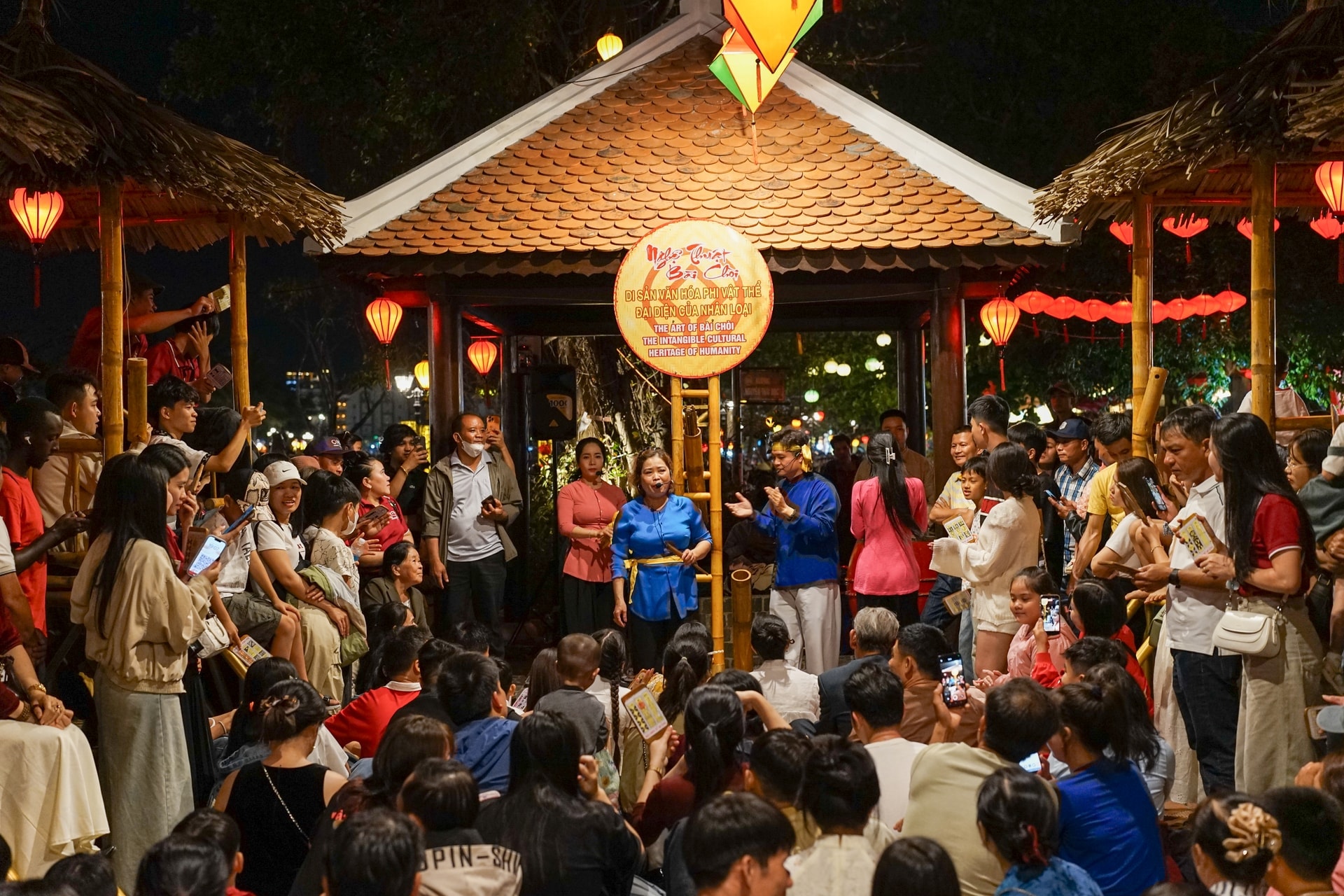
And so, amidst the hustle and bustle of life, many people still ponder how to ensure that the melodies of folk songs will continue to resonate in the future...
The heartache of a lover
In a conversation with musician Tran Hong, author of the book "Musical Pieces - Folk Songs in Traditional Vietnamese Theatre (Tuong, Cheo, Folk Drama)" a few years ago, what resonated with me was the concern of someone who has dedicated his life to traditional music . He said that folk songs have survived through generations because they emerged from everyday life. People sing folk songs while rowing boats, lulling their children to sleep, during festivals, or on moonlit nights while harvesting rice. Therefore, the melodies are as natural as breath, permeating the memories of countless people.
Driven by his deep concern, he spent many years researching and systematizing the melodies and songs used in various forms such as Tuong, Cheo, and folk drama. According to him, in Quang Nam folk songs, the "ly" (lyrics/folk songs) play a crucial role in conveying emotions and story content, helping audiences deeply understand the cultural values and the spirit of the Central Vietnamese community. Unfortunately, amidst the modern flow and numerous new forms of entertainment, the gap between young people and traditional folk songs is widening. Many people no longer know the "ly" melodies of Quang Nam such as "Ly Con Sao," "Ly Choi Xuan," "Ly Ngua O," "Ly Thien Thai," etc.
Undeniably, the folk songs of Quang Nam province thrive thanks to their strong community bonds. These songs are relatable, flexible, humorous, and serve both entertainment needs and the preservation of folk memories. Dr. Tang Chanh Tin, a lecturer at the University of Education ( Da Nang University), argues that familiar folk songs can be adapted to different situations while still retaining the distinctive folk melodies of Quang Nam in their pronunciation, intonation, and rhythm. Singers can improvise and change the lyrics to suit the circumstances, but still preserve the essence of the melody. This is what allows folk songs to endure through generations as a form of folk culture closely connected to daily life.
We need to consider the rationale behind the conservation argument.
Many believe that it is time for the cultural sector to seriously consider preserving folk melodies as part of a strategy for community cultural education and development. Composer Tran Hong once emphasized that preserving folk melodies must go hand in hand with direct teaching in daily life. Younger generations should be introduced to folk melodies through classes, folk music clubs, and festivals, where children and young people can experience them firsthand, listening, singing, and playing accompanying musical instruments.
According to musician Tran Hong, the important thing is to systematize the melodies and tunes of folk songs in various forms of traditional theater. Continuing to research, collect, record, and compile typical melodies helps preserve these songs and transform them into serious academic materials, serving as a foundation for the education and performance of future generations. “Melodies like 'Ly Con Sao,' 'Ly Choi Xuan,' 'Ly Ngua O,' 'Ly Thien Thai,' etc., when recorded and systematically analyzed, will help young people learn, practice, and develop the essence of Quang Nam folk songs,” he shared.
In recent years, many schools in Da Nang have incorporated Bài Chòi, folk songs, and Lý melodies into extracurricular programs, school cultural clubs, and arts competitions. However, objectively speaking, a few extracurricular lessons cannot create a lasting impact without connection to community life and systematic guidance from artisans. Researcher Nguyen Van Bon warns that many valuable Lý melodies will only exist on paper or in old audio recordings if there is no clear preservation policy. He emphasizes that the value of Lý melodies lies in their ability to record memories, emotions, customs, and community life, and that direct exposure of children and teenagers to these melodies is essential to maintaining this heritage.
Having taught folk singing to students, artist Phung Thi Ngoc Hue from the Hoi An World Cultural Heritage Conservation Center said it takes several days for students to learn one folk melody and more than a month to learn about 30 basic folk melodies. According to her, teaching folk singing cannot be rushed or done simply because it's trendy. Young people today are exposed to a lot of modern music, so it takes time for them to truly appreciate folk songs. The important thing is to create initial interest, so that the children see folk melodies as familiar and not something too unfamiliar.
From her teaching experience, she noted that many students were initially hesitant, believing folk songs were difficult to sing, slow-paced, and "outdated." However, after some time, many began to enjoy the simplicity and wit in the lyrics and appreciate the unique beauty of their homeland's music. Some even proactively sought out more about Bài Chòi, Tuồng, and other folk art forms of Central Vietnam. This shows that, with the right approach, folk songs can still resonate with today's youth.
It can be said that, amidst the flow of modernity, the melodies of "Ly tinh tang o tang tinh oi…" still quietly exist in the memories of many people from Quang Nam province. It's no longer just music, but a whisper, like the voice of their homeland, their roots. What's most needed now is perhaps love and continuity before an older generation of artists gradually fades away. Because if those who know each lyric, each rhythm, each characteristic inflection of Quang Nam folk songs are gone, and there's a lack of successors, then the risk of their disappearance is inevitable.
Source: https://baodanang.vn/de-dieu-ly-con-ngan-3336896.html
![[Image] "Journey of Hope" promotes the organ and tissue donation movement in Vietnam.](https://vphoto.vietnam.vn/thumb/1200x675/vietnam/resource/IMAGE/2026/05/20/1779294400833_1-8910-jpg.webp)
![[Photo] National Assembly Chairman Tran Thanh Man working with the Standing Committee of the National Assembly's Ethnic Council](https://vphoto.vietnam.vn/thumb/1200x675/vietnam/resource/IMAGE/2026/05/21/1779337435930_ndo_br_1-jpg.webp)






























































Comment (0)