

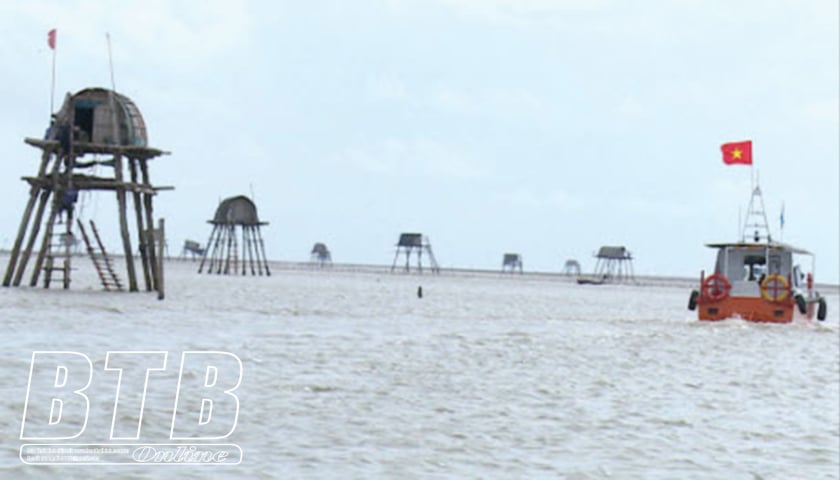
Clam farming area in Nam Thinh commune (Tien Hai district).
Many aquaculture models have proven highly effective.
With its favorable natural conditions, Thai Thuy district has implemented various solutions to promote the development of the aquaculture industry, contributing to economic growth and increasing farmers' incomes. Visiting the high-tech shrimp farming model of Mr. Pham Duc Bang in Thai Thuong commune while he was preparing for the spring-summer planting season, Mr. Bang shared: "Over the years, I have invested more than 4 billion VND to build 4 shrimp farming tanks in a covered area with a total area of 5,000 m² . The shrimp farming area is equipped with modern equipment such as aeration machines, temperature measuring devices, automatic feeders, and surveillance cameras... Since starting high-tech shrimp farming, I have been able to maintain production for 4 seasons a year thanks to technology that controls the temperature, environment, and feed for the shrimp. The shrimp are raised in clean water and according to standard procedures, so they are about 40 shrimp per kilogram. Each season yields about 4-5 tons of shrimp." The effectiveness of aquaculture in coastal areas has been confirmed to yield high economic returns.
Regarding freshwater aquaculture, in recent years, specialized agencies and localities have implemented various solutions to promote its development, such as semi-floating pond models and planning for aquaculture areas specializing in specific aquatic species. At the end of 2019, Mr. Pham Van Tinh's family in Binh Dinh commune (Kien Xuong district) requested permission to convert 5.5 hectares of low-yield rice land belonging to the collective and several households to implement a semi-floating pond model for freshwater fish farming. To date, Mr. Tinh's family has been in production for three years, and after deducting costs for fry and feed, they earn a profit of over 800 million VND per year. On average, each hectare yields approximately 160 million VND per year.
These two models are just two of thousands of successful aquaculture models that bring high economic efficiency to farmers, gradually eradicating poverty and creating legitimate wealth in their homeland.
Promoting sustainable fisheries development.
Sixty-six years ago, in late March and early April 1959, President Ho Chi Minh visited fishing villages and fishermen on Tuan Chau and Cat Ba islands. There, he taught: "Our silver sea is owned by our people." To commemorate this historical event and in accordance with the wishes of officials, civil servants, workers, and a large number of fishermen, determined to implement his teachings, on March 18, 1995, the Prime Minister issued Decision No. 173/QD-TTg officially designating April 1st as the traditional day of the Vietnamese fisheries industry. Mr. Hoang Minh Giang, Head of the Department of Marine and Fisheries, stated: The sustainable development of Vietnam's fisheries industry has benefited from the contributions of Thai Binh province's fisheries sector, with a focus on sustainable development, enhancing production value while protecting and developing fisheries resources and the ecological environment.
Thai Binh province has a 54km long coastline with many potentials and strengths for developing its marine economy. In recent years, Party committees and authorities at all levels have implemented many policies and solutions to promote the development of the fisheries sector, especially focusing on sustainable exploitation and aquaculture. This includes strengthening the application of scientific advancements and new technical processes in production to improve productivity, output, and efficiency per unit area, creating high-value aquatic products to meet market demands. The province has also diversified its aquaculture species and methods in saltwater, brackish, and freshwater areas, such as farming whiteleg shrimp, tiger shrimp, grouper, red snapper, catfish, and areas for cultivating high-value economic lugworms. The fishing industry is a long-standing traditional occupation of fishermen in Thai Binh province. From a small-scale, inshore fishing activity, the structure of fishing vessels has shifted towards increasing offshore fishing vessels and reducing inshore ones, applying technology to exploit high-value marine resources. Fishermen in the province have invested in building many new fishing vessels and logistics support vessels, applying advanced technology to preserve products after harvest, improving the quality and value of their catch. They also equip and use communication equipment such as short-range and long-range walkie-talkies, GPS devices, and vessel tracking devices to ensure the safety of people and vessels during fishing operations at sea.
In the field of seafood processing, Thai Binh has contributed products for domestic consumption and exported many high-quality items such as clams, fish sauce, and peeled shrimp to markets in Southeast Asia and European countries. The protection and development of aquatic resources is increasingly receiving attention from all levels, sectors, and organizations, and is enthusiastically supported by the people of the province. People's awareness is increasingly improving in complying with regulations on the exploitation, protection, and development of aquatic resources, especially in preventing and combating illegal, unreported, and unregulated fishing. The rapid and sustainable development of the fisheries sector, particularly the production, aquaculture, and fishing infrastructure, has significantly improved the economic, cultural, and social lives of the people. In 2024, the aquaculture area reached 15,365.09 hectares, with an aquaculture production of 188.8 thousand tons, an increase of 0.5% compared to 2023. The estimated production of fish fry reached 565.4 million. The province had 731 fishing vessels with a total capacity of 143,891 horsepower, and a catch of 291.7 thousand tons. The total value of the fisheries sector reached 6,073 billion VND, an increase of 2.27% compared to 2023, making a positive contribution to the overall growth rate of the agricultural sector and the province's economic development.
To develop sustainable aquaculture in the coming period, Thai Binh province has implemented numerous solutions for aquaculture development in each region and locality. It has actively transformed the structure of aquaculture, applying high-tech agricultural production to provide new methods for aquaculture farmers, changing traditional farming practices based on experience and techniques. The province has effectively carried out its state management duties regarding aquaculture, exploitation, and protection of aquatic resources in accordance with the Fisheries Law and its implementing regulations; and has directed and guided organizations and individuals involved in aquaculture production to consolidate land, invest in infrastructure, apply science and technology to adapt to climate change, and establish product consumption linkages to improve efficiency, increase value, and ensure sustainable development.
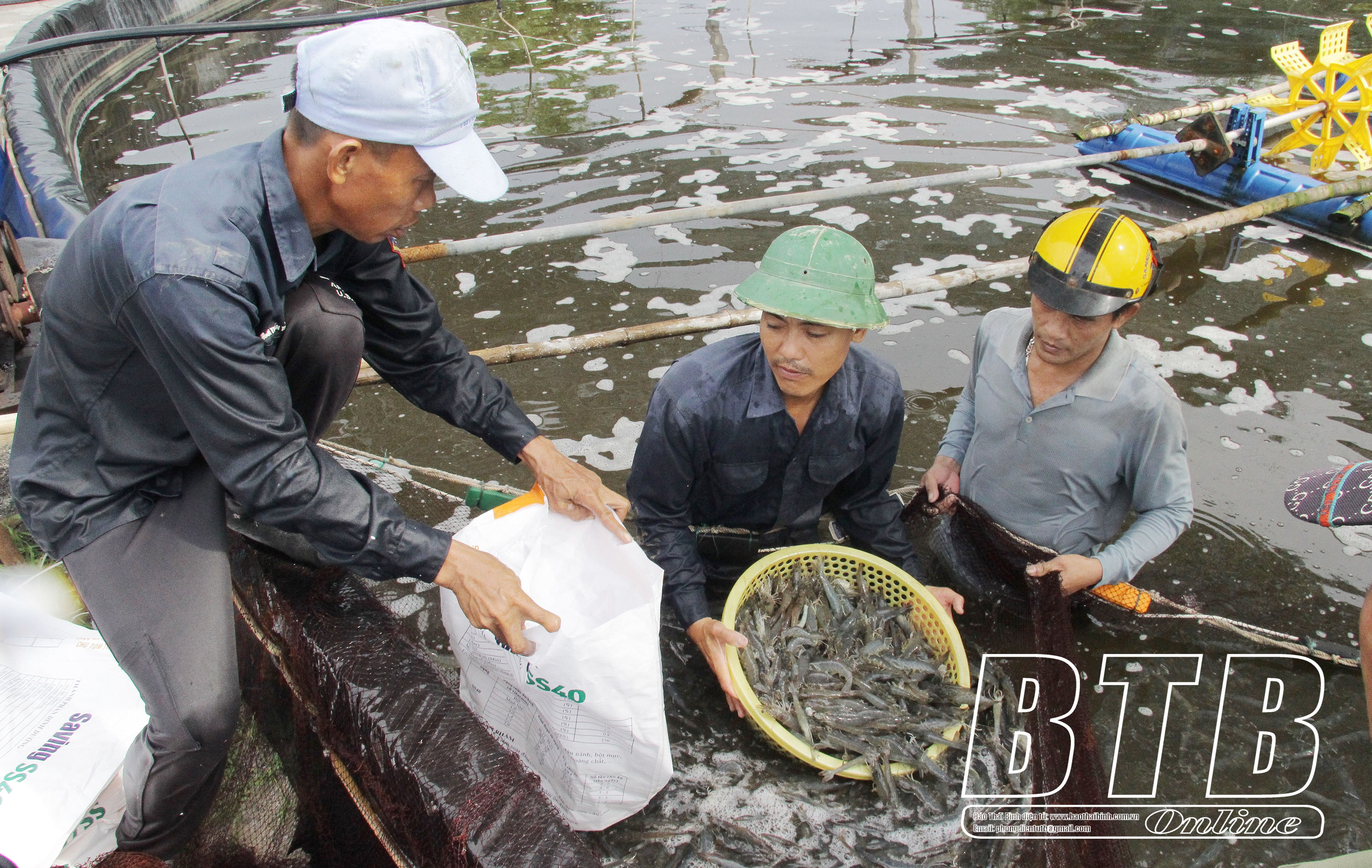
The effectiveness of high-tech shrimp farming in Nam Phu commune (Tien Hai district).
Manh Thang
Source: https://baothaibinh.com.vn/tin-tuc/4/220957/de-nganh-thuy-san-phat-trien-ben-vung


























































Comment (0)