

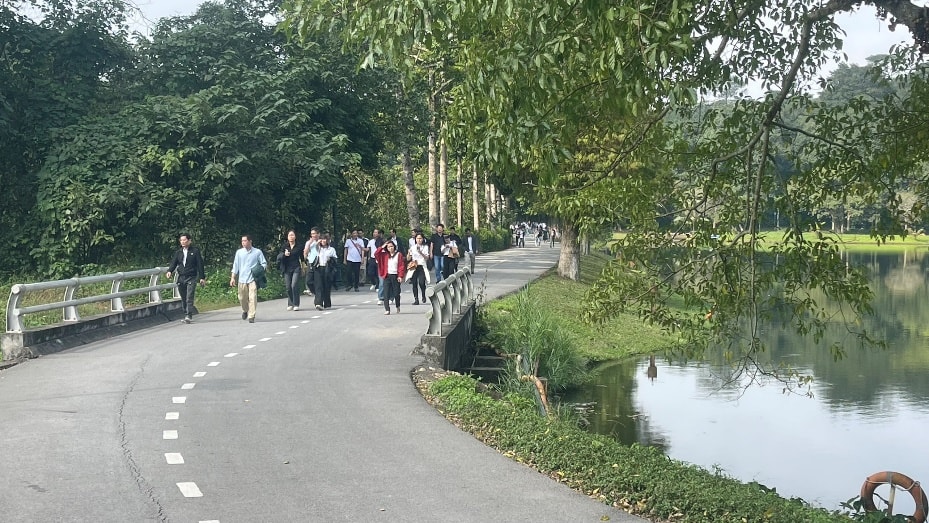
The historical site possesses unique values.
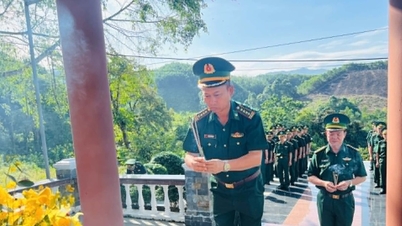
Stepping through the gates of K9, the first impression isn't the grandeur of a historical structure, but rather a sense of tranquility. The tranquility of the mountains and forests, of time, and of a space that has witnessed momentous decisions for the nation, yet still retains its humility and simplicity.
Da Chong – a rustic yet evocative name, associated with the unique topography of this region. According to the tour guide, in May 1957, during an inspection of the 36th Regiment, 308th Division, President Ho Chi Minh stopped to rest and have lunch on a hill beside the Da River. There were three sharp rock formations, arranged side-by-side, resembling spikes protruding from the earth, hence the local name Da Chong (Spike Rock). During that simple lunch amidst the mountains and forests, with the eye of a strategist, President Ho Chi Minh quickly recognized the special advantages of this area. He discussed with his companions the possibility of researching and developing it into a base for the Central Committee.
On February 23, 1958, Uncle Ho returned and decided to choose Da Chong to build a base. Hearing that story again amidst the quiet atmosphere of the year-end days, I felt even more clearly the strategic yet extremely concrete thinking style of President Ho Chi Minh. It wasn't abstract calculations, but rather meticulous observation of the terrain, the people, the mountains, and the rivers, closely linked to the practical requirements of the revolution.
In September 1959, the General Department of Logistics was tasked with constructing the base. On March 15, 1960, the project was completed and officially inaugurated with the codename "K9 Base". From then on, it became an important working location for President Ho Chi Minh and the Politburo .
In the humble, one-story houses nestled beneath the forest canopy, many important meetings and discussions on Vietnam's revolutionary strategy took place. It was also here that President Ho Chi Minh received close international friends who consistently offered sincere support to Vietnam. Walking among these houses today, everything remains meticulously preserved, without ostentation or extravagance. This simplicity reminds me of President Ho Chi Minh's own lifestyle and work ethic: profound in thought but simple in everyday life.
K9 is not just a working base. It also carries a special and sacred mission. After President Ho Chi Minh passed away on September 2, 1969, in response to the need to preserve and absolutely protect his remains during the fierce war , the Politburo and the Central Committee of the Party decided to choose this location as the main site to carry out this special task.
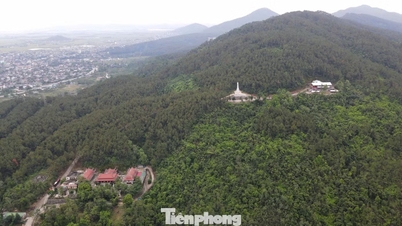
Da Chong was chosen because it is located in a strip of forest connecting to Ba Vi mountain. From above, the structures here are nestled within a forest and lack distinctive topographical features that would easily draw attention, thus offering many advantages in maintaining secrecy. Da Chong is not too far from Hanoi, making the transportation of President Ho Chi Minh's remains relatively easy, and it is connected to safe mountainous forest areas, allowing for mobility in special situations.
Over a period of six years (1969-1975), President Ho Chi Minh's remains were preserved here three times, for a total of four years, four months, and nineteen days. Now, standing before the building where the room containing his remains was once kept, I feel a profound sense of solemn silence. That atmosphere seems to hold back my steps, forcing me to slow down and think more deeply.
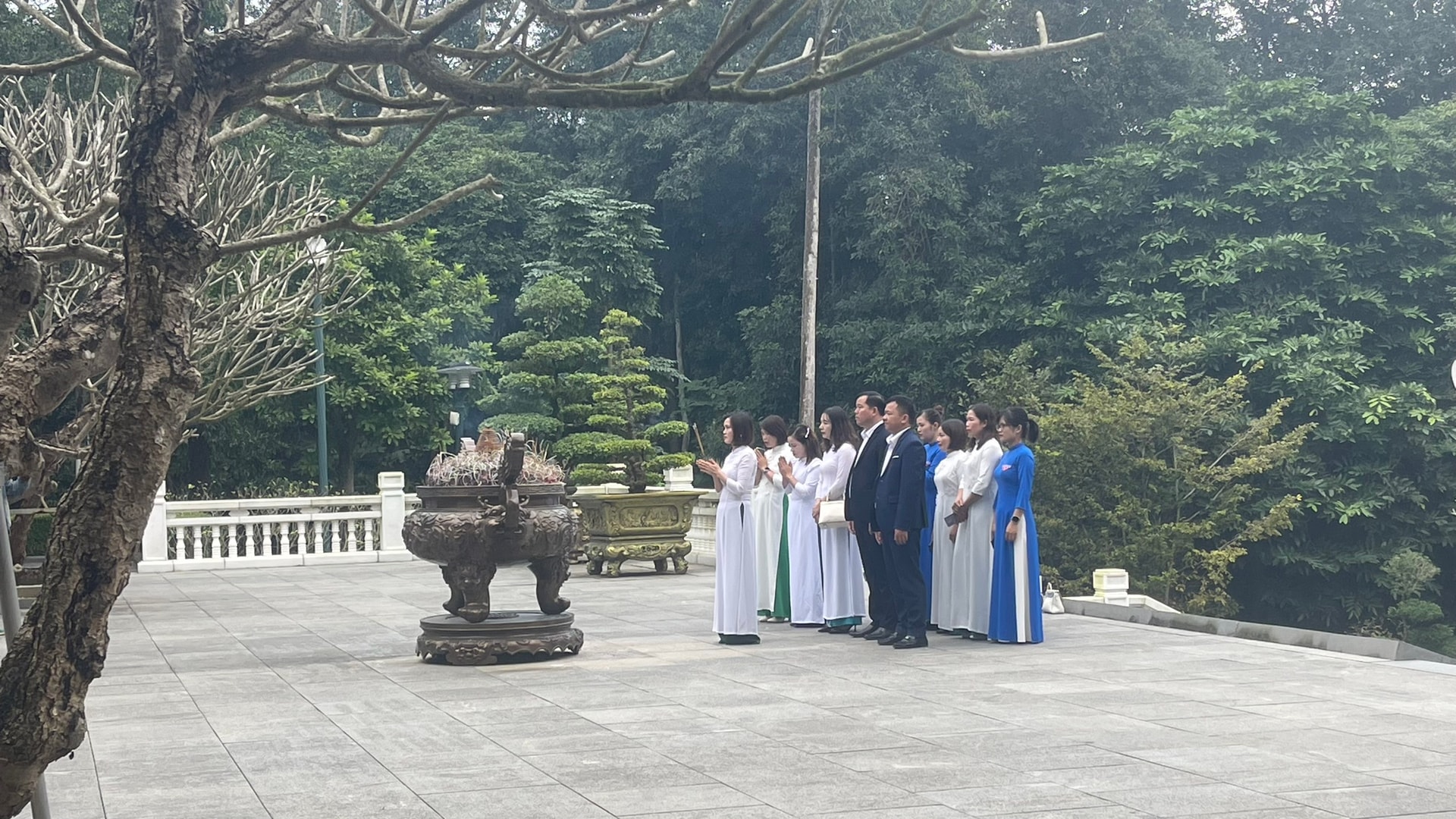
"The source" for nurturing ideals
It was no coincidence that President Ho Chi Minh chose this place. Da Chong possessed all the conditions of a strategic base: a pristine forest cover, a united people wholeheartedly devoted to the revolution; a distance not too far from the capital; and sufficient safety for the Central Committee to lead and direct the revolution during the most critical times. The practical experience of operating the K9 base area for nine years during the period of resisting the bombing campaign against North Vietnam and providing support to South Vietnam has left many valuable lessons about building strategic bases, which remain relevant in the cause of national defense today.
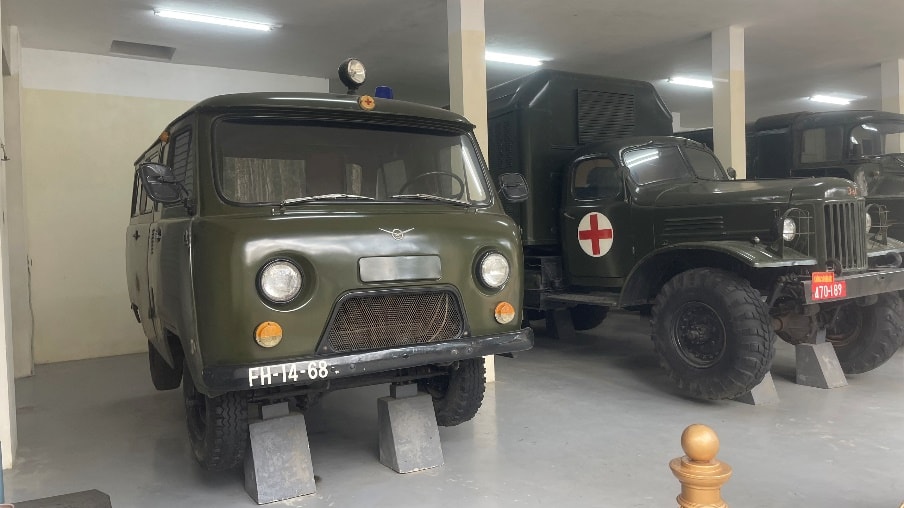
Today, the Da Chong historical site is recognized not only for its historical value but also for its cultural and educational depth. Many believe that researching and promoting the value of the Da Chong site is of particular importance, serving as a "source" for fostering revolutionary ideals, ethics, and the qualities of the Ho Chi Minh's soldiers in the new era. The application of technology and the training of a team of highly skilled and emotionally expressive tour guides are expected to help K9 become more accessible to the public, especially the younger generation.
Leaving Đá Chông at 11 a.m., the cool air here added to my feeling of exhilaration. I looked back at the base nestled peacefully in the old forest. There, history is not noisy or ostentatious, but quietly spreads an enduring spiritual strength. Đá Chông is like a pillar of memory, reminding each person today of the vision, wisdom, and great character of President Ho Chi Minh – who chose this place not only to work, but also to entrust his faith in the future of the country.
The K9 historical site is located approximately 70 km west of Hanoi's city center, within the Ba Vi mountain range. The average altitude of the mountains ranges from 40 to 50 meters, with the peak of U Rong mountain exceeding 130 meters. The area boasts picturesque scenery, situated along the winding Da River. The K9 site covers 234 hectares, mostly hilly and forested, and includes two large lakes covering 16.5 hectares. It is divided into four zones: A, B, C, and D. Zone A comprises structures built to serve President Ho Chi Minh and the Central Committee from 1960 to 1969, and to preserve his remains during the war years of 1969-1975. Recently, the unit has begun construction of the Ho Chi Minh Memorial House and several facilities for military training, sports, and forest fire prevention. Areas B, C, and D, newly constructed in recent years, serve the purposes of territorial management, troop training, area protection, and agricultural production.
Source: https://baolamdong.vn/den-da-chong-nghe-lich-su-ke-412119.html



![[Photo] National Assembly Chairman Tran Thanh Man working with the Standing Committee of the National Assembly's Ethnic Council](https://vphoto.vietnam.vn/thumb/1200x675/vietnam/resource/IMAGE/2026/05/21/1779337435930_ndo_br_1-jpg.webp)


















![[Image] "Journey of Hope" promotes the organ and tissue donation movement in Vietnam.](https://vphoto.vietnam.vn/thumb/1200x675/vietnam/resource/IMAGE/2026/05/20/1779294400833_1-8910-jpg.webp)


























































Comment (0)