

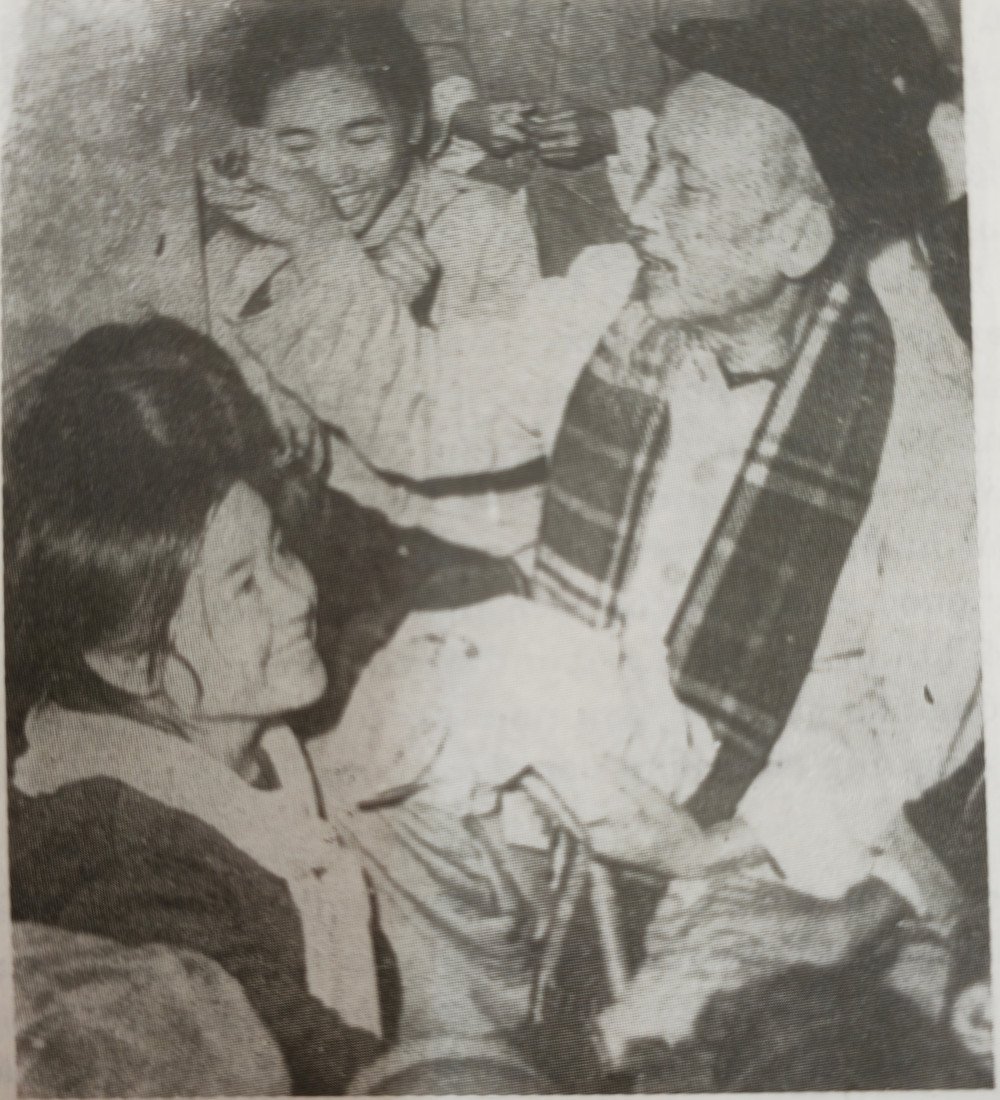
Ms. Vo Thi Thu Dung (Tu Dung, Thu Ha) - Member of the Executive Committee of the Vietnam People's Revolutionary Youth Union of Tay Ninh province (far left) and young people from the South meeting President Ho Chi Minh at the Presidential Palace in 1968.
Later, through the accounts of veteran officials, hearing stories about the solemn funeral ceremony for President Ho Chi Minh held by the Tay Ninh Provincial Party Committee amidst tears, or the story of painters Tam Bach (Ba Trang) and Vo Dong Minh hastily painting portraits of the President, or the story of the Provincial Party Committee's Propaganda Department devoting its efforts to building a shrine in the middle of the forest... only then did I truly understand the boundless love and sorrow of the army and people of Tay Ninh when the President passed away.
Earlier, in March 1968, Uncle Ho had requested the Politburo's approval for him to visit the South. In a letter addressed to Comrade Le Duan, marked "absolutely secret," Uncle Ho proposed disguising himself as a "worker" on a ship sailing south. He wrote: "...This matter, B. will arrange it himself, it's easy. When you arrive, the comrades there (Central Committee of the South) will only be responsible for welcoming you when the ship docks in Cambodia and taking you to the house of Comrade Six and Comrade Seven. Stay there. Depending on the conditions, we will decide: a few days at the very least, and a month at most. How to operate will be decided with the comrades there..." (Comrade Six refers to Comrade Le Duc Tho; Comrade Seven refers to Comrade Pham Hung). At that time, if the fighting in the South hadn't been so fierce, who knows, Tay Ninh - the base of the Central Committee - might have had the honor of welcoming Uncle Ho.
On the day of President Ho Chi Minh's death, in the Ta Boi forest, Mr. Nguyen Van Hai (Bay Hai) - former Secretary of the Tay Ninh Provincial Party Committee - choked up as he read the eulogy: "...Our nation and our Party have lost a brilliant leader and a great teacher... Farewell, our beloved President. We vow to forever uphold the banner of national independence, to resolutely fight and defeat the American invaders, liberate the South, protect the North, and unify the country to fulfill your wishes... President Ho Chi Minh has passed away, but he always guides us. We still feel his presence beside us. Because we continue to follow his path, continuing his great work. Because he lives on forever with our land and country, his name and image are increasingly etched in the hearts and minds of each of us..."
In a conversation, Mr. Bay Hai recalled: “Perhaps at that time, the comrades in the Propaganda Department felt the heaviest burden because they had to do a job that was normally very normal but in this case was beyond their endurance: transcribing the funeral announcements read slowly by Hanoi Radio. Even though the reader read slowly, the writer was afraid of not being able to write fast enough, the words trembling. Only those who cried while writing could truly understand that heavy burden… Even after the prescribed week of mourning had passed, many people still wore mourning cloths on their chests. For many days afterward, the atmosphere remained somber. Everyone cried in silence, without a loud sound or a single voice.”
The Provincial Party Committee's Propaganda Department leadership decided to build a temple dedicated to President Ho Chi Minh using self-made materials and equipment. The temple's design was overseen by Mr. Phan Van (former Chairman of the Provincial People's Committee), while the construction was the responsibility of Mr. Vu Dai Quang. Artist Tam Bach handled the interior decoration, and Mr. Ho Van Dong was in charge of logistics and security.
According to the design, it was a majestic temple. In the main hall, the temple was designed with a double roof to allow light into the interior, highlighting the different colors of the brick walls, columns, incense burner, and altar – a blooming lotus pedestal, topped with a statue of Uncle Ho. To maintain the secrecy of the agency, the wood had to be sourced from a forest about 5 kilometers from the base. At that time, the clearing was flooded, so after felling the trees, the officers and staff of the Department would push the logs into the water, regardless of whether the water in the middle of the clearing was chest-deep. Usually, it was past midnight before the officers and staff who went to fell the trees could rest.
The temple was completed after nearly a month of intensive construction. The walls and columns were painted a light yellow. Because the bricks were unburnt, the builders used wood to ensure structural integrity before cladding the exterior with bricks. The altar wall features raised red patterns and is decorated with a five-pointed star-shaped lantern. The altar base is blue, the lotus pedestal is white, and instead of a statue of President Ho Chi Minh as originally designed, due to time constraints, a portrait of him painted by artist Tam Bach is placed on the lotus lamp. It is widely recognized as a very beautiful painting. The artist himself considers it his most cherished work since he began painting.
Artist Tam Bach painted a portrait of President Ho Chi Minh during the resistance war.
Without waiting for the construction to be completed, officials and local people came daily to watch and encourage the workers. When the temple was finished, the people brought incense, tea, and fruit to commemorate Uncle Ho. Hoang Le Kha Printing House printed small cards, briefly introducing the project, to distribute to the people and soldiers who came to pay their respects to Uncle Ho. Battalion 14 would come here after each battle to report their achievements to him. Vietnamese and Khmer people on both sides of the border, as well as people in the temporarily occupied areas, often came to visit and light incense at Uncle Ho's altar, sometimes hundreds of people a day, including monks, Buddhists, and Cao Dai followers and dignitaries.
My father recounted: “In early 1970, right after the coup against King Norodom Sihanouk, the Lon Nol regime of Cambodia sent a company to search for the Ho Chi Minh Memorial Temple in Ta Boi. One morning, upon discovering Lon Nol soldiers, heavily armed, storming the area near the temple, Mr. Tu The (a photojournalist for Tay Ninh Newspaper) raised the alarm, rushed out, and shouted in French to drive them away. At this time, the staff of the Propaganda Department were ready to fight if Lon Nol's men tried to destroy the temple. Then, Mr. Phan Van, Head of the Provincial Party Committee's Propaganda Department – who was very fluent in French – spoke with the commander of these soldiers. After a rather heated conversation, the commander finally agreed to withdraw his troops.”
Mr. Bay Hai recalled: “Following the Provincial Party Committee's initiative, many cadres, Party members, and people set up altars to Uncle Ho. Many altars in the temporarily occupied areas were erected without Uncle Ho's picture, only a single incense burner, reflecting their boundless love and remembrance of him.” When news of Uncle Ho's death spread, many families in the town of Tay Ninh at that time set up altars in their yards, offering incense and flowers to commemorate him, especially with each vase of flowers featuring both red and yellow. When the militia and rural officials inquired, the people replied: "It was the day of the festival, we were praying to Buddha and the heavens." The militia remained silent, having no way to find fault with them.
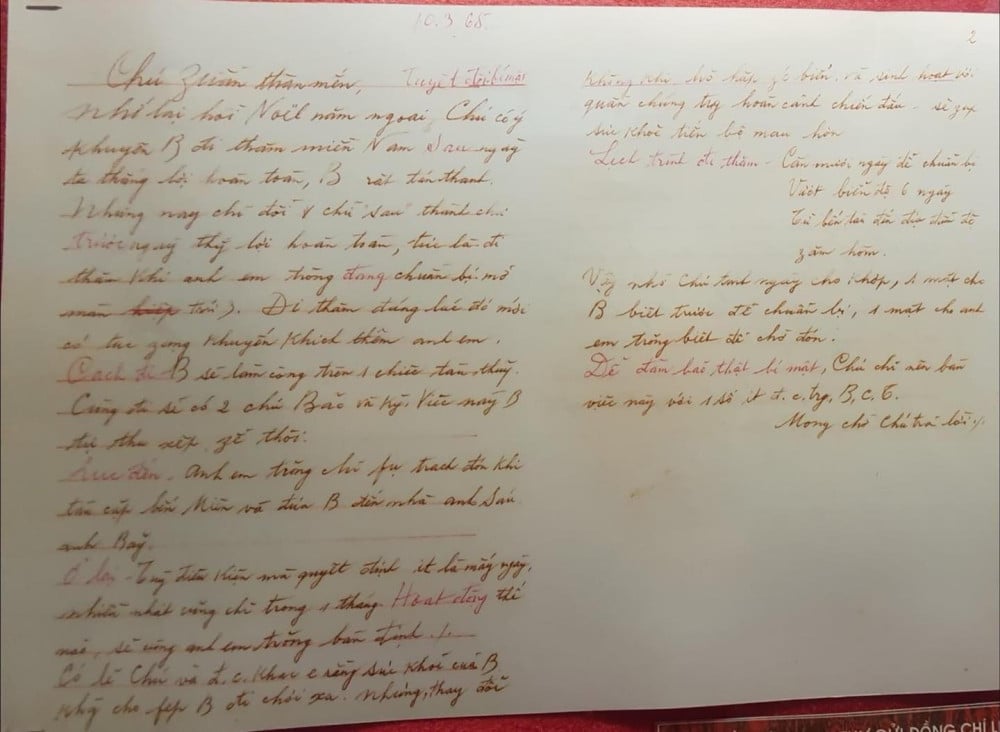
A copy of President Ho Chi Minh's "top secret" letter regarding his visit to the South is currently on display at the Central Committee Headquarters of the Southern Region historical site (Tan Lap commune, Tay Ninh province).
On September 5, 1969, while the Central Committee of the Party and the Government solemnly held a memorial service for President Ho Chi Minh at Ba Dinh Square, a memorial service for him was also held at a small temple in Gia Loc commune, Trang Bang district. This was Phuoc Thanh Temple in Bau Lon, presided over by Venerable Thich Thong Nghiem, whose secular name was Pham Van Binh. The ceremony was extremely solemn and moving, with over 40 Buddhists and local people in attendance. An altar to President Ho Chi Minh was set up in the ancestral hall, consisting of a red paper plaque with the large Chinese characters: "HO CHI MINH, respectfully invited to be seated," and two couplets in Vietnamese.
After the three resounding tolls of the Buddhist drum and bell, all those present respectfully lit incense at the altar dedicated to Uncle Ho. Venerable Thich Thong Nghiem solemnly read the eulogy he had written: “Hearing the news of Uncle Ho’s passing, we monks and Buddhist followers are deeply saddened. Thus, our wish, the wish of the South, for Uncle Ho to visit us when our country was completely independent, is no more… President Ho, alas, you overcame so many hardships to bring our country to independence. You braved the wind and frost, crossed streams and rivers, endured snow and ice, and faced scorching sun and pouring rain, yet you never wavered, determined to sacrifice yourself to repay your debt to the Fatherland.”
The following morning, soldiers from the Loc Trat outpost raided the temple to question the monks, but found no evidence to cause trouble. Although the incense, candles, tea, and fruit were still there, the ancestral tablets and accompanying documents had been hidden very secretly by the temple. They asked, "Why were the bells and drums rung last night?" "To pray for the soul of a deceased person," the abbot replied calmly. Afterward, the police and local soldiers searched the temple twice more, but without success.
Transforming grief into strength, in An Tinh commune, Trang Bang district, the Party Committee and the commune's guerrilla team made a solemn vow before the District Party Committee, the District Military Command, and the people: "We will strive to maintain and expand our base of operations. We will actively build up our political and armed forces, and intensify the three-pronged offensive across all areas to inflict even greater casualties on the enemy." The people of So Cot, Loi Hoa Dong, Bau Tram, Bau May, and other areas pledged before the Party Committee to resolutely fight against the enemy, not giving up an inch of land, clinging to their land and villages to serve the resistance, and sending their children to join the guerrilla team.
One will, one action, beginning with the battle at So Cot, annihilating a US commando platoon. This was followed by counter-insurgency operations at Bau May, Bau Tram, Thap, An Phu, and Cay Dau; and deep penetration into the strategic hamlets of Suoi Sau and An Binh. Particularly in December 1969, the commune's armed forces organized hundreds of large and small battles against the enemy throughout the area, killing and wounding 120 US-backed enemy soldiers, including 8 ruthless pacification cadres, and destroying 6 M.113 armored vehicles.
Meanwhile, at the security branch of Chau Thanh district, Secretary Nguyen Hoang Sa (Tu Sa) initiated the practice of reading excerpts from President Ho Chi Minh's will before each meeting. This ritual aimed to strengthen unity, making everyone feel that President Ho Chi Minh was always with them, always watching over the work of each person—his children fighting for his ideals.
Allow me to borrow the preface from the book "The People of Tay Ninh's Heart for Uncle Ho," published by the Provincial Party Committee's Propaganda Department 35 years ago, as a concluding remark for this article: Although they never had the honor of welcoming Uncle Ho on a visit, the people of Tay Ninh always have him present in their hearts, because he is the Communist Party of Vietnam, he is the revolution. Following Uncle Ho's teachings, the people of Tay Ninh fought bravely, worthy of the title "Tay Ninh, courageous and resilient."
Dang Hoang Thai
Source: https://baolongan.vn/den-tho-bac-ho-giua-rung-ta-boi-a200106.html
![[Photo] National Assembly Chairman Tran Thanh Man attends the policy seminar to promote Vietnam-Türkiye cooperation.](https://vphoto.vietnam.vn/thumb/1200x675/vietnam/resource/IMAGE/2026/04/16/1776351415367_vna-potal-chu-tich-quoc-hoi-tran-thanh-man-du-toa-dam-chinh-sach-thuc-day-hop-tac-viet-nam-tho-nhi-ky-8705791-jpg.webp)










![[Image] Bridges and roads connecting the eastern part of Ho Chi Minh City](https://vphoto.vietnam.vn/thumb/1200x675/vietnam/resource/IMAGE/2026/04/16/1776328595108_ndo_br_bh-vt5-jpg.webp)






















![[Infographic] Details of the Hanoi-Quang Ninh High-Speed Railway Project](https://vphoto.vietnam.vn/thumb/402x226/vietnam/resource/IMAGE/2026/04/16/1776338188424_anh-man-hinh-2026-04-16-luc-18-16-10.png)

![[Photo] National Assembly Chairman Tran Thanh Man meets with the Speaker of the Georgian Parliament](https://vphoto.vietnam.vn/thumb/402x226/vietnam/resource/IMAGE/2026/04/16/1776338494029_anh-man-hinh-2026-04-16-luc-18-21-21.png)










Comment (0)