|
| A dugout canoe and Tay girls on Ba Be Lake were photographed with a film camera in 2002 by photographer Vu Kim Khoa. |
The last wooden dugout canoe
Artisan Ngon Van Toan, born in 1947, over a cup of strong, highland-flavored tea at his home, began to tell stories about the ancient dugout canoes that "never sank when capsized," like the waters of the Nang River flowing into the lake.
At nearly 80 years old, his memory remains vivid of the summer of 1995 when he crafted his last wooden dugout canoe at the vigorous age of 48. He laughs heartily, excitedly recounting the nearly week-long journey with five brothers, carrying axes and hammers into the dense forest. The trip was fraught with danger, facing wild animals, and carrying packed lunches as they ventured deep into the wilderness.
Finding wood was a battle of wits. It wasn't until the fourth day that he found a large, straight-trunked melaleuca tree, so thick that it would take two people to encircle it. The craftsman immediately began carving the boat on the spot, using an axe to hollow out the interior and then smoothing the exterior with a keen eye to ensure both sides were perfectly symmetrical.
Mr. Toan emphasized that no repairs were allowed to be made to any part of the boat before launching it; even a small mistake that caused the boat to tilt meant all the hard work was wasted. Bringing the 8-10 meter long boat across the stream and through the forest back to the village was also a "battle." They had to use forest wood to make rollers to propel the boat into the stream and then sail downstream. When the boat finally reached the shore after a week, the whole village rejoiced as if it were a festival.
Now, the specialized tools are lost, but Mr. Toan still speaks of the old days with the pride of the people of the lake region. Those were the days of sweating over rock-hard hardwood trees to find "floating wood" like the "rotten wood" or the "star wood," a resilient tree species that endures even when submerged in water.
He enthusiastically described the skill of "cutting waves": "When there's a storm, you have to calmly cut diagonally across the waves instead of sideways to avoid being overturned. If the water gets into the boat to a depth of about 40cm, the rower must coordinate rhythmically, one hand maintaining balance, the other kicking the water out with each stroke of the oars." That skill transforms a narrow boat, only 50-80cm wide, into a nimble vessel that effortlessly weathers the fury of the lake.


 |
| The photograph "Childhood," which won an international award, by photographer Vu Kim Khoa was taken at Ba Be Lake in 2014. |
Now, nostalgia for those wooden boats is a complex feeling. Mr. Toan, an old craftsman, pointed towards the Pac Ngoi village cultural center, saying that it houses the only remaining specimen of a traditional wooden dugout canoe as a memento. It's the last witness to the golden age before iron-hulled boats took over the lake. He understands that protecting the forest is essential, and since the people around the lake abide by the law, no one cuts down trees to make boats anymore.
But the old craftsman was unwilling to let that spirit fade away. He meticulously researched how to make iron boats while preserving the slender, traditional form. He discovered a technique of welding iron to create hollow sections at both ends, so that even if the iron boat capsized, it wouldn't sink. His enthusiasm flared up when he spoke about the boat racing techniques used in the Lồng Tồng festival at the Ba Bể spring festival. With his years of experience, he explained that the boats must have oar poles, and the people in front and behind must "rhythmically shout in unison" for the boat to accelerate. The spirit of chivalry and the skill of rowing remain intact beneath the steel hull of the modern era.
A single log in the frame
 |
| "A Glimpse of Ba Be Lake" - a photograph from photographer Vu Kim Khoa's series of dugout canoes - was taken in 2013. |
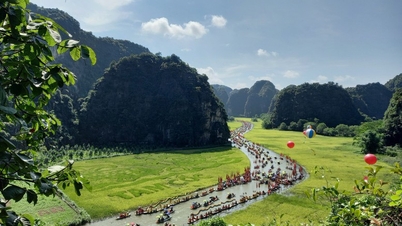
On the scenic Ba Be Lake, the image of Tay girls in indigo-dyed blouses gracefully paddling their dugout canoes has left a lasting impression on tourists and many photographers who visit this place. For photographer Vu Kim Khoa, the image of the dugout canoe is etched in his memory. Since 2002, Mr. Khoa has been searching for unique perspectives at Ba Be. He realized the silent loss as the wooden canoes, once as nimble as shuttles on the water, have become increasingly rare; some sink beneath the trees, others are stolen if they are made of precious teak wood.
He was troubled by the increasing number of metal boats appearing on the lake, calling them "floating aliens," as light as an indifferent glance at a scenic spot. In 2014, thanks to funding from the Vietnam Association of Photographic Artists, he undertook a "rescue" of memories. The owner of the motorboat spent an entire day scouring the lake before finally gathering exactly six dugout canoes that were still afloat, bringing them back to the foot of Ba Goa Island.
A dugout canoe is carved from a single, large, intact tree trunk, usually from water-resistant trees with a low density relative to water. The craftsman uses an axe to hollow out the inside of the tree and shape the canoe according to a predetermined design. Making a dugout canoe is difficult because the hull must be thin yet strong enough to withstand the impact of waterfalls and waves; therefore, it requires skillful hands and meticulous work, which is why few people can make them.  Ambassador Nguyen Quoc Dung visits and works in Minnesota, USA.From June 28-30, the Vietnamese Ambassador to the United States, Nguyen Quoc Dung, paid a visit and worked in Minnesota.  Vietnam encourages US businesses to expand investment in high technology.On the morning of June 26th, at the Government Headquarters, Deputy Prime Minister Ho Quoc Dung received Mr. Jeff Place, Supply Chain Director of Coherent Group (USA). During the meeting, the Deputy Prime Minister affirmed that Vietnam encourages US businesses to expand investment, especially in high-tech, innovation, and semiconductor industries.  Encourage U.S. businesses to expand investment in high-tech sectors.Deputy Prime Minister Ho Quoc Dung said that Vietnam welcomes US businesses to continue expanding their operations in Vietnam, especially in high-tech industries and sectors with high added value. |
With the help of Tay women and a group of talented swimmers, Mr. Vu Kim Khoa captured his final photographs of the original dugout canoes. The images of the children playing in the river that year earned him a Bronze Medal in the United States that same year. It was the last time he photographed an original dugout canoe, a fortunate opportunity at the "right time" to preserve the essence of the lake region before wooden dugout canoes truly faded into the past.
“Boat, please wait for me slowly/ I want to stay here, I don’t want to go home…” The Lofi Acoustic melody of the song “On Ba Be Lake” drifted from the stilt house, like a comforting whisper for the regrets gradually fading into the sunset. Bidding farewell to boat builder Ngon Van Toan and silently admiring the photographs by photographer Vu Kim Khoa, I understood that the wooden dugout canoe may have lain beneath the deep mud or silently captured in the frames, but its spirit—its steadfastness, skill, and deep, visceral love for the ancient forest—still flows… The wooden dugout canoe is gone, but its soul remains, sparkling and profound like the thousand-year-old lake.
Source: https://baothainguyen.vn/van-hoa/202603/di-tim-bong-dang-thuyen-xua-a694504/