

 |
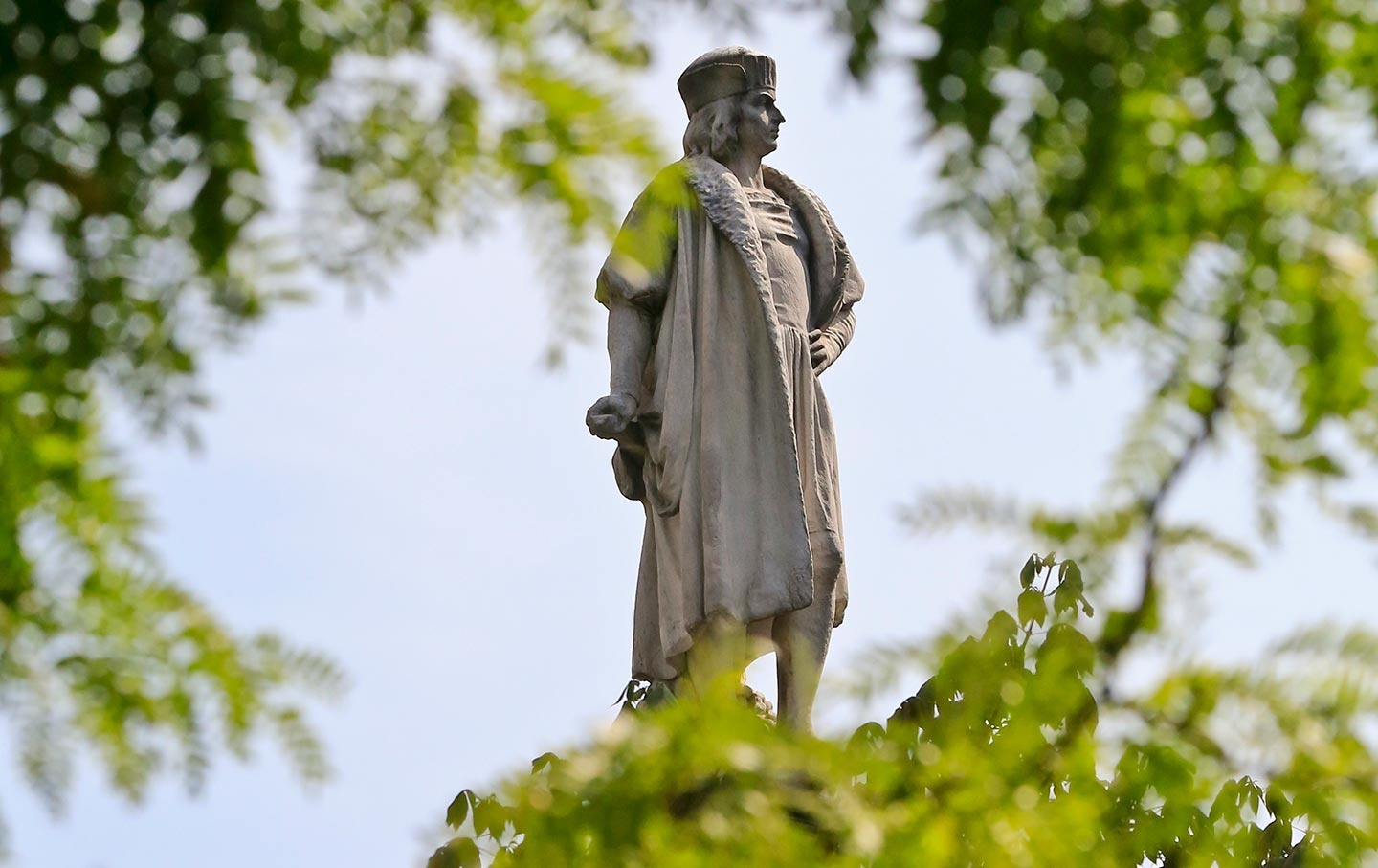
Christopher Columbus had to overcome many difficulties to reach America. (Illustration: TN) |
Although the rain had just stopped, the air was still hot and stuffy. There wasn't a soul in sight. The only sounds, besides insects and seagulls, were the rhythmic, deep lapping of Caribbean waves.
Around me, on the red earth, scattered squares formed by rows of stones were visible: these were the foundations of now-vanished buildings, excavated by archaeologists. Small cement pathways were faintly steaming from the rainwater runoff. One of these buildings had walls that were particularly striking.
Researchers have given it a new roof, the only structure they have chosen to protect it from wind and rain. Standing like a guard at the entrance is a handwritten sign: Casa Almirante, meaning House of the Admiral. It marks the first American dwelling of Christopher Columbus, the Atlantic Admiral[1], whom generations of schoolchildren have been taught to discover the New World .
La Isabela, the former name of this community, is located north of the large island of Hispaniola in the Caribbean Sea, now the Dominican Republic. It was the first European attempt at establishing a permanent base in the Americas. (More precisely, La Isabela marks the beginning of the next European settlement period, when the Vikings established a short-lived village in Newfoundland[2] centuries ago).
The admiral positioned his new territory at the confluence of two small, fast-flowing rivers: a heavily fortified garrison on the north bank and a satellite settlement of farms on the south bank.
As for his own home, Columbus, or Cristóbal Colón as he was called at the time, chose the best location in town: a high rocky outcrop north of the settlement, right at the water's edge. His house was perfectly situated to catch the afternoon sun.
Today, La Isabela has been almost forgotten. Sometimes, a similar fate threatens its founders. Of course, the name Colón hasn't completely disappeared from history textbooks, but in those books, he seems less respected and less important.
Critics today say he was cruel, a fraud, and that he only arrived in the Caribbean by chance. A loyal servant of imperialism, he was a scourge to the indigenous peoples of the Americas in every respect.
But there is now another perspective that we should continue to pay attention to the Admiral. Of all the members of humanity who have ever walked this Earth, he is the only one who has ushered in a new era in history.
The King and Queen of Spain, Fernando (or Ferdinand) II and Isabel I, reluctantly supported Colón's first voyage. At that time, transatlantic travel was an expensive and deadly undertaking, perhaps comparable to today's space shuttle launches.
Despite his persistent pleas, Colón could only meet with the monarchs to present his plan after threatening to hand it over to France. A friend later wrote that, as he was riding to the border, the queen “sent an envoy urgently” to summon him back.
The story was most likely exaggerated. However, it is clear that the caution of the high-ranking figures forced the Admiral to reduce his expedition, if not his ambitions, to a minimum: Three small ships (the largest probably less than 20 meters long), a crew of about 90 men in total.
According to his associates, Colón himself had to contribute a quarter of the budget, presumably borrowed money from Italian merchants.
-----
[1] Original text: Admiral of the Ocean Sea. Ocean Sea is the general name for the entire large sea area surrounding the continents, to distinguish it from the Mediterranean Sea, commonly used before 1650. Based on Columbus's achievements, it can be translated as "Atlantic Ocean".
[2] A large island off the coast of Canada.
Source: https://znews.vn/van-de-nan-giai-ma-columbus-phai-doi-mat-truoc-khi-tim-ra-chau-my-post1653823.html
































































































Comment (0)