


According to Ms. Ngo Thi Thu Hong, General Director of Ameii Vietnam Joint Stock Company, this is the sixth year the company has partnered with farmers in Bac Giang to export lychees. To date, the company has exported its products to 10 countries, including the United States, Australia, several European countries, and countries in Southeast Asia. The product's spread from these markets has been quite positive. However, to successfully export to high-end markets, the company must closely cooperate with farmers from cultivation to harvesting.
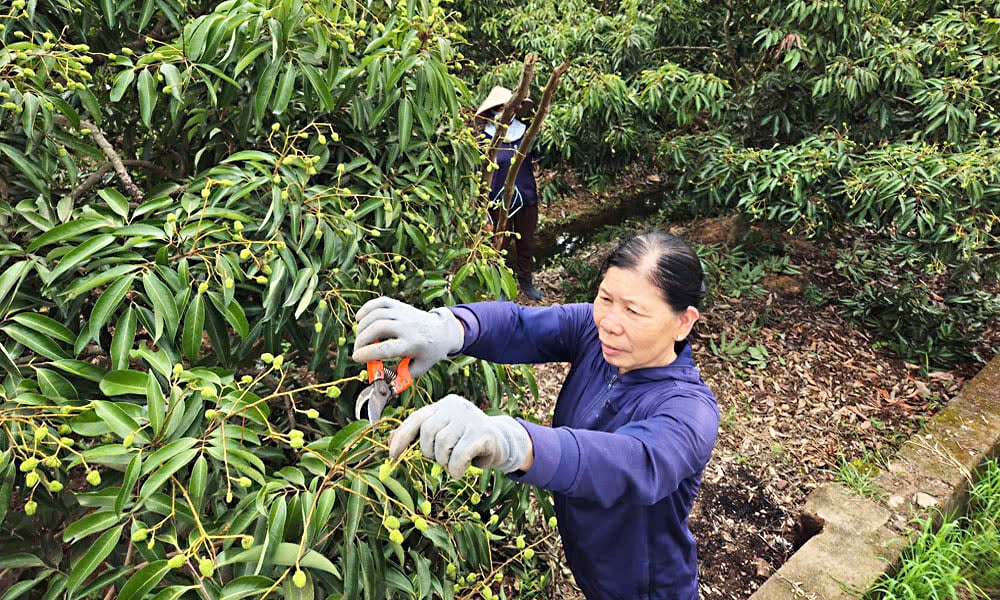 |
Ms. Ly Thi Ha, from Giap Son commune (Luc Ngan district), cultivates lychee trees according to VietGAP standards. |
The cultivation process strictly adheres to food safety and hygiene standards, and when analyzing samples, the indicators must meet the requirements of importing countries. Thanks to this synchronized approach, lychees grown using this process command higher prices, resulting in significantly higher income per unit area compared to conventional methods. It is projected that by 2025, Ameii Vietnam Joint Stock Company will export approximately 1,000 tons of fresh lychees from Bac Giang to high-end markets.
Agreeing with Ms. Hong, many agricultural export businesses also believe that exporting lychees to demanding markets requires a guaranteed source of high-quality raw materials. This necessitates planning and monitoring of production models, creating more linkages between lychee growers and businesses. Therefore, in addition to the participation of farmers and the support of businesses, investment in building and developing raw material areas by relevant authorities is needed. The State should have policies and mechanisms to support and promote market expansion in countries with potential and high demand for lychees, such as South Korea and Japan. Furthermore, specialized agencies should continue researching post-harvest lychee preservation technologies. Adjusting the lychee harvesting time will bring many economic benefits, especially if the harvest season can be moved earlier or extended, creating more export opportunities and increasing the product's competitiveness.
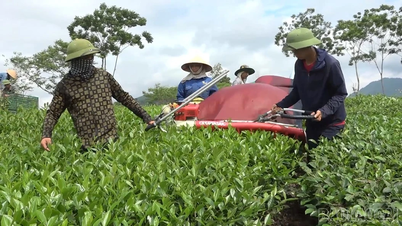
Bac Giang province has the largest concentrated lychee growing area in the country, covering approximately 29,700 hectares. Of this, Luc Ngan district accounts for over 10,000 hectares. While not large in scale, this area produces high-value lychees grown and cared for according to VietGAP, GlobalGAP, and organic standards, resulting in products that meet the demands of the high-end market. Ms. Ly Thi Ha, from Giap Son commune (Luc Ngan district), stated that for many years, her family has grown lychees according to VietGAP standards, producing large, beautiful fruits that meet food safety and hygiene standards. During harvest season, traders come to place orders and purchase the lychees directly from the orchards at higher prices than conventionally grown lychees. If the weather remains favorable from now until the end of the season, her family estimates a harvest of over 10 tons.
There is still much room for developing lychee production using advanced processes. With the support of the government, scientists , the people, and businesses, not just a portion of the area, but in the near future, Luc Ngan district in particular, and Bac Giang province in general, will have numerous lychee growing areas that meet standards, affirming their brand and position in the international market.
Source: https://baobacgiang.vn/dien-tich-nho-gia-tri-lon-postid418339.bbg



![[Photo] General Secretary To Lam presides over a meeting with the Editorial Teams to summarize 100 years of the Party's leadership of the Vietnamese revolution and 40 years of implementing the National Construction Program.](https://vphoto.vietnam.vn/thumb/1200x675/vietnam/resource/IMAGE/2026/03/04/1772601288977_a1-bnd-8134-7576-jpg.webp)






















































Comment (0)