


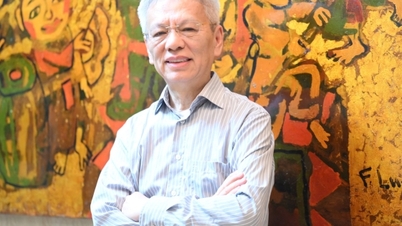
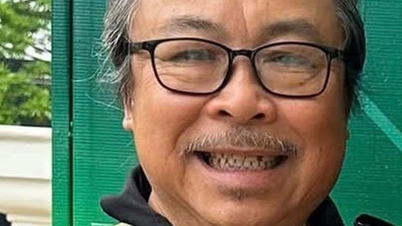
Journalist Do Quang (on the right) presents a poem to the author of the article - photographer Ngoc Phan.
1. For a long time, there's been a folk saying, "When meeting, shake hands and greet each other warmly, but whatever you give, please don't... give poetry." Yet, "Truthful Words," with 1,000 copies printed, sold out instantly upon release. The first reprint is scheduled for December 2025, and then a second in February 2026. What miracle caused this event? It's the simplicity, the honest words that come from the heart. The poetry is simple, like grains of rice or potatoes. There's something raw about it. Perhaps this is the quality of authenticity, the characteristic of the journalistic genre in which Do Quang has been so successful, still subtly present in his poems.
Reading "Truthful Words," we see that the author writes about things we've all thought about, things we've heard and seen. His feelings and aspirations are also those of the majority of people, which is why his poetry resonates with readers.
Do Quang was not bound by any particular poetic form. He wrote poetry in his own way, as long as the verses conveyed the meaning of what he wanted to say and expressed his feelings. A unique poetic voice. Sincere. Full of the responsibility of a citizen. A courageous writer. He not only "spoke the truth" about life, about the hidden corners, about the dark side of society through the cases of embezzlement, corruption, and fraud by some people, many of whom held positions of power but were corrupt and degenerate. His poem "Words of Truth": "A chronic disease drags down the cycle of history / embezzlement, corruption, waste, abuse / Internal enemies, hidden corrupt officials." And "A Rewritten Poem": "Don't mistake a chicken for a quail / Don't think red means ripe / But / How can a real chicken become a quail / How can a real red remain green / I ask / Whose crime is this /..."
The entire piece has 12 sentences. 12 blank line breaks. The period doesn't appear until the very last sentence. And two sentences contain only one syllable. Just one syllable. But they carry immense weight, posing a question to the reader, to society.
“Truthful Words,” the title sounds strange and not at all poetic, but it’s effective. It’s about speaking the truth to each other, sharing feelings. No embellishment, no rambling, no lengthy explanations. It’s about things that are real. Real stories that the author has felt and seen, not fiction, and Do Quang dares to speak his true thoughts—things that people usually call sensitive. Still in “The Rewritten Poem”: “Mistaking people/Using the wrong people/Destroying the country/Making the people suffer…”
The author is troubled by the state of human affairs and the haunting anxieties of life. Writing stems from frustration, from sudden thoughts, and from sleepless nights.
Ancient poets were inspired by the scenery. Now, Do Quang reflects on life and takes up the pen to write poetry. The great poet Ho Chi Minh once wrote: "Ancient poetry loved beautiful natural scenery / Clouds, wind, moon, flowers, snow, mountains, rivers / Now, poetry should contain steel..." Readers can find similar ideas in Do Quang's poetry. In the poem "The True Face": "Chirping like birds / Pure words of gold and jewels / Cadres must serve the people / Do what benefits the people / Water flows down the duck's back / Live like the king of the world / Eat whatever you can /...".
Then the author condemns: "Those single worms/Recognize their true faces/A shameful farce of life!" The poem's words are sharp, like a painful blow to those who only theorize, whose words don't match their actions.
2. Despite the many shortcomings in society, from the perspective of a poet, Do Quang demonstrates humanism and reveals a deep sense of compassion. He engages in a monologue with himself. In the poem "Through the Night": "Eighty years old/Tomorrow I will return to heaven/I will take with me the good, the beautiful, the loving/I will leave behind the ugly, the dirty, the sad."
Over a hundred pages. 66 poems. Do Quang mentions the woman selling sticky rice, the girl selling peach blossoms during Tet, wounded soldiers, the sound of a general's guitar… The image of each person, each character in his poems, is just a few sketches of their portrait and actions, yet it tells a story about life, a slice of life that is a lesson, a truth.
The author praises his former classmates in the poem "Overnight": "In our humble beginnings, we earned our living day by day at school / Today we are professors, experts, writers, journalists / Diplomatic envoys, generals with one or two stars / We have nothing in terms of possessions, but we leave behind an example."
They are truly role models. Great role models for all time.
Journalists, without a doubt, have experienced the hardships but also the glory of the profession. I particularly appreciate the author's article "The Journalism Profession" and Do Quang's philosophy of life: "Just keep doing the job/Overcome yourself/Journalist/If I am reborn tomorrow, I will choose this profession again." This affirmation is truly heartfelt.
The author uses a very interesting metaphor. Time is likened to a rice sieve (the original line of the poem: "Time is like a rice sieve"). Those who were born or have lived in the countryside surely know the function of a sieve when sifting rice: "Empty grains, plump grains / Bran, chaff, pebbles / Stones, dirt, garbage / Everything is visible…".
The author uses the story of sifting rice to address a larger issue: a social issue, a matter of national importance. Here, it's about fighting corruption. And "The most terrible thing is the corruption of power" - from the poem "My Heart Has Rejoiced Again." But the author places his complete trust (in the Party and its leader - naturally). From the poem "To Those Who Remain": "...The furnace is heating up, keep the fire burning, burn even brighter/Fresh wood, wet wood, put it all in the furnace and it will all burn/Fight corruption/Without ceasing/No forbidden zones/No exceptions, no matter who it is…".
3. Do Quang, a loyal and affectionate man. He deeply respected senior journalists, those talented and virtuous individuals. This was evident when he saw on television the ceremony awarding the 50-year Party membership badge to journalist Dinh The Huynh, former Editor-in-Chief of Nhan Dan Newspaper. His poem "Reality or Dream": "Happiness overflows/Tears well up/My heart races."
Elsewhere, in the poem "Remembering Hoang Tung," looking at the banyan tree in the newspaper office courtyard, the author feels a sense of nostalgia… remembering the simple posture and demeanor of the man from the past, expressing his deep affection for Hoang Tung: "The banyan tree is still here / But the man is gone / White clouds fly to the sky / Leaving behind his gait / His voice."
Or sometimes, just a chance encounter with a street sign would bring tears to Do Quang's eyes. In his poem "The Street Sign" (Remembering journalist and photographer Nguyen Ba Khoan): "The street sign glorifies Nguyen Ba Khoan / Every time I stand and gaze at it, my eyes well up with tears."
4. Readers will also find many interesting things in the poetry collection "Truthful Words." Do Quang has a beloved daughter whom he nicknamed "Carrot": "Carrot" goes to her grandparents' house/Just one night, Dad is alone without his daughter." In the poem "Alone," he laments the loneliness of being without his beloved daughter: "My daughter/Late at night/The lights in your room are out/Dad sits at the table with a pen/A few lines of poetry well up from tears/Hiding all the bitterness in my heart." It's unclear whether this is worldly sorrow, personal pain, or both. Do Quang encourages himself and also advises his daughter: "Just live like this/Just experience joy and sorrow/Words are the shoulder we lean on to stand up/Like a magic wand guiding our steps."
The old man, nearly 90, leaned on his daughter's shoulder and also on words. They were like a magic wand, helping him live out his remaining days meaningfully. This shows that a poem that touches the reader's heart doesn't necessarily have to be connected to grand things. It lies in the simple things around us.
Looking at the collection as a whole, Do Quang's poetry belongs to the genre of social commentary poetry; some poems are monologues, while others have the feel of an epic poem.
Do Quang's tone and verses are resonant, somewhat distinctive, full of confidence, and at times passionate. In the vast world of poetry, retaining the reader's attention is truly difficult. With Do Quang, through "Truthful Words," he has achieved even more than that.
According to Nhandan.vn
Source: https://baoangiang.com.vn/do-quang-su-chan-that-cua-mot-doi-cam-but-a487807.html
![[Image] Shipbuilders exposed to steel and record-breaking heat.](https://vphoto.vietnam.vn/thumb/1200x675/vietnam/resource/IMAGE/2026/06/04/1780545781745_ndo_br_img-5402-4683-jpg.webp)





























![[Video] Sunset at Lap An Lagoon – Where the sun sets over the fishing nets](https://vphoto.vietnam.vn/thumb/1200x675/vietnam/resource/IMAGE/2026/05/31/1780192137701_beach-landscape-sea-water-nature-grass-745871-pxhere-com.jpeg)












![[INFOGRAPHICS] Sustainable Business Support Program (2026 – 2030)](https://vphoto.vietnam.vn/thumb/402x226/vietnam/resource/IMAGE/2026/06/04/1780552996067_1780552915.webp)









Comment (0)