

TPO - High schools report that a survey of subjects registered for the 2025 high school graduation exam shows that students overwhelmingly choose social science subjects, with some schools reaching up to 90%.
TPO - High schools report that a survey of subjects registered for the 2025 high school graduation exam shows that students overwhelmingly choose social science subjects, with some schools reaching up to 90%.
According to Mr. Nguyen Manh Quyen, Principal of Dai Cuong High School in Ung Hoa district ( Hanoi ), this school year, up to 90% of 12th-grade students chose to take social science subjects in the exams, with only about 10% of students with good or excellent academic performance choosing natural science subjects.
Regarding the reasons, the Principal of Dai Cuong High School stated that the quality of incoming students is not high, and students have limited opportunities to learn foreign languages, so they mainly choose easy-to-learn and easy-to-understand social science subjects. However, there are still some students with outstanding abilities who choose to take the natural science exams, and their exam results are very good every year.
"When entering 10th grade, the school organizes counseling sessions, encouraging students to carefully research subject combinations, then discuss with parents and older students before making a choice. However, in last year's 10th grade, out of 8 classes with 385 students, only 2 classes focused on science subjects, while the rest followed social science subjects," said teacher Nguyen Manh Quyen.
Ms. Nguyen Boi Quynh, Principal of Viet Duc High School in Hoan Kiem District (Hanoi), said that the school had allowed students to try registering for graduation exam subjects to plan their teaching. The results were not surprising: besides Literature and Mathematics, the most popular subject was Foreign Language (738 out of 912 students). The subjects chosen by students were Physics, History, and Chemistry, in that order.
The subjects with the lowest or no student selection for the graduation exam include: Biology (35 out of 912 students); Informatics (5 students); and Information Technology (no students chose it).
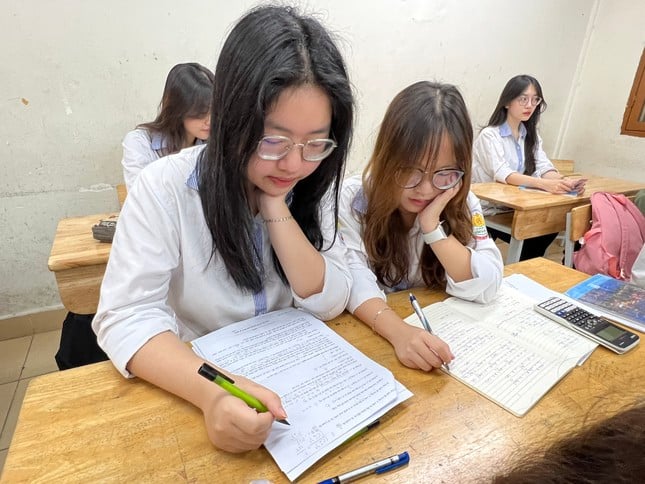 |
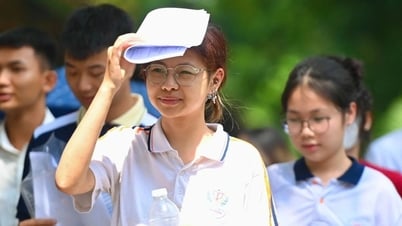
Students are increasingly choosing social science subjects for their graduation exams, avoiding natural science subjects. |
According to Ms. Quynh, students are generally tending to choose social science subjects for the graduation exam, avoiding natural science subjects because these subjects are difficult to learn. Instead, they choose Literature, Math, English, and one more subject from the social science combination, which are easier to score well on than Physics and Chemistry, subjects that require critical thinking and foundational knowledge from junior high school to easily grasp.
However, the principal of Viet Duc High School recognizes that, in the long run, this will create an imbalance in the country's human resources. Therefore, the high school's approach is to build subject combinations scientifically, making it easier for students to choose subjects to form university entrance exam blocks.
“At Viet Duc High School, when students enter 10th grade, the school provides very thorough counseling for both students and parents, and encourages students to choose subject combinations that include natural sciences. If, after a period of study, it is not suitable, the school will facilitate the students to change. However, in recent years, after one year of study, almost no students have switched from natural sciences to social sciences,” Ms. Quynh said.
For many years, the proportion of students registering for the high school graduation exam has consistently favored social science subjects. In 2024 alone, out of 1.07 million students registering for the high school graduation exam, 670,000 candidates registered for the social science exam, overwhelmingly dominating at 63%.
Urgent program evaluation
In a recent petition sent to Minister of Education and Training Nguyen Kim Son, the Association of Vietnamese Universities and Colleges stated that the 2018 General Education Program differs significantly from the 2006 General Education Program in terms of curriculum and implementation.
This means a greater number of subjects, including some new ones. The content of these subjects is more advanced, the workload is greater, and some knowledge is borrowed from university-level programs. Some elective subjects are not only new but also not familiar basic subjects for career guidance, nor are they intended to equip students with basic academic or vocational skills (Information Technology, Technology, Economic and Legal Education, Fine Arts, Music). These subjects are mostly theoretical, with little practical application or internship.
According to the Association of Vietnamese Universities and Colleges, after 5 years of implementing the 2018 General Education Program, it has been observed that students are experiencing an overload of learning (both in terms of workload and difficulty).
Many elective subject combinations established by high schools may not be suitable for students' abilities, aptitudes, and career aspirations. The immediate consequence is that high school teachers of natural sciences, especially Biology and Chemistry, lack teaching hours and are forced to take on other responsibilities. For example, they may shift to guiding educational activities and teaching local educational content.
The Association of Vietnamese Universities and Colleges recommends that the Ministry of Education and Training urgently evaluate the entire 2018 General Education Program at all three levels, especially at the high school level, from all perspectives: objectives, content (volume, level, and quality), degree of overload, level of career orientation, flexibility, articulation (horizontal and vertical), and the ability to stream students after lower secondary school, etc. If serious shortcomings are found, adjustments should be made immediately.
The Ministry of Education and Training also needs to take decisive measures to direct provincial Departments of Education and Training to implement in-depth career guidance from the end of lower secondary school and the beginning of upper secondary school. Currently, students do not receive early career counseling from lower secondary school, leading to difficulties and shortcomings in choosing elective subjects to study in upper secondary school. At the same time, flexibility in switching elective subjects is needed to ensure a relative balance between natural science and social science subjects, thereby guaranteeing a sufficient workforce for basic science and natural science fields.
The Departments of Education and Training are requested to direct high schools to review the list of elective subject combinations so that students have more opportunities to register for multiple combinations for university admission. Students should be allowed to switch elective subjects according to their needs to apply for university-level programs that match their abilities and strengths developed during their high school studies.
For example, adding Chemistry to the Physics-Informatics-Technology-Economics and Law subject combination would give students more opportunities to register for university majors in the A00 subject combination,...
"The Ministry of Education and Training needs to instruct high schools not to arbitrarily arrange elective subject combinations contrary to the regulations of the Ministry of Education and Training, and to develop elective subject combinations based on surveys of students at the beginning of the school year, while maximizing the arrangement of elective subjects according to students' needs," according to the proposal of the Association of Vietnamese Universities and Colleges.
Source: https://tienphong.vn/do-xo-chon-mon-xa-hoi-kien-nghi-bo-gddt-ra-soat-lai-chuong-trinh-post1699642.tpo

![[Photo] Prime Minister Pham Minh Chinh presides over the conference announcing the establishment of the International Finance Centre in Vietnam.](/_next/image?url=https%3A%2F%2Fvphoto.vietnam.vn%2Fthumb%2F1200x675%2Fvietnam%2Fresource%2FIMAGE%2F2025%2F12%2F21%2F1766309817714_ndo_br_dsc-3400-jpg.webp&w=3840&q=75)


![[Photo] Prime Minister Pham Minh Chinh presides over a meeting on private sector economic development.](/_next/image?url=https%3A%2F%2Fvphoto.vietnam.vn%2Fthumb%2F1200x675%2Fvietnam%2Fresource%2FIMAGE%2F2025%2F12%2F20%2F1766237501876_thiet-ke-chua-co-ten-40-png.webp&w=3840&q=75)







































































Comment (0)