

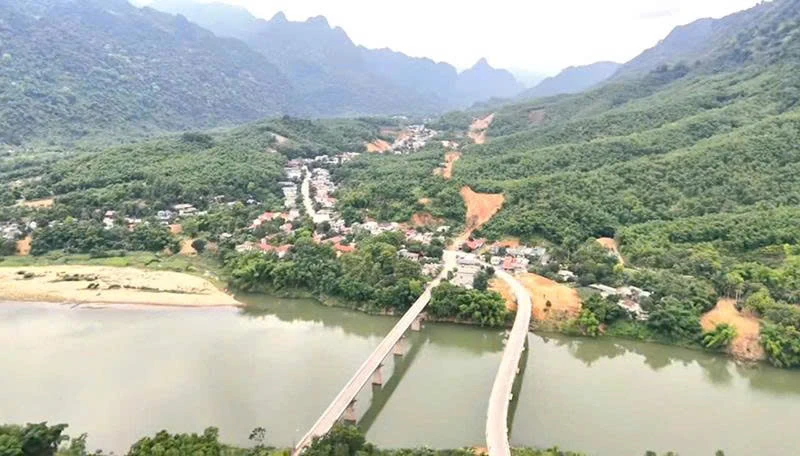
The Na Sai bridge spans the Ma River in Hoi Xuan commune.
A journey down the Ma River in early spring is not only a scenic trip, but also a stroll through the many layers of cultural and historical heritage of Thanh Hoa province. From the remote borderlands to the coastal cities, this river not only deposits alluvial soil but also carries the memories, beliefs, and rhythm of life of countless generations of inhabitants.
In the border region of Muong Lat commune, the Ma River appears fierce and expansive amidst the vast forest. Its waters swirl over rocky rapids, embracing the villages of the Thai and Mong people nestled against the mountains. This landscape once bore the footprints of soldiers during the resistance war, associated with Quang Dung's poem "Tay Tien": "The Ma River is far away now, Tay Tien...". This historical depth gives tourism in the upstream area a unique value. Visitors come here not only to admire the rapids, go boating, or trek along the river, but also to envision an experience following in the footsteps of the soldiers of yesteryear. With proper investment, this section of the river could be developed into a tour combining ecology and history: walking on old trails, listening to stories of local culture, staying in stilt houses in the villages, and enjoying folk art amidst the sound of flowing water and flickering firelight...
Downstream towards Hoi Xuan, the river still has many rocky rapids, but it is less turbulent. The Na Sai bridge area, once an important transportation hub during the resistance war, now has two parallel bridges, creating a scenic highlight amidst the mountains and forests. On the left bank is Ong Pagoda, and on the right bank is Ba Chua Thuong Ngan Cave, a rare "pagoda on one side, cave on the other" configuration. The oral traditions of the Thai people about the pagoda's origins are still preserved, adding spiritual depth to this riverside area. Given these immense potentials, in March 2024, the People's Committee of Quan Hoa district (formerly) approved a plan to develop the "Downstream Ma River" tourist route, approximately 24km long. Currently, Hoi Xuan commune is actively promoting and encouraging people to participate in tourism, primarily targeting the domestic market. Slogans like "Quan Hoa people travel in Quan Hoa" demonstrate an approach that relies on internal resources as a foundation, gradually developing unique tourism products for the upstream region.
As it flows through the former districts of Bá Thước and Cẩm Thủy, the Mã River takes on a gentler rhythm. The water meanders through wide valleys, interspersed with limestone mountain ranges. This area connects to the Pù Luông ecological zone, a familiar destination for adventurous tourists. Water from the Mã River and its tributaries nourishes the terraced rice fields, creating a traditional farming space for the Thái people and opening up opportunities for community-based tourism linked to agricultural experiences and local culture.
Upon reaching the Bong junction, the Ma River splits: one branch flows towards the sea, while the other, the Len River, flows in a different direction. This confluence has long been known by the saying, "a rooster's crow can be heard in six districts," suggesting a vast, open riverine landscape where many regions meet. The Tong Son commune currently houses a system of temples and shrines with long-standing ties to the delta's inhabitants, such as the Han Son Temple and the Co Bo Temple. During festivals, crowds of pilgrims flock here, the smoke from incense mingling with the river breeze, creating a solemn yet intimate atmosphere. This presents significant potential for developing spiritual tourism combined with sightseeing along the river.
Before heading out to sea, the journey concludes at Ham Rong Bridge – a symbol of Thanh Hoa province. Once a target of fierce bombing during the war, the bridge has now become a scenic landmark and a historical memory. From the tourist pier at the foot of the bridge, visitors can board boats and experience a journey upstream and downstream on the wide, long river. On both banks, low mountains, green fields, and peaceful villages unfold; on the boat, guides introduce historical sites, traditional crafts, and cultural landmarks along the riverbanks. This experience is both relaxing and informative, suitable for various groups of visitors.
Given its vast potential, since 2016, the People's Committee of Thanh Hoa province has issued Decision No. 4589/QD-UBND approving the development plan for river tourism destinations and routes until 2025, with a vision to 2035. In this plan, the Ma River is identified for diverse tourism activities: sightseeing, ecotourism, cultural-historical tourism, festivals, adventure sports , conferences, and seminars. The Ham Rong area is designated as the main pick-up and drop-off point for tourists in the central urban area.
The Ma River's course is a journey through many layers of value. The upper reaches hold historical memories and pristine beauty. The midland region showcases ecological landscapes and community life. And the lower reaches offer religious spaces and urban rhythms. Each riverine region possesses its own unique character, yet they share a common flow. With synchronized investment in infrastructure, docks, experiential products, and promotion; and by linking cultural and ecological preservation with local economic development, the Ma River could become a continuous tourism axis, connecting the mountainous region with the plains, the past with the present, and creating new impetus for sustainable development.
Text and photos: Dinh Giang
Source: https://baothanhhoa.vn/doc-dai-ma-giang-284591.htm
![[Photo] My Son at night: A thousand-year-old heritage site amidst the Milky Way](https://vphoto.vietnam.vn/thumb/1200x675/vietnam/resource/IMAGE/2026/04/15/1776261039184_ndo_br_chon6-jpg.webp)
![[Photo] National Assembly Chairman Tran Thanh Man attends the opening session of IPU-152](https://vphoto.vietnam.vn/thumb/1200x675/vietnam/resource/IMAGE/2026/04/16/1776277863731_ctqh5-jpg.webp)
![[Photo] The General Secretary, President and his wife meet with Vietnamese-Chinese friendship leaders.](https://vphoto.vietnam.vn/thumb/1200x675/vietnam/resource/IMAGE/2026/04/15/1776264829725_vna-potal-tong-bi-thu-chu-tich-nuoc-to-lam-gap-mat-nhan-sy-huu-nghi-viet-nam-trung-quoc-8703641-3130-jpg.webp)
![[Photo] Mrs. Ngo Phuong Ly meets and exchanges views with Mrs. Peng Li Yuan](https://vphoto.vietnam.vn/thumb/1200x675/vietnam/resource/IMAGE/2026/04/16/1776277858080_phu-nhan-1-jpg.webp)




![[Infographic] How to register to buy social housing in the Thanh Sen ward project?](https://vphoto.vietnam.vn/thumb/402x226/vietnam/resource/IMAGE/2026/04/16/1776306626899_fb_tren-dia-ban-tinh-ha-tinh-png.webp)







































Comment (0)