

The Ngo Dong River meanders through limestone mountains, creating a system of cool, water-filled caves with bizarre stalactites and stalagmites, telling stories from millions of years ago, when this place was once a sea.
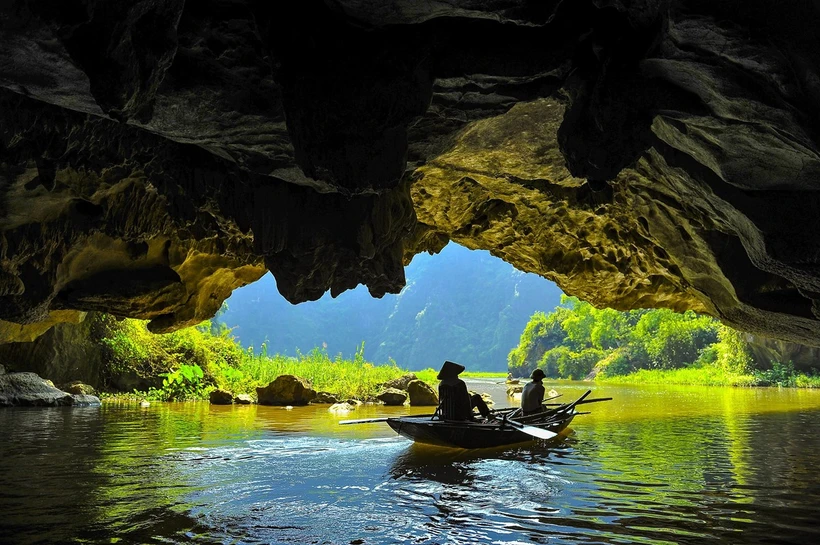
Tam Coc-Bich Dong is a stunning cave complex located within the Trang An scenic area – a key national tourist destination in Vietnam.
This is a complex of scenic sites that has been classified as a Special National Monument by the Prime Minister of Vietnam and was recognized as a World Heritage Site by UNESCO in 2014.
Located in Ngu Nhac Son, in Dam Khe village, Ninh Hai commune, Hoa Lu district, Ninh Binh province, the Tam Coc-Bich Dong scenic complex covers a natural area of 350.3 hectares, boasting pristine natural landscapes with a system of caves both above and below water, harmoniously combined with ancient religious architectural works and historical relics related to the Vu Lam royal palace of the Tran dynasty nearly 1,000 years ago.
Tam Coc - Ha Long Bay on land
In 2015, Tam Coc was included in the list of "beautiful but little-known places" selected by the Telegraph (UK).
In early 2018, Tam Coc continued to appear in Business Insider magazine, topping the list of the 50 most attractive destinations on the planet, with the image of the Ngo Dong River flowing like a soft silk ribbon, winding over golden rice paddies and around limestone mountains.
Tam Coc is often likened to Ha Long Bay on land. From ancient times, this area was once a sea, and over hundreds of millions of years, waves have eroded and carved deep into the rocky mountains, creating the magnificent caves we see today.
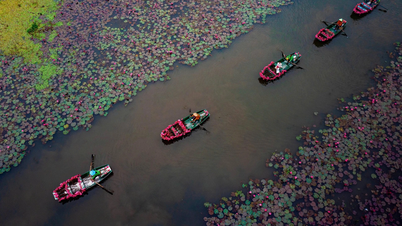
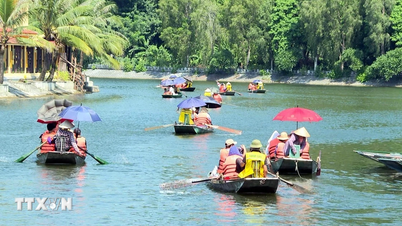
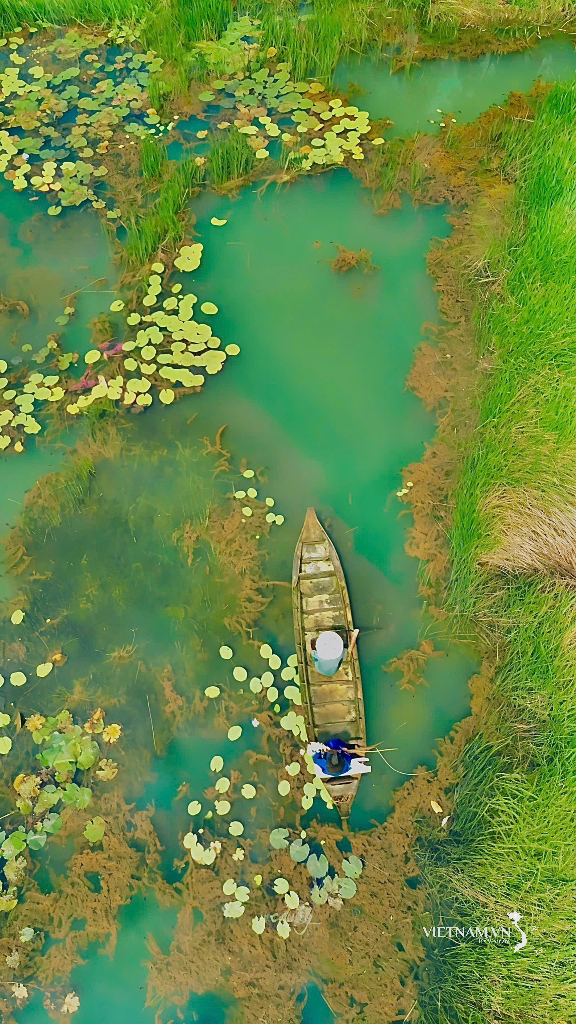
To explore Tam Coc, visitors will travel by boat down the winding Ngo Dong River, passing through rocky cliffs, water-filled caves, and undulating rice fields at the foot of the mountains. Each time of year, it takes on a different color, leaving visitors in awe.
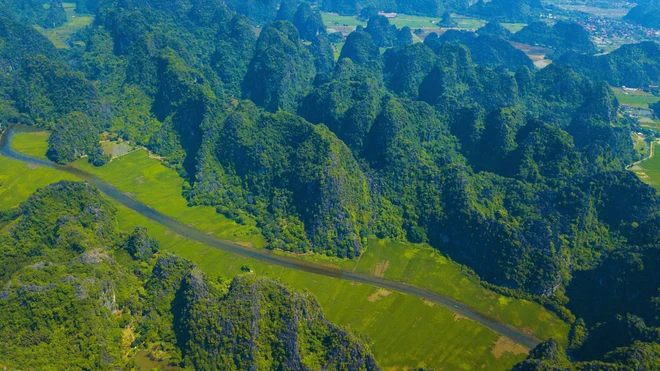
Tam Coc, meaning "three caves," consists of Cave One, Cave Two, and Cave Three. All three caves were formed by the Ngo Dong River flowing through the mountains.
Of the three caves, Hang Ca is the largest, measuring approximately 127 meters in length, xuyên through a large mountain, with a vaulted ceiling about 20 meters high.
As the boat enters the cave, visitors will clearly feel the crisp coolness of the space, with only the gentle sound of oars splashing in the water and the boatman recounting ancient legends about the myriad shapes and forms of stalactites hidden within the cave.
After passing through Hang Ca cave, the boat takes tourists about another 1km to Hang Hai cave. Hang Hai cave is 60m long and, similar to Hang Ca, has a cool and pleasant atmosphere with strange stalactite formations, carrying within it mysterious stories from the imagination of the local people.
Hang Ba is located quite close to Hang Hai, but is shorter, only about 50m long, and its ceiling is also lower compared to Hang Ca and Hang Hai. Visitors sometimes have to duck their heads low to avoid hitting the rock ceiling above.
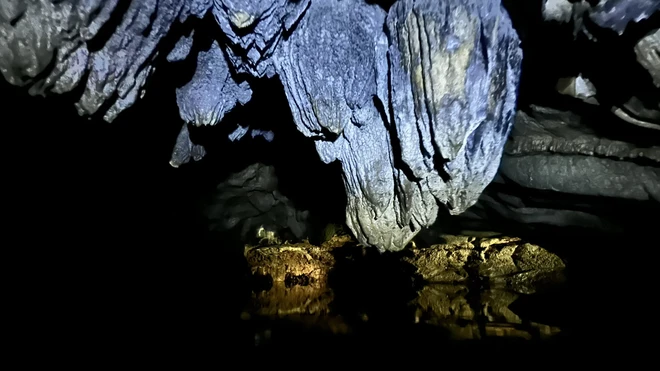
A boat trip to explore 3 water-filled caves in Tam Coc. The tour lasts approximately two hours, including both the outward and return journeys. Afterwards, visitors will explore Thien Huong Dry Cave and visit the Thai Vi Temple historical site.
In the past, the Tam Coc mountain region was where the Tran dynasty built the Vu Lam royal palace during the resistance against the Mongol invaders.
Thai Vi Temple is a place of worship for the Tran Dynasty kings Tran Thai Tong and Tran Thanh Tong, generals Tran Hung Dao and Tran Quang Khai, and Queen Tran Thi Dung, located 2km from Tam Coc boat dock.
Before entering the temple, visitors will stop at Thien Huong Cave, a dry and bright cave located halfway up the mountain, about 15 meters above ground level.
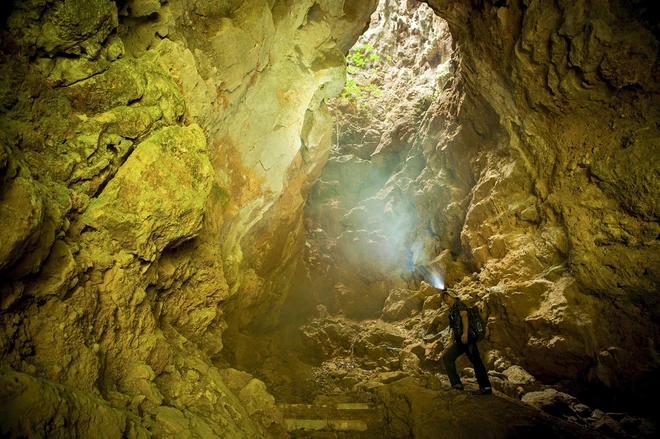
The cave is approximately 60m high, 40m deep, and 20m wide. Because the top of the cave is hollow, it is also known as the Heavenly Cave.
Nestled within the cave is a shrine dedicated to Queen Tran Thi Dung, wife of King Ly Hue Tong, who passed on the art of lace embroidery to the people of Ninh Hai commune.
Bich Dong - The Second Most Beautiful Cave in Southern Vietnam
Located about 2km from Tam Coc pier, Bich Dong consists of a dry cave situated halfway up the mountain, and in front of it is Xuyen Thuy Cave – a water cave that runs through the heart of the mountain.
It is precisely because of its unique natural beauty, a combination of rock and water, that Bich Dong is known as "Nam Thien De Nhi Dong," meaning the second most beautiful cave in Southern Vietnam, second only to Huong Tich Cave in Huong Son region.
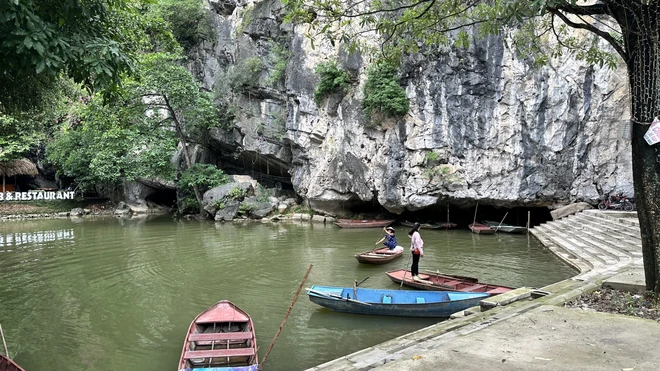
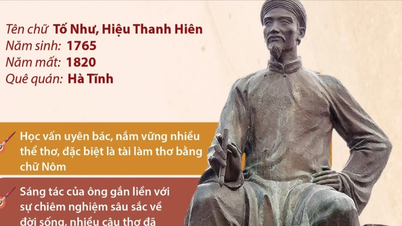
Bich Dong means "Green Cave," a name given to this scenic spot by Prime Minister Nguyen Khiem, father of the great poet Nguyen Du, when he visited in 1773.
Before entering the dry cave, visitors will take a boat ride through Xuyen Thuy Cave – a dark, water-filled cave shaped like a semicircular tube, approximately 350m long and 6m wide. The ceiling and walls of the cave are fairly flat, with an arched shape and countless beautiful stalactites hanging down.
The unique feature of Xuyen Thuy Cave is a natural archway inside the cave shaped like the letter M, dividing it into two passageways. Local people explain that these represent the Father's Gate and the Mother's Gate, hence the saying when entering Xuyen Thuy Cave: "Enter through the Father's Gate - exit through the Mother's Gate."
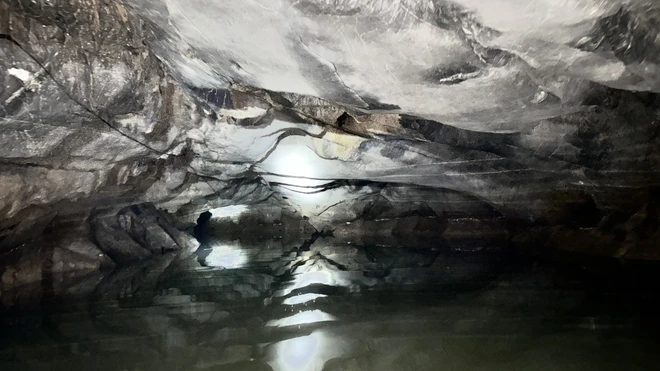
On the way in, the boat passes through the Father's Gate, which is taller and narrower, while the way out through the Mother's Gate is lower but very wide. This shows how nature's creation is both creative and purposeful.
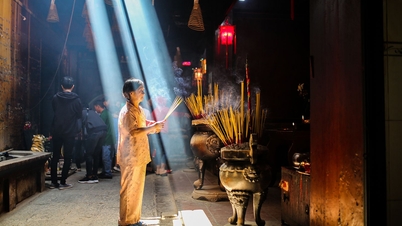
Bich Dong Pagoda is located behind the mountain, opposite the entrance to Xuyen Thuy Cave. Upon returning from the Xuyen Thuy Cave tour, visitors can continue climbing the mountain to reach the cave and Bich Dong Pagoda.
Bich Dong Pagoda is an ancient temple built on the Truong Yen limestone mountain range in 1428, at the beginning of the Later Le Dynasty. Today, the pagoda still houses a large bell cast during the reign of King Le Thai To, and the tombs of the monks who contributed to its construction.
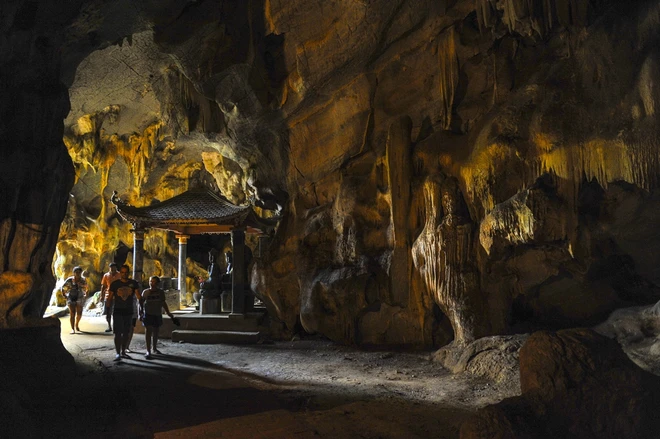
During the reign of Emperor Lê Hiển Tông (1740-1786), the temple was renovated and expanded, comprising the Lower Temple, Middle Temple, and Upper Temple, spread across three levels of the mountain.
The Bich Dong Pagoda historical site and scenic area is a harmonious combination of the majestic beauty of caves and mountains with the talent and skill of humankind... The architecture here is mainly based on the cliffs and caves, forming a unified and solid structure.
The Trang An cave complex and the Tam Coc-Bich Dong area still preserve a considerable number of artifacts and relics made of materials such as stone, bronze, and wood, dating mainly from the Nguyen dynasty.
The scenery of Tam Coc-Bich Dong is said to be at its most beautiful in the summer, around the end of May and the beginning of June. At this time, the rice fields on both sides of the Ngo Dong River turn a brilliant golden color, adding to the splendor of the scenic spot.
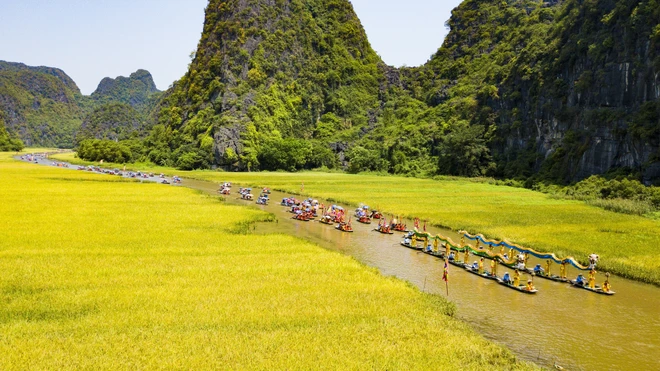
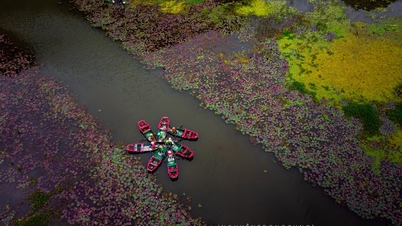
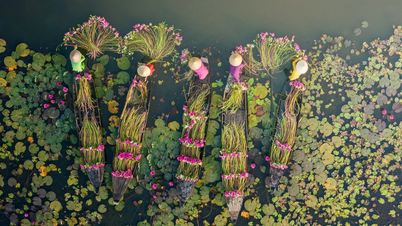
This is also the time when the lotus and water lily ponds near Tam Coc are in full bloom. Amidst the picturesque landscape, the pink and white lotus flowers and the vibrant purple water lilies spread their petals and emit an intoxicating fragrance – making them irresistible photo spots for many tourists.
Tam Coc-Bich Dong is not only charming in the summer, but also at other times of the year. For example, spring, from January to March, is the ideal time to explore many famous festivals in Ninh Binh, such as the Truong Yen festival in Hoa Lu, which takes place from the 8th to the 10th of March according to the lunar calendar.
The weather in Ninh Binh right now is cool and the air is fresh. Tourists can participate in the festival, go boating on the Ngo Dong River, and enjoy the beautiful, expansive natural scenery and picturesque landscape.


![[Photo] Prime Minister Pham Minh Chinh presides over the conference announcing the establishment of the International Finance Centre in Vietnam.](/_next/image?url=https%3A%2F%2Fvphoto.vietnam.vn%2Fthumb%2F1200x675%2Fvietnam%2Fresource%2FIMAGE%2F2025%2F12%2F21%2F1766309817714_ndo_br_dsc-3400-jpg.webp&w=3840&q=75)

![[Photo] Prime Minister Pham Minh Chinh presides over a meeting on private sector economic development.](/_next/image?url=https%3A%2F%2Fvphoto.vietnam.vn%2Fthumb%2F1200x675%2Fvietnam%2Fresource%2FIMAGE%2F2025%2F12%2F20%2F1766237501876_thiet-ke-chua-co-ten-40-png.webp&w=3840&q=75)















































































Comment (0)