


Under the full moon of the first lunar month, Dai An commune is bustling with activity as the Lantern Festival approaches. This unique cultural and spiritual festival has existed for over a century.
Originally a traditional festival of the Chinese community, the Lantern Festival here has gradually become a shared celebration for the three ethnic groups: Chinese, Kinh, and Khmer. The event bears the strong imprint of cultural exchange, reflecting a spirit of unity and aspiration for peace and prosperity.
 |
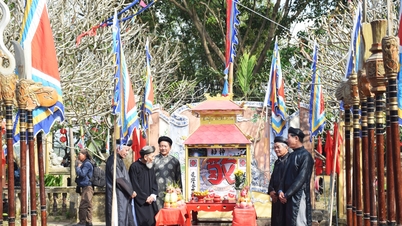
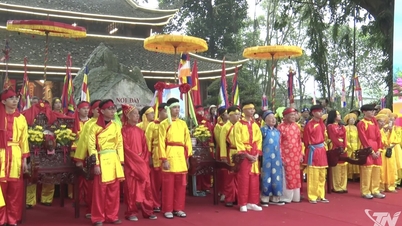
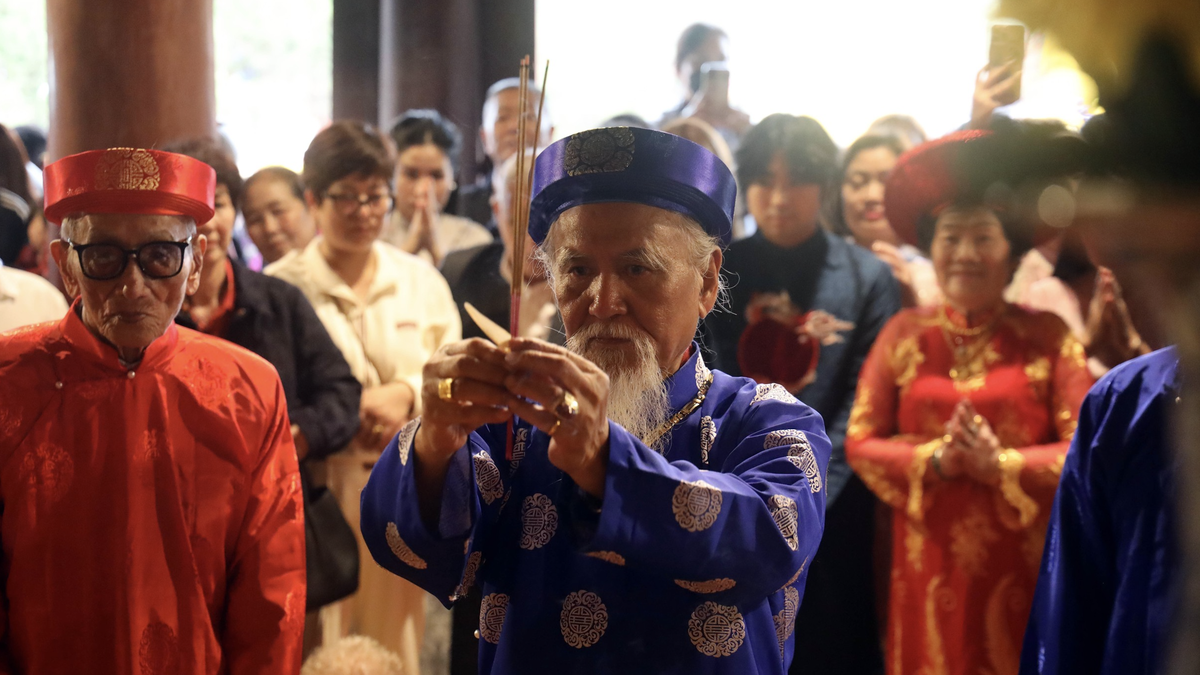
| The ritual of welcoming the deities during the Lantern Festival in Dai An. |
Preserving the spirit of the past
In Sino-Vietnamese, "Nguyên" means first, and "Tiêu" means night; Nguyên Tiêu is the first full moon night of the new year. In folk beliefs, this is a time when positive energy is abundant, helping to dispel the misfortunes of the old year and usher in a new cycle of hope. For the Chinese community in the former Trà Cú district of Trà Vinh province (now Đại An commune, Vĩnh Long province), the Nguyên Tiêu festival, also known as "Nguyên Tiêu Thắng Hội," is not only an occasion to worship deities but also a time for family reunions, connecting with ancestors, and praying for national peace and prosperity.
The Chinese arrived in Tra Vinh province in general, and Tra Cu district in particular, in the latter half of the 17th century. They migrated primarily from Guangdong, Fujian, and Chaozhou (Guangdong province, China). Over many generations, they have lived alongside the Vietnamese and Khmer, creating a diverse cultural landscape for this region. In Tra Cu district, although the number of Chinese households is not large, religious institutions such as Phuoc Thang Palace, Minh Huong Temple, Phuoc Long Palace, Phuoc Loc Hoa Palace, and Tan Hung Palace are still preserved, becoming centers of community cultural activity.
The Lantern Festival in Tra Cu originated approximately 120 years ago. Initially, it was an internal festival of the Chinese community, associated with folk beliefs mixed with elements of Taoism, Confucianism, and Buddhism. Over time, the festival gradually expanded in scale, with the participation of Vietnamese and Khmer religious establishments such as Dai An Temple, Phno Don Pagoda (also known as Giong Lon Pagoda or Co Pagoda)... This integration did not diminish the unique identity but rather contributed to making the Lantern Festival in Tra Cu richer and more vibrant.
The procession is vibrant and colorful, sacred and lively.
While the ceremonial part reflects the spiritual depth, the festive part is the unique highlight of the Lantern Festival. Through this, the festive part of the "Lantern Festival" attracts a large number of locals and tourists from all over. Among these activities, the ritual of welcoming the deities, also known as the "caravan procession," is the most distinctive feature of the Lantern Festival.
Previously, during the Lantern Festival, in the communes of Dai An, Dinh An, and the town of Dinh An, religious establishments such as Phuoc Thang Cung, Minh Huong Temple, Phuoc Long Cung, and Phuoc Loc Hoa simultaneously organized ceremonies on the 14th and 15th of the first lunar month. Each place had its own way of organizing the ceremony, but all aimed at inviting the deities to "travel" and bestow blessings upon the people.
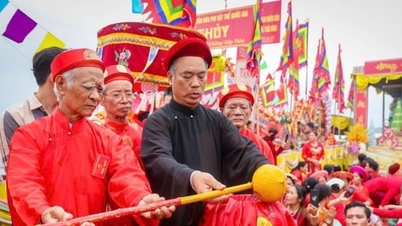
At Phuoc Thang Palace, the largest venue for the event, the opening ceremony and entry into the festival took place solemnly at noon on the full moon of the first lunar month. The organizing committee, dressed in traditional attire, respectfully offered gifts and lit incense to pay homage to deities such as Bao Sanh Dai De, Quang Trach Ton Vuong, and Phuoc Duc Chinh Than… Traditional music played in the style of "Lau Cau" (or "Bat Cau"), inviting the deities and creating a sacred yet joyful atmosphere for the villagers.
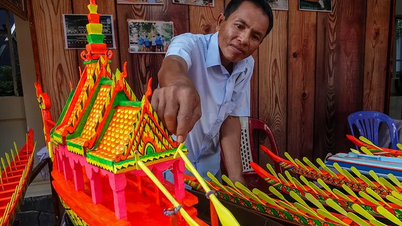
As night falls, the procession begins. Leading the procession are the "spirit soldiers and generals," uniquely dressed up by local teenagers using leaves and paint, creating a magical and playful scene. The palanquins carrying the deities are lavishly decorated with flags, lanterns, and flowers, followed by costumed characters such as Ông Văn and Ông Võ, Quan Âm, the Buddha, Tam Đa, the Tang Monk's group on their pilgrimage, and the 12 zodiac animals… Each year, a different animal representing the zodiac is chosen to be placed in a prominent position, creating a unique highlight for the procession.
Accordingly, the procession carrying the deity passed through the streets, blending into the crowds of enthusiastic festival-goers on both sides of the road. In front of each house the procession passed, people of all ethnicities, whether Chinese, Kinh, or Khmer, set up altars and lit incense, waiting to welcome the deity. As the palanquin passed, the ceremonial committee scattered rice and salt, believing it would ward off evil and bring peace. This was also a way for people to receive a small "blessing" at the beginning of the year, with the belief that good fortune would follow them throughout the year.
As the procession converged at Bao An Temple, continuing to Dai An Holy Temple and Phno Don Pagoda, the cultural exchange became even more evident. Here, Cao Dai dignitaries and Khmer Theravada Buddhist monks solemnly welcomed the procession and performed rituals before the altar. After a journey lasting many hours, the procession returned to its starting point. The consecration ceremony took place in a solemn atmosphere, concluding a colorful, vibrant, and emotionally rich full moon night.
Cultural exchange is the enduring lifeblood of heritage.
The Lantern Festival, formerly held in Dai An commune and Dinh An town, also takes place in the old Tra Cu town with its own unique characteristics. At Tan Hung Cung – the former assembly hall of the Chinese community of "Seven Palaces" – the opening ceremony is held from the morning of the 14th day of the first lunar month with offerings, most notably roasted pig. The rituals of worship and incense offering are conducted solemnly, expressing gratitude to the deities for their blessings throughout the past year.
On the afternoon of the full moon, the procession of deities set off from Tan Hung Palace, passing through the central streets, creating a lively atmosphere throughout Tra Cu market. An Thanh Temple and Ngai Xuyen communal house also participated, contributing to the richness of the festival's colors. The brightly colored lanterns, traditional music, and the sounds of lion dance drums blended together, making the full moon night of the first lunar month even more enchanting and magical.
What is commendable is that, over more than a century, despite many societal changes, the Lantern Festival has retained its traditional core. Successive generations of the organizing committee, from the elderly to the younger generation, are conscious of their responsibility to preserve this heritage. Preparations for the festival are meticulously organized; the rituals are performed according to tradition but remain flexible and adapted to current conditions. The festival also opens up potential for tourism development, contributing to promoting the image of Dai An in particular and Vinh Long province in general.
With its unique characteristics, on June 27, 2025, the Ministry of Culture, Sports and Tourism announced Decision No. 2210/QD-BVHTTDL to include the traditional Lantern Festival in Tra Cu (Dai An commune, Dinh An commune, Dinh An town and Tra Cu town, Tra Vinh province) in the list of national intangible cultural heritage.
Text and photos: LAM THY
Source: https://baovinhlong.com.vn/van-hoa-giai-tri/202602/doc-dao-le-hoi-nguyen-tieu-fd103c9/





![[Photo] Head of the Central Propaganda and Mass Mobilization Department visits and congratulates the Ministry of Health and the Military Traditional Medicine Institute.](https://vphoto.vietnam.vn/thumb/1200x675/vietnam/resource/IMAGE/2026/02/24/1771938483290_img-2682-3562-jpg.webp)
![[Photo] White pear blossoms bloom across the border of Pho Bang](https://vphoto.vietnam.vn/thumb/1200x675/vietnam/resource/IMAGE/2026/02/24/1771927665653_a8-8280-jpg.webp)
![[Image] A dreamy "livable city" under pink clouds](https://vphoto.vietnam.vn/thumb/1200x675/vietnam/resource/IMAGE/2026/02/24/1771930060937_tp4-jpg.webp)






























Comment (0)