

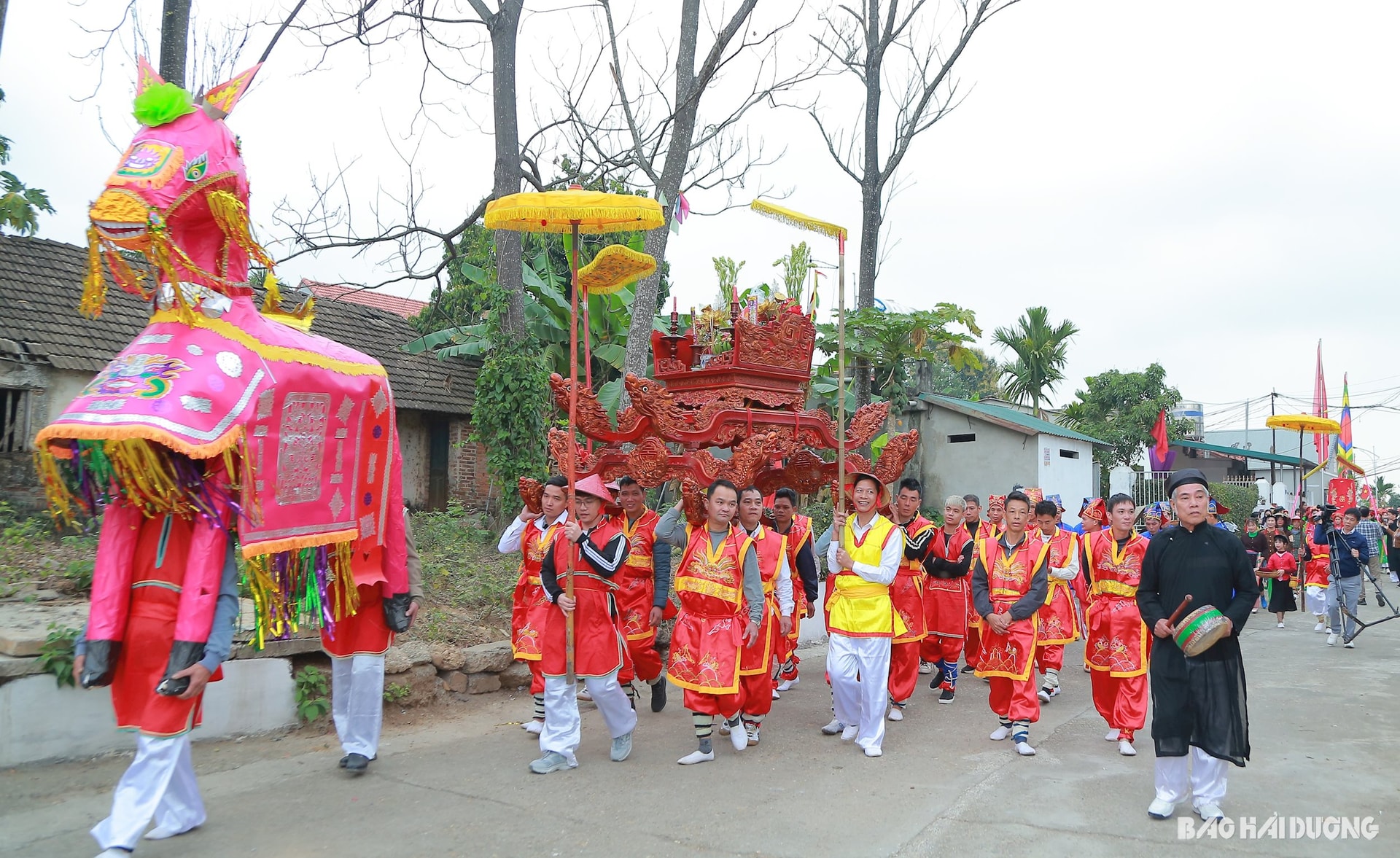
The procession of the Goddess of Vi village - Treo village
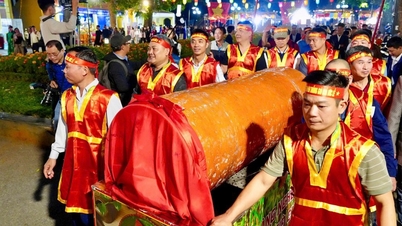
People vied with each other to bring the King home to celebrate Tet.
The villages of Trẹo in Hy Cương commune and Vi in Chu Hóa commune (both in Việt Trì city), situated at the foot of Nghĩa Lĩnh central mountain, jointly built the Hùng Temple, initially as a small shrine. The He village festival (the old name for the two villages of Vi and Trẹo) features a unique procession of the Hùng King to celebrate the Lunar New Year.
Legend has it that, on a day at the end of the year, the 18th King Hung ascended Nghia Linh mountain and issued a decree: “The Hung dynasty’s fortune has come to an end. I have no son to succeed me, only two daughters, both married and living far away. I am deeply saddened, and furthermore, a national calamity has befallen me. Lord Thuc is arrogant day and night, plotting to seize my kingdom. He has already attacked the Co Loa region. Recently, he has also attacked the Bo Sao and Huong Cham regions, not far from the capital. I am very worried and have entrusted my son-in-law, Tan Vien Son (Nguyen Tuan), to remain and guard the capital.”
We went to Nghia Linh, a place where our ancestors had left traces of history, knowing it to be a strategically important but safe location where we could establish a base."
The imperial decree was issued near the end of the year.
Upon hearing the news, people from both villages simultaneously came to pay their respects, wanting to invite the King to their village to celebrate the New Year. The King asked where they were from, and one group replied:
- We live in Song Thao.
"The other side is here, we live by the Lo River," the king said.
- I thank everyone, but I am alone and cannot go to both sides. Going to one side would displease the other. Therefore, I hereby declare that at midnight tonight, whichever side I hear the sound of roosters crowing and dogs barking closer, I will go to that side to celebrate the New Year.
The people from both villages bid farewell and left. That very night, the villagers of He village, on the Thao River, quickly gathered bamboo and leaves to set up camp at the foot of the mountain, bringing along some young men with rudimentary weapons for self-defense, a few strong roosters, and some dogs. At midnight, they teased the dogs to bite them and tickled the roosters' necks to make them crow in unison.
In the morning, the king sent someone down to ask where this place was. The people replied:
- We are villagers from He Song Thao.
The tribal chiefs reported to the king. The king said:
- Then let's go back to He village, by the Thao River, to celebrate Tet with the people and fulfill our promise.
The procession began, with the military officials riding red horses at the front, followed by the civil officials on white horses. The king rode a black elephant in the middle. Upon reaching the royal procession, they saw a crowd gathered, with flags and banners fluttering everywhere. Suddenly, a strong wind arose, changing the direction of the flags and banners. Seeing this, the villagers gathered around, clasped their hands, and invited the king to dismount from the elephant and board a palanquin so the people could carry him back to the village. From then on, this place was called the Hill of the Royal Procession. When the king entered the house, the villagers hung a bed high for him to sit on (called the "gourd bed"), while the officials sat on either side. That day was the 25th of the twelfth lunar month.
Seeing that it was already noon, the sun was about to set, and nothing had been cooked yet because the butchers were so excited about watching the villagers welcome the king that they forgot about preparing the food, the elders and officials discussed the matter:
- It's already past noon, butchering cows and pigs would take too long. Let's quickly slaughter a few chickens to make a meal for the king. The glutinous rice has already been soaked, let's steam it.
So, at that meal, the king and representatives of the villagers drank wine and ate sticky rice with chicken. While eating, the villagers explained their reasons to the king. The king said, "It will be a long time before I return here to celebrate Tet with the people. This meal is enough; there's no need to prepare such a grand feast. During this Tet, the people should try to master the Xoan and Dum folk songs, humorous games, and various arts for entertainment; and I will tell my daughter to come here to celebrate Tet with me so she won't be lonely."
By the 26th day of the Lunar New Year, work had settled down, and the villagers discussed slaughtering a pig for a feast, cooking sweet soup, eating bananas, oranges, and roasted sugarcane; after eating, they drank five-flavor tea. They continued eating like this until the 30th day of the Lunar New Year. On the night of the 30th, news arrived that the princess had arrived, but for some reason, Princess Ngoc Hoa had gotten lost in the forest the previous night, and the soldiers had to search for her for a long time before they found her. The princess was terrified and frightened in the deep forest at night, and suddenly became speechless.
When the king heard the news, he immediately ordered, "Everyone, quickly find a broken tool like a broken plow, a blunt hoe, a chipped knife, or a sickle, bring it to where the princess is resting, and sing and dance wildly, creating a joyful scene." The villagers obeyed. As a result, the princess gradually recovered. Seeing the villagers enthusiastically singing and dancing, the princess laughed and happily conversed as usual. The villagers cheered, welcoming the princess back to the village to celebrate the New Year with her father, the King.
Perform acts to please the King.
On the night of the 30th of Tet (Lunar New Year's Eve), around midnight, the villagers prepared a feast with chicken, sticky rice, sweet soup, and bananas to offer to the king (called New Year's Eve welcoming spring). On the 2nd day of Tet, they slaughtered a pig. The king ordered some of the meat to be mixed with mung beans to make the filling for the cakes, and the people followed his instructions, hence the name "fermented pork." On the 4th day of Tet, early in the morning, the villagers selected a number of young men to gather in the Mulberry field, stripping off their shirts to race and snatch the flag. When they took off their shirts, everyone shivered from the cold. The king said, "You should all gather around and wrestle to warm yourselves up." As soon as the king finished speaking, the villagers formed teams of strong young men, lined up horizontally, and when the signal was given, they all ran to where the flag was planted. Whoever reached the finish line first, and whose team had someone snatch the flag, won the race (championship), hence the name "running the enemy."
Next, the whole village flocked to the host's house. (The person chosen by the villagers to serve in the ritual) brings two jet-black pigs and releases them into an open space by the rice fields near the village. The villagers surround them, beating gongs and drums to entertain and tire the pigs out so they can't run away (this is called the custom of surrounding the pigs), then they bring the pigs back to present to the King to ask permission to slaughter them (this is called the ritual of slaughtering ) ...
On the night of the 5th day of the Lunar New Year, the villagers brought rice, sugarcane, and sticky rice to show the king that they had had a bountiful harvest that year. They then wrapped the sticky rice in leaves and tied it tightly (called "cua"). They tied the rice into bundles to present to the king on the evening of the 6th day of the Lunar New Year as a show of joy (also called "trinh tro"). On the evening of the 6th day of the Lunar New Year, the villagers selected several large, fat roosters to present to the king, boasting about how well they had raised them, and then asked permission to slaughter them (called "su ga"). They also cooked sticky rice and sweet soup, and placed bananas on a tray to offer to the king. After eating and drinking, the young men and women of the village carried the bundles of rice and sugarcane on their shoulders, arranged them in rows, ran back and forth, shouting and cheering, accompanied by gongs and drums to create a joyful atmosphere, and then fed them to the king's elephants and horses.
On the seventh day of the Lunar New Year, the villagers celebrated the New Year again. At noon, they brought flags, banners, and incense to the communal house, and stood guard with incense and candles. The chief priest secretly prayed, waiting for the east wind to turn the flags towards the village before preparing to escort the King to Nghia Linh. The villagers, on one hand, assigned people to prepare the sacrificial feast, and on the other hand, waited until evening for the young men and women of the village to bring out their farming tools and run around, shouting and cheering as they did the day before. The difference was that on that day, during the festivities, the young men and women performed suggestive movements, bumped into each other, and laughed heartily. Afterwards, everyone rushed in to snatch the tools and take them home as a blessing (hence the name "tung ri game").
The following day, the eighth day of the Lunar New Year, the King returned to the capital. The villagers bid him farewell, slaughtering chickens and preparing sticky rice to offer to the King, and also burning paper elephants and horses (called the "farewell feast ").
According to ancient texts and accounts from village elders, the rituals of bringing the king home for Tet (Lunar New Year) celebrations were still performed by the villagers during annual festivals. Due to historical events, the festival of bringing the king home for Tet was lost for a long time.
In 2011, the local authorities and people organized the restoration of the festival, leaving a positive impression on the people in the surrounding area about a unique traditional ritual and festival of the descendants of the Hung Kings. To this day, the festival of bringing the Hung Kings back to the village to celebrate Tet remains a unique cultural activity in the Hung King worship tradition in Vietnam.
VAN THANH
Source: https://baohaiduong.vn/doc-dao-le-hoi-ruoc-vua-hung-ve-an-tet-408525.html
![[Photo] Prime Minister Pham Minh Chinh presides over a meeting on private sector economic development.](/_next/image?url=https%3A%2F%2Fvphoto.vietnam.vn%2Fthumb%2F1200x675%2Fvietnam%2Fresource%2FIMAGE%2F2025%2F12%2F20%2F1766237501876_thiet-ke-chua-co-ten-40-png.webp&w=3840&q=75)


![[Photo] Prime Minister Pham Minh Chinh presides over the conference announcing the establishment of the International Finance Centre in Vietnam.](/_next/image?url=https%3A%2F%2Fvphoto.vietnam.vn%2Fthumb%2F1200x675%2Fvietnam%2Fresource%2FIMAGE%2F2025%2F12%2F21%2F1766309817714_ndo_br_dsc-3400-jpg.webp&w=3840&q=75)

















































Comment (0)