During their spring excursion through Dao Xa commune, Thanh Thuy district, besides the centuries-old festivals, visitors are particularly delighted by the fire-making and rice-cooking competition. The unique aspect here comes from the contest between men amidst the cheers and encouragement of the villagers.  The three competing teams came from three different residential areas, and were mostly men.
The fire-making and rice-cooking competition is usually held alongside the elephant procession on the 28th day of the first lunar month. This is the most anticipated part of the festival and also attracts the largest crowd. This year, the competition features three teams from three different residential areas. Each team has three members, regardless of age, as long as they are healthy, agile, and skillful. The equipment for the rice-cooking competition includes a tripod stove, a cast iron or aluminum pot, a mortar and pestle for pounding rice, dry straw or firewood, a rice strainer, plates, a beautiful rooster weighing 1.5-2 kg, and rice grains...
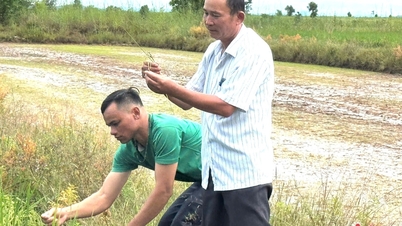
After the judges' introduction, the chief judge shouted, "Begin!" The drums sounded, and the three teams officially competed. The first unique aspect was that contestants were not allowed to use matches or lighters, but had to start a fire using a special device. This was a cylindrical wooden tube with diagonally drilled holes, just large enough to fit a braided string made from the inner core of a young bamboo plant, the kind of string commonly used to wrap sticky rice cakes.
 The process of lighting a fire using traditional methods.
The person making the fire must continuously pull the string until the friction between the string and the wood creates sparks, then quickly bring a handful of tinder to the fire, simultaneously cupping their hands and blowing forcefully to make the flames flare up before using it to light the stove. The person making the fire must be patient and skillful because pulling too gently won't create enough friction to start the fire, while pulling too hard will break the string, requiring replacement and affecting the speed of cooking rice. This is a traditional method of making fire that has been passed down from generation to generation.
After lighting the fire, everyone busied themselves with their tasks. One pounded the rice, another butchered the chicken, and another tended the stove. The chicken chosen was a rooster weighing 1.5-2 kg with a beautiful comb; it was gutted and shaped into a fairy-like form for presentation. The rice was pounded in a wooden mortar until it was white and smooth, and all the husks were blown away, just as the water was boiling. Once the ingredients were prepared, the three members gathered around the stove to cook the rice and boil the chicken.
 After lighting the fire, the teams quickly started their stoves, preparing to cook rice.
The person in charge of the rice cooker must stir and cook the rice carefully, ensuring it cooks evenly, is soft and chewy, and retains its appealing aroma. After slaughtering the chicken, it's placed in a pot of water, carefully turning it over to ensure it cooks thoroughly from the outside in. Meanwhile, drums beat continuously, the surrounding audience cheers and shouts, creating a lively atmosphere like a wrestling match. Once the rice is cooked and the chicken is boiled, it's time to arrange the food. White rice is scooped onto small aluminum trays, spread evenly, neither too full nor too empty. The boiled chicken is removed and placed in the center of the white rice tray, with a red rose or marigold flower in its beak, its wings spread out, resembling a feast offered during holidays and festivals.
 Locals cheered for the competing teams.
The judges will personally taste the rice and chicken from each kitchen. Scores will be compiled based on factors such as: time taken to complete the meal, quality of the dishes, aesthetics of the meal, and adherence to competition rules. After discussion and agreement, the chief judge will announce and award the first prize to the winning team amidst cheers and applause from the villagers.
Comrade Le Quoc Ky, Chairman of the People's Committee of Dao Xa commune, said: "The fire-making competition for cooking rice has a history of hundreds of years, running parallel to the elephant procession festival in Dao Xa. The competition is organized to recall the historical traditions of our ancestors through the primitive fire-making method, characteristic of the rice-farming inhabitants of the delta region."
Today, the fire-making and rice-cooking competition is not only held in Dao Xa but has also spread to many village festivals, especially the annual Hung Temple Festival. This is a highlight that attracts tourists to this ancient land with a rich history and cultural tradition.
Thuy Trang


![[Photo] General Secretary and President To Lam presides over a meeting on assessing national development resources.](https://vphoto.vietnam.vn/thumb/1200x675/vietnam/resource/IMAGE/2026/05/20/1779253785852_a1-bnd-2943-8519-jpg.webp)























































Comment (0)