

When the first rains of the season refresh the plants and awaken the hills after a long drought, it is also the time when the people of Quang Phu, Krong No, and Nam Da communes are busy preparing for a new planting season. With the arrival of the rainy season, the people here begin clearing weeds and burning undergrowth to prepare for the corn crop. Unlike other places, corn cultivation here cannot be done with machinery because the entire area is covered with rocks.
Everything is done manually. The villagers carefully mark each crevice in the rocks, select small patches of soil to create holes, and then gently place each corn seed into them. The tools are also very simple, just bamboo or wood, one end sharpened and covered with iron. The seed-sowing process requires strong hands to poke holes between the rocks and sow the seeds, and strong legs to walk across the uneven, rocky hills.
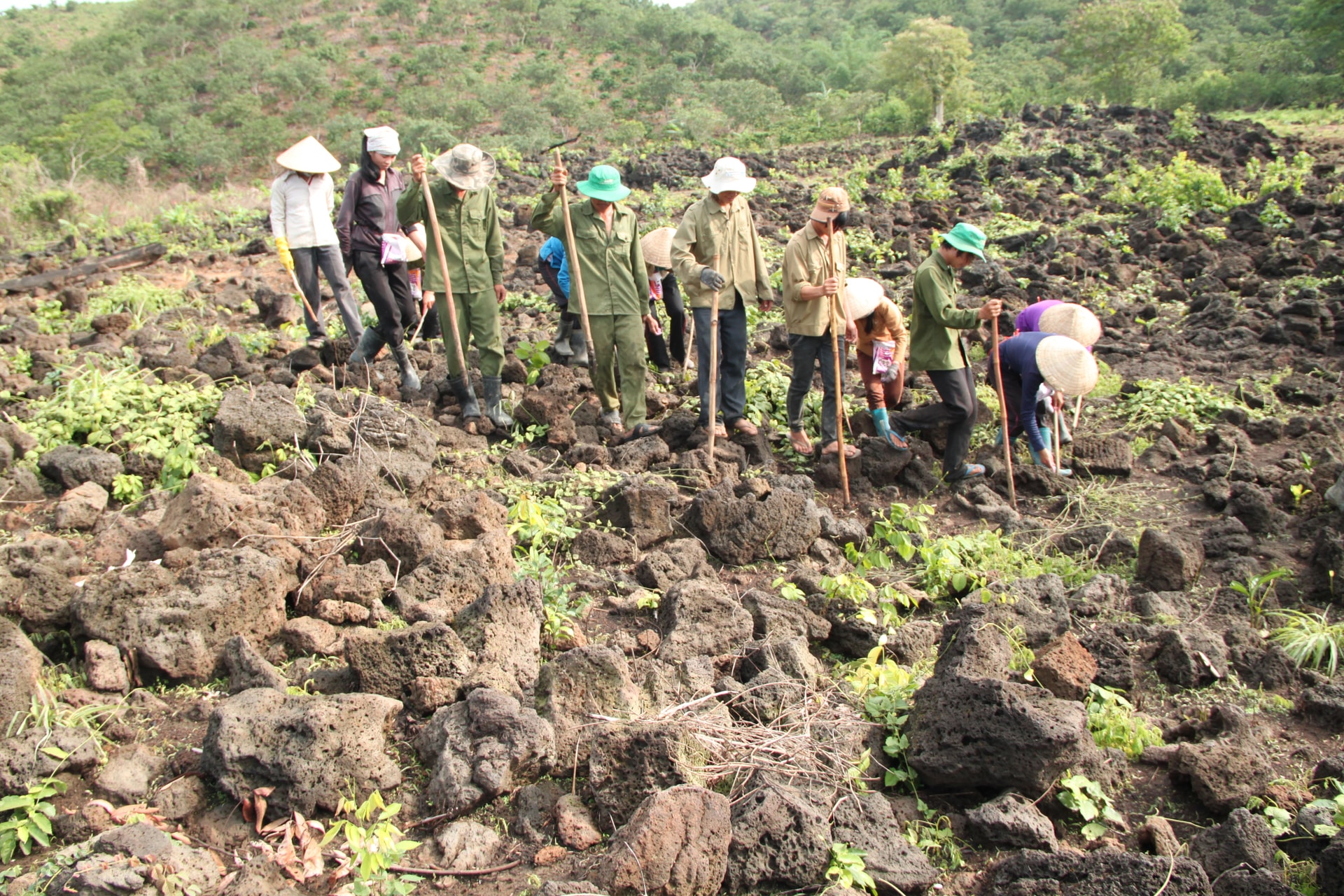
Sowing seeds is also done in pairs, with one person making the holes first and the other planting the seeds following behind, from one end of the field to the other. The person in front holds a stick and forcefully pokes it into the gaps between the stones, while the person behind holds a corn seed in one hand and a long stick in the other to cover the seed after planting. This coordination must be rhythmic and even to avoid forgetting the holes made or missing places where seeds could be sown. Even with maximum effort, a pair of "hole-poking - seed-planting" workers can only sow about 1 kg of corn seeds per day.
Because of this planting method, the area is not measured by land area, but by the quantity of seeds planted each season. Mr. Cao Van Cuong, from Phu Xuan village, Quang Phu commune, said that they plant wherever there is soil and avoid rocky areas. Surprisingly, despite growing on rocky ground, the corn plants thrive thanks to nutrients from the volcanic rock.
To facilitate planting, the locals often exchange labor with each other. Groups of 5-10 people take turns working on the fields of different households, moving from one to another. Those with little or no land work hire themselves out to earn extra income to support their lives. Ms. H'Giót, from Phu Xuan village, Quang Phu commune, happily said: “Working in groups and exchanging labor is so much fun! We chat while we work, and having someone to help each other makes things less strenuous. Even on days with heavy rain, we don't take a break because after finishing our own field, we help others work on theirs to ensure they are ready for the planting season.”
The rocky land where the locals are growing corn covers approximately 3,000 hectares, located in the communes of Quang Phu, Krong No, and Nam Da. This area is characterized by laterite rock formed from lava flows erupting from the Chu B'lúk and Nam Kar volcanoes. Despite the unfavorable soil conditions, the farmers here diligently maintain their annual production through traditional manual methods. The local government is also supporting and encouraging the people to switch to growing high-yielding hybrid corn varieties.
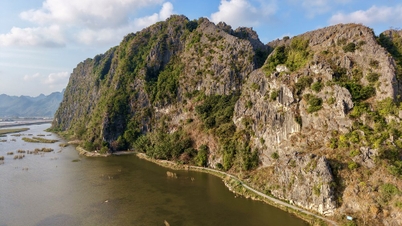
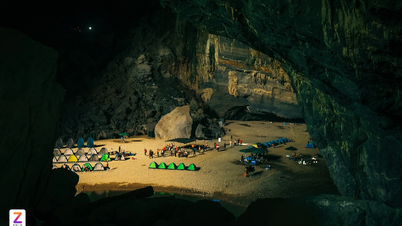
Nam Kar and Chu B'lúk volcanoes are beautiful volcanoes within the UNESCO Global Geopark area. These volcanoes were active millions of years ago, exhibiting a combination of eruptions and explosive eruptions. The land surrounding the volcanoes is characterized by layers of laterite rock formed from erupting lava flows.
Visiting the production area at the foot of the volcano and within the longest volcanic cave complex in Southeast Asia, tourists can not only explore volcanic craters, lava caves, and learn about M'nong culture, but also immerse themselves in the lives of farmers, clearing land, sowing seeds in the fields, roasting corn in the fields, or staying overnight in local homes to fully experience the rhythm of life of the ethnic minorities in the Central Highlands. Each activity, from simple tasks like carrying water to more elaborate ones like poking holes in rocks to sow seeds, can become a valuable experience, helping tourists better understand the people, culture, and nature of this region.
Tourism is not just about sightseeing, but about experiencing, sharing, and accompanying the local people. With continued investment in both agriculture and tourism, this place has the potential to become a model of sustainable development in a global geological heritage site.
Source: https://baolamdong.vn/doc-la-trong-ngo-tren-dung-nham-nui-lua-386481.html
![[Photo] General Secretary and President To Lam presides over a working session with the Central Policy and Strategy Committee on the development of the materials industry.](https://vphoto.vietnam.vn/thumb/1200x675/vietnam/resource/IMAGE/2026/05/21/1779359935432_a3-bnd-3129-1412-jpg.webp)

![[Photo] National Assembly Chairman Tran Thanh Man working with the Standing Committee of the Law and Justice Committee](https://vphoto.vietnam.vn/thumb/1200x675/vietnam/resource/IMAGE/2026/05/21/1779378929214_ndo_br_1-4610-jpg.webp)






























































Comment (0)